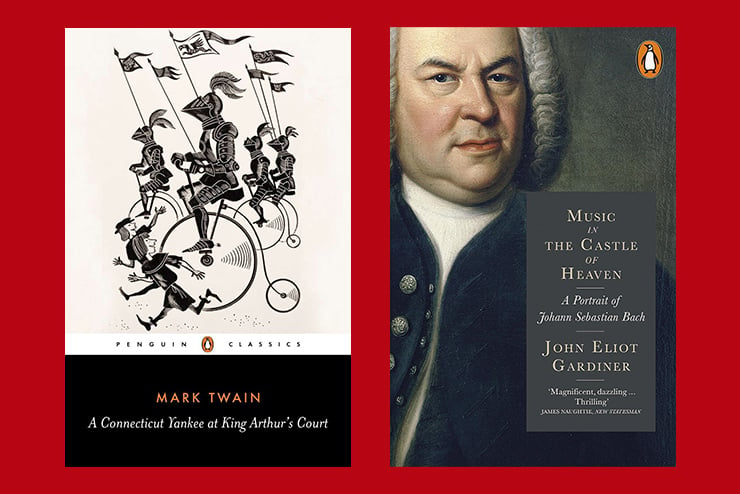
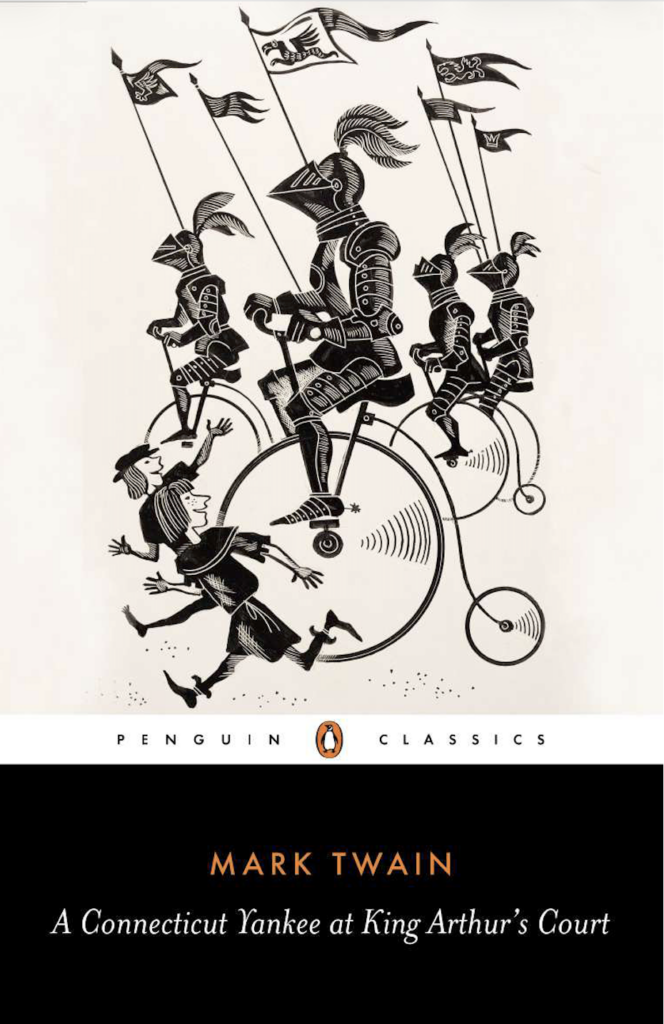
Mark Twain’s celebrity in the late 19th century rivaled that of our current Hollywood A-list, but financial reversals and an increasing pessimism make some of his later works, such as The Mysterious Stranger, less than compelling. Somewhere in the middle is his weirdly problematic time-travel novel, A Connecticut Yankee in King Arthur’s Court (1889). In it, a transplanted 19th-century factory foreman quickly becomes “The Boss” in Camelot and seeks to bring enlightened production methods, modern advertising, democracy, abolition of slavery, and religious freedom to sixth-century Britain.
Twain can’t avoid the influence of Mallory’s Morte D’Arthur, and, as in Mallory, it all ends badly in Connecticut Yankee when Arthur’s queen, Guinevere, betrays Arthur with Lancelot. Throughout the book, Twain relentlessly and dyspeptically savages monarchy, aristocracy, and the Church, in a manner not calculated to appeal to paleoconservatives. Most critics declared the work a failure. Indeed, the plot is repetitive, most of the characters lack depth, and much of the action is unbelievable. The carnage at the end of the book, when all the knights are massacred, is way over the top, and The Boss’s plan to bring the 19th century into the Sixth ends in catastrophe.
Nevertheless, as Ron Chernow’s overlong, and relatively hagiographic biography of Twain demonstrated, this seriously flawed man of genius had an unparalleled ability provocatively to hold the reader’s interest—even though it is hard to figure out what he actually stood for. Worse, late in life, Twain wandered into something close to pedophilia, as he surrounded himself with attractive, underage young girls he called his “angelfish.” Something of that bizarre adoration of youth is revealed in Connecticut Yankee, when The Boss gathers about himself a troop of 52 youths “as pretty as girls.”
In 1943, George Orwell wrote that Twain had “squandered his time on buffooneries [such as] A Connecticut Yankee, which is a deliberate flattery of all that is worst and most vulgar in American Life.”
And yet, Twain is so dazzling a writer that his descriptive power rarely flags even in Connecticut Yankee. The book is still something of a page-turner, and the extended exposition of matters such as the inevitable infestation of suits of armor with alarming varieties of uncomfortable vermin is weirdly and off-puttingly entertaining. Ernest Hemingway said that all American literature flows from Huckleberry Finn; Connecticut Yankee shows that, even at his worst, the great patriarch of American literature retains his power.
—Stephen B. Presser
Imagine you were orphaned at age 10. Despite this catastrophe, you make it into adulthood, marry, and have children. Your spouse unexpectedly dies while you are away on business. You remarry, and eventually, the fruit of the two marriages is 20 children. Only eight survive past the age of three.
Unthinkable for anyone alive in the contemporary West. And in any epoch, we would scarcely expect much more than survival, if even that, from such an unfortunate soul. Yet this was the life of the greatest composer the world has ever seen, who made the whole of his life’s work a method of the worship of God.
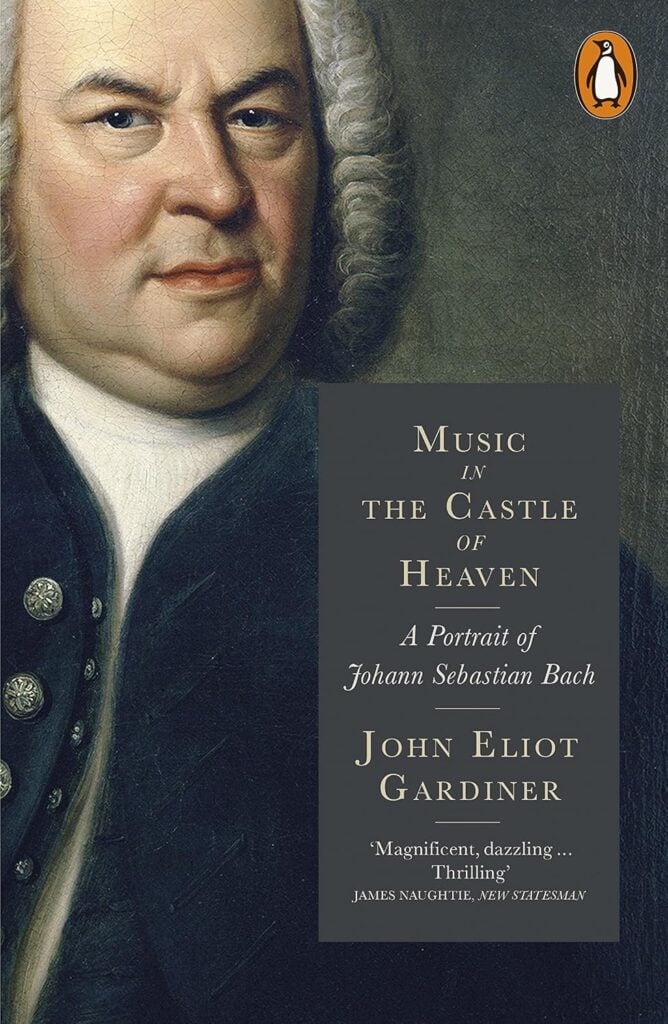
Sir John Eliot Gardiner’s book is perhaps the most ambitious we have on the life and work of Bach. It covers a great deal of social history to contextualize Bach’s life, as well as plentiful detail on his personal and professional life. It also contains an extended analysis of some of his greatest works, especially the “Saint John Passion” and the “Saint Matthew Passion.” The latter is privileged today, but the former may well be, as Schumann put it, “more daring, forceful, and poetic.”
The provenance of Bach’s formidable gift is eternally debated. He was from a Baroque-music familial dynasty, a German equivalent of the Couperins in France and the Scarlattis in Italy. He was an imperfect man. His contentiousness and disrespect for authority led to many professional setbacks and even landed him in jail. Bach himself believed that musical invention was not truly creative, but rather a process of discovering the “hidden secrets of harmony” already placed there by the one true Creator.
Bach revered Luther and spent considerable time studying his works. Gardiner notes that his sizable private library was as large as that held by a “church of a respectably sized town.” Among the tomes were many religious works on ars moriendi, the art of dying. Bach’s life and faith taught him that mortality and immortality are the problem before which all others fade into inconsequentiality.
Last summer, on July 28th, we marked the 275th anniversary of Bach’s death. Near the end, he was consulting Heinrich Müller’s Love’s Kiss, a Lutheran devotional that advises readers to prepare constantly for death. Gardiner cites a passage that perfectly summarizes the meaning of Bach’s work for us: “Music offers not only a glimpse of heavenly life but a tool with which to focus one’s thoughts about death.”
—Alexander Riley
Leave a Reply