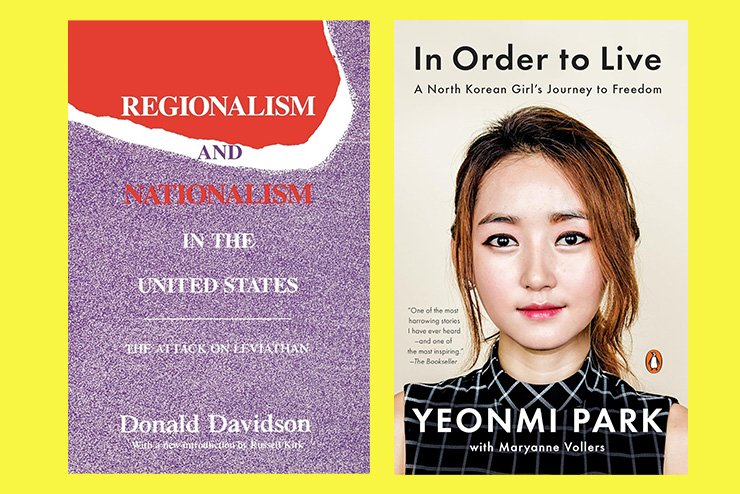
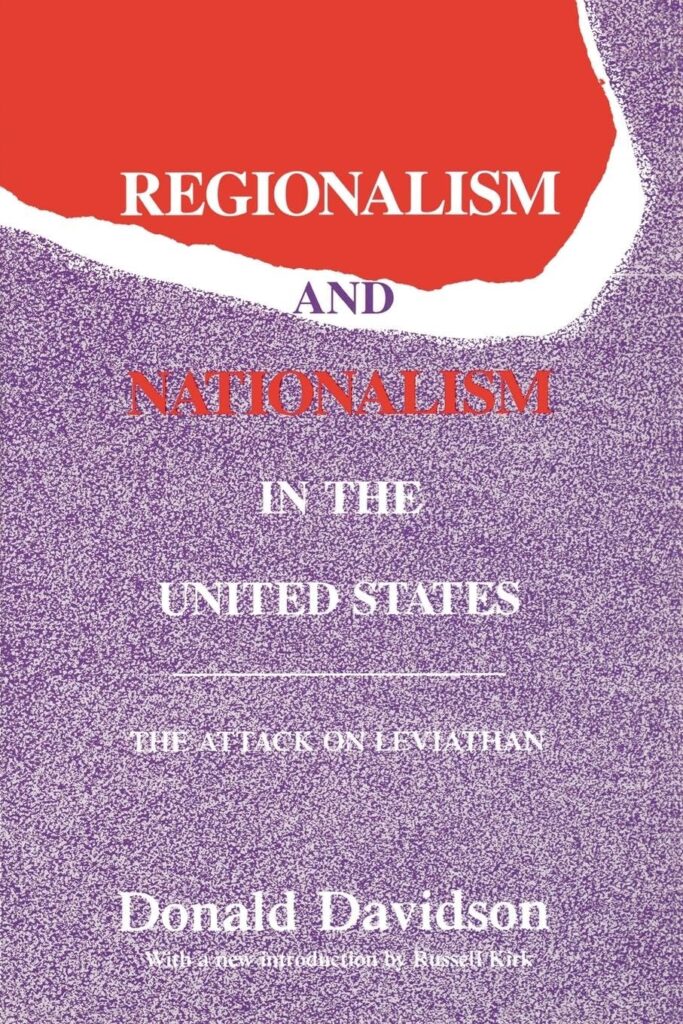
In 1938, the young Russell Kirk, then a sophomore at Michigan State College, read Donald Davidson’s essay collection The Attack on Leviathan. Kirk was bowled over. When Kirk was appointed editor of Transaction Publishers’ Library of Conservative Thought in 1988, he brought Donaldson’s 1938 volume back in print under a new title, Regionalism and Nationalism in the United States.
The lead chapter is “The Diversity of America.” How the meaning of that word has changed! Diversity, to Davidson, meant regional cultural differences; he championed folk cultures, especially in literature: The New England of Robert Frost, the South of William Faulkner, the Midwest of Edgar Lee Masters.
Mostly Davidson celebrates the “old folks at home” who don’t talk about the good life; “they live it.” In “Still Rebels, Still Yankees,” Davidson’s most widely anthologized essay, he wrote of such citizens:
They attach themselves to a home-section, one of the sections, great or small, defined in the long conquest of our continental area. They seek spiritual and cultural autonomy. They seek to define the nation in terms of its real and permanent rather than its superficial and temporary qualities. They are learning how to meet the subtlest and most dangerous foe of humanity—the tyranny that wears the mask of humanitarianism and benevolence. They are attacking Leviathan.
Davidson disliked New York City’s dominance over American culture. Gotham, to him, was too cosmopolitan. He preferred a cultural center nearer to the Mississippi than the Thames or the Seine. Was that ever possible? New York has the money and the power. The New York publishers published and reviewed Davidson’s work and that of his fellow Agrarians. The big city can be a venue for much dramatic fiction and verse. Edward Abbey had it right when he imagined a harmony between country and city life.
Davidson matters. His prose remains accessible and forthright. He influenced M. E. Bradford, who inspired Clyde Wilson, Tom Fleming, and Sam Francis. In The Rebuke of History, Paul V. Murphy acknowledges Davidson’s legacy while maintaining its negligible influence on the conservative movement at large. Not so fast! It’s too early to count Davidson out. Regionalism and Nationalism has plenty of legs. The reader discovers the old America all over again.
—Joseph Scotchie
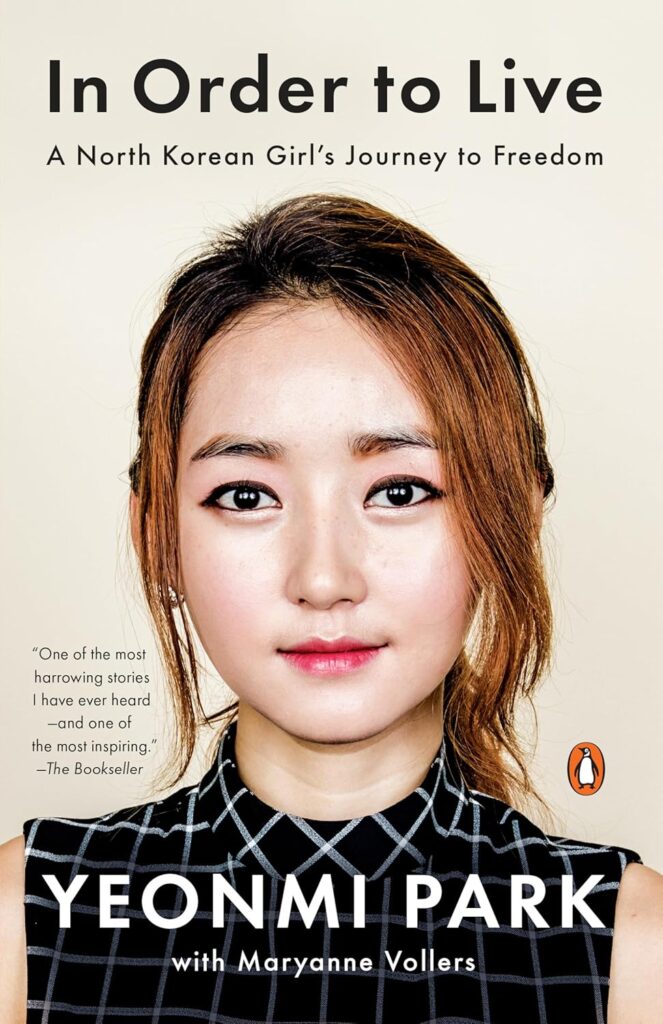
Yeonmi Park made the difficult journey from North to South Korea by way of China and Mongolia. She rose to prominence in recent years as she warned of an American left that too closely resembles the enforcers of the North Korean regime. But before her career as a commentator, Park did what just a small number of North Koreans succeed in doing: she escaped.
Her improbable journey out of North Korea is chronicled in a highly readable 2015 memoir, In Order to Live, which she wrote with the help of Maryanne Vollers. The title, borrowed from a line by Joan Didion, suggests that sometimes it is only through crafting a narrative that one can wring meaning from past suffering. And suffer Park and her mother did, falling victim to frequent sexual abuse in China. Her mother was at one point sold as a bride; both experienced malnourishment. Even when, against all odds, they finally made it to South Korea, they were treated with prejudice, viewed as backward North Koreans incapable of assimilating to the modern world.
But the art form of the memoir is not mere jeremiad. As in Viktor Frankl’s Man’s Search for Meaning (1946), Park reminds her readers that one can assert one’s humanity even amid the most trying of circumstances. Yeonmi’s mother sacrificed herself for her daughter time and again. And, even amid a North Korean famine, some neighbors shared what little they had. In perhaps the most touching passage of the book, Park learns, years after her escape, that the man responsible for trafficking both her and her mother tended daily to the grave of her father, in an act of repentance for what he had done.
Although In Order to Live’s prose comes off as a bit too wordsmithed at times, likely the result of multiple pass-throughs by editors at Penguin, that can perhaps be forgiven when one recalls that Park certainly would have needed significant help writing this book. Her education in Korean—much less English—was very much interrupted by her ordeals, all of which took place before her 16th birthday.
At the end of the book, the reader cannot help but emerge with a burning question: What will become of the 26 million still stranded in North Korea? While militarily confronting North Korea is not the answer, one earnestly hopes that some diplomatic entreaties can encourage Kim Jong Un, like Mikhail Gorbachev before him, to try a different way.
—Erich J. Prince
Leave a Reply