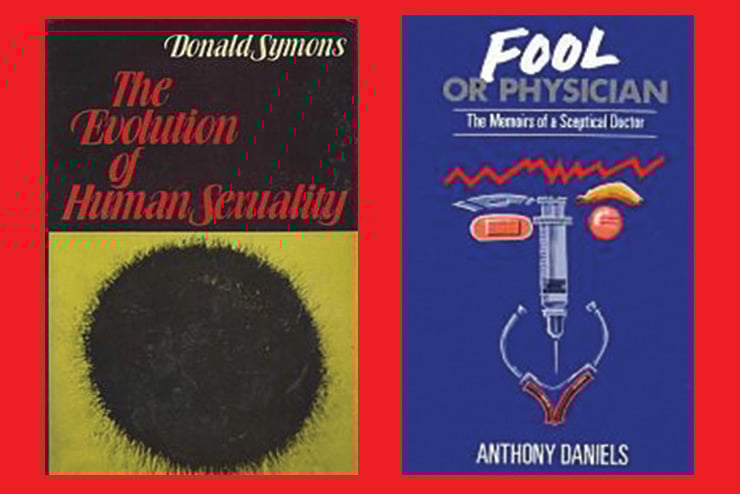
In an era when public figures fatuously proclaim a “spectrum” of sex differences and other fantastic absurdities, it is essential to have recourse to serious works that catalog the voluminous data on sexual reality.
Donald Symons’ classic book dates from the late 1970s, and many minor details have changed. But the broad scientific picture of the profound differences between human males and females remains accurate. That is so because the fundamentals are straightforward. In non-hermaphroditic many-celled animals that reproduce sexually—such as our own species—there are only two sexes.
The mechanisms each sex brings to reproduction differ. Sperm are much smaller and simpler in composition than eggs and are materially easier to produce. Owing to these different costs, human males and females produce quantities of gametes that differ by magnitudes. All other things being equal, it follows that females invest more in the reproductive potential of each gamete than males. Parental concern for individual offspring will therefore vary between the sexes accordingly.
From the basic building blocks of gamete differences, myriad other differences accrue along sexual lines through the mechanics of natural selection. For example, human males on average are larger and more muscular, much easier to arouse through simple visual stimuli, and desirous of greater sexual variety.
Symons recounts a vivid example of the difference in male and female sexual interest from a French author’s erotic autobiography. He describes enlisting the help of a female restroom attendant to peep into a women’s restroom. “A lusty, non-prudish, working-class woman,” she nonetheless found his interest incomprehensible. “Pourquoi mon Dieu,” she wondered, would anyone want to look at anyone “when they were doing their nastiness?” It is difficult to imagine any woman with a similar interest, while this perverted fetish is certainly not unique among males. Pornography will always be of greater interest to men, and sociobiology helps us understand why.
We can certainly try to alter some of the effects of sexual difference through culture. But, as Symons shows, the differences are also productive, in the quite literal sense of the word, and there are deep historical and biological explanations for their durability.
—Alexander Riley
Published not long after he began sending unsolicited submissions to magazines under the pen name Theodore Dalrymple, Fool or Physician is the best entry point into the writing of the doctor Anthony Daniels.
Having entered the medical profession to earn a living rather than out of a sense of calling, Daniels recounts early in the book a stern warning from a dying senior physician who had spent decades climbing the hierarchy of one hospital: “To live an interesting life, that is the main thing. You don’t appreciate it yet, but this is the only life you have, so make the most of it… The world is much bigger than
any hospital.”
And that is what Daniels sets out to do, both as told in the book, which chronicles his travels practicing medicine both in England and in Rhodesia, South Africa, and Kiribati, and throughout his lifelong writings.
Langston Hughes reportedly threw his books into New York Harbor before setting sail, resolving to see the world anew and with his own eyes. Likewise, Daniels also shed his ingrained liberal pieties after leaving England, deciding to experience far-flung parts of the world for himself.
Like many of Daniels’s works, Fool or Physician is eminently quotable. Lovers of aphorism will appreciate how frequently Daniels’s writing takes this form. Some examples include: “As Hume would have been the first to admit, toothache is quite sufficient to destroy any philosophy”; “Harsh indeed are the penalties for being born in the wrong place at the wrong time”; and “One would tolerate almost any political system that enabled one to enjoy such a garden and such mornings.” He is the master of the artful turn of phrase, such as his unforgettable description after prolonging the life of an ailing patient as offering a “temporary reprieve from oblivion.”
While one can read Fool or Physician as a story of how real-world experience can disabuse one of “the imaginations of theorists,” what makes the book so relevant today is its entreaty to live an interesting life. Ours is an era in which many are blessed with plentiful wealth and leisure. But we too often frivolously spend our most limited resource—our time—scrolling the Internet, or overworking and agonizing about things beyond our control.
The writer Alex Perez notably bemoaned how today’s writers tend to be so much less interesting than writers of generations past. Instead of driving ambulances in war zones or trekking the Serengeti, the so-called elite writers of today are living in Gramercy, waxing poetic about gender. Now more than ever, Daniels’s global travels observing peoples and events firsthand is a welcome model to follow.
—Erich J. Prince
Leave a Reply