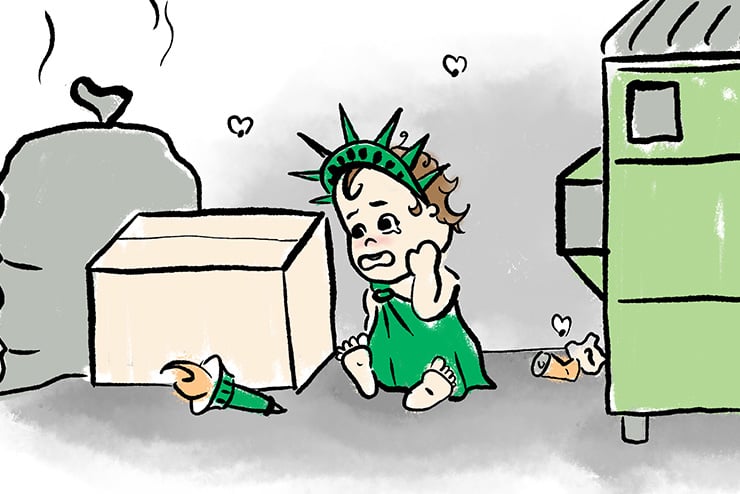
A middle path exists between the neoconservative distortions of America’s liberal democratic values and the postliberal condemnation of America’s founding documents.
Screwtape we have always with us. In fact, C. S. Lewis’s tempter plays Whack-A-Mole like a master, always ready to pounce when one of his old lies gets corrected, and to turn each emerging insight into a fresh new heresy, every bit as toxic as the error it replaces. Those of us who seek the Golden Mean between two opposite falsehoods end up like janitors at Burning Man, tramping along behind one set of raving maniacs or another with buckets, mops, and trash bags.
That’s how I feel as I witness the soccer hooligan riot pitting Red Bull-addled postliberals against dead-ender neoconservatives, which erupted in the wake of Charlie Kirk’s murder: “Have fun guys, knock yourselves out. You won’t have to be the ones cleaning all of this up.” On one side, we’re treated to exotic varieties of conspiracy theory and ethnic scapegoating, while the other side finger-wags, harrumphs, and keeps calling for Security to toss the hooligans out of the country club. We’re told to choose at gunpoint between Tucker Carlson, who spins narratives about Jewish plots for global domination that sound like they were concocted by the Muslim Brotherhood’s paymasters in Qatar, and Ted Cruz, sneering that he ran for the U.S. Senate to represent not Texas so much as Israel. We’re tempted to say, “Just shoot me. Twice, to be on the safe side.”
Perhaps there’s a better option. Before I seek it, let me try what I did in The Bad Catholic’s Guide to the Seven Deadly Sins, where I identified the virtues as the middle way between outrageous, unhinged extremes—each with a bloody piece of the truth that it gouged out and noisily munches on. Let’s start with the two grotesque self-caricatures that currently struggle for dominance over key institutions on the right, from Turning Point USA to the Heritage Foundation. Of course, I must deal in broad strokes, avoiding the kind of nuance that demands thousands of words and dozens of footnotes.

Until Trump, the neoconservative consensus ruled the right, and gave us presidential tickets Bush/Quayle, Dole/Kemp, Bush/Cheney, McCain/Palin, and Romney/Ryan. Just listing those names is almost enough to make you dismiss this faction out of hand, and run as fast and as far as possible in the opposite direction—but that’s what Screwtape wants you to do.
The neoconservatives also gave us stupidly counterproductive wars that got millions of Christians ethnically cleansed, refugee policies that filled our cities with resentful, grabby jihadis, and a Republican party that seems to prefer dignified defeat. Watching the Senate even now fail to confirm President Trump’s qualified nominees for the sake of honoring old-fart traditions such as the “blue slip,” and fund more fratricidal war in Ukraine, we see that the GOP establishment has internalized the mission statement of the Washington Generals: Go out each night and lose graciously to the Harlem Globetrotters.
So much for the bathwater. What of the baby? Are there worthwhile truths and worthy institutions that the neoconservatives inherited from their betters, and cling to out of habit, which we shouldn’t blithely abandon?
The postliberals say, “No.” They want us to make a clean sweep, and treat our family home for termites, not with pesticides, but a bulldozer. That doesn’t strike me as a realistic alternative so much as a dark temptation, which is why I view the current squabbles on the right less as intellectual ferment and more as spiritual warfare.
As I wrote in an essay titled “America the Abstraction” way back in January 2003, at the apex of the neoconservative sugar high, it’s dangerous to replace the defense of a historic nation and its people with the neoconservatives’ global ideological crusade for liberal democracy, however much we might value the role the ideas of the founding fathers have played in our own history. I feel compelled to write today that it’s reckless to throw America’s founding ideas of liberal democracy on the trash heap of history, just because neoconservative ideologues have distorted and hijacked them. One should not have a knee-jerk overreaction to any ideas, even bad ideas. Ayn Rand did that, allowing her experience of Soviet Communism and anti-Semitism to form all her views into the mirror-image opposite of collectivism: radical individualism.
Which brings me to the postliberals. This heterogeneous group of figures on the right is united only by what it rejects: the American founding and the classical liberalism on which that founding supposedly solely rests.
Postliberals don’t contest the views of figures like the “conservative” New York Times columnist David French, who said that Drag Queen Story Hour is “one of the blessings of Liberty,” or Supreme Court Justice Anthony Kennedy, who claimed that liberty demands legal abortion and same-sex marriage. Instead, postliberals agree with these distortions of the concept of liberty and use them to argue for abandoning liberty altogether.
They rinse and repeat the same process with each of the values championed by the old conservative movement model, “fusionism,” which tried to combine libertarian economic theories with socially conservative values. From the market economy to the separation of powers, from religious freedom to medical privacy, postliberals want to throw it all into the scrapheap.
For 60 years, the cultural left has used false reasoning and cynical distortions of America’s founding documents to pretend that the logic of James Madison, Thomas Jefferson, and John Locke inevitably leads to whatever the Harvard faculty and the writers at The New Yorker wish to impose on the public by force. Postliberals gladly concede each constitutional point to the left, echoing the arguments of the ACLU and Planned Parenthood to better trash the Constitution as inherently a tool of the left.
Some follow Patrick Deneen in insisting that John Locke’s ideas were more central to the founding than they actually were (Robert Reilly refuted this in his book America on Trial), and treat Locke as a crypto-Hobbesean whose nihilism infected the entire founding enterprise. (This ignores the fact that most of the founding fathers were Christians of one variety or another, mostly Calvinists with church-going Anglicans, a few lonely Deists, and one devout Catholic in the mix.) M. E. Bradford, decades ago, disposed of the myth that the framers of our nation were Enlightenment philosophes with a thin Christian veneer. In fact, most were closer philosophically to Oliver Cromwell than to the likes of Thomas Paine.
But such proofs have little impact on rightly disgusted right-wingers who believe that our current depraved political culture is the inevitable result of past intellectual errors. The West made the wrong turn at … fill in the blank. For some, we went astray when nominalism came to dominate Western philosophy. For others, we were doomed when Martin Luther escaped a burning stake. The postliberals pick the U.S. founding as their moment of eclipse.
The fuzzy, smug moralism of the neoconservatives makes this move especially tempting. They don’t present an honest, complex picture of what America’s actual, historical founders said and believed about democratic values. The neoconservatives shrug at the founders’ indifference to blasphemy laws and their preference for English-speaking Protestant immigrants, to choose just two examples. No, the ideology of “Americanism” presented by the neoconservative-dominated institutional right since at least the early 1990s is a smug, sanitized revision of our past, like one of the woke Star Wars sequels squeezed out by Disney. We see the actual intent of the authors of America’s governing documents only as refracted through Emma Lazarus’ immigration poetry, the postwar consensus of Hitler-obsessed Boomers, the Civil Rights Movement, and, increasingly, the LGBTQIA+etc. movement.
As I wrote in “America the Abstraction”:
The messy history and imperfectly liberal institutions that conservatives used to argue—following Montesquieu and Tocqueville—made freedom practicable in the West were swept aside. Increasingly, America was defined according to the most expansive, abstract reading of the Declaration of Independence, combined with a version of market economics well-suited to the unrestricted “pursuit of happiness.” Anything that did not fit that formula tended to fall down the memory hole: the Anglo-Celtic roots of the Founding, the specifically Christian (mostly Protestant) identity of America, the very existence of the Confederacy, and the profoundly Western roots of our culture. For this reason… Cold War conservatives have rendered themselves helpless against multiculturalism—and undermined the concrete foundations upon which the edifice of American freedom stands.
In order to reject the neoconservative distortion of our founding philosophy, we don’t need to abandon the actual goals and beliefs of the men who authored the Declaration, the Constitution, and the Federalist Papers—in favor of some variety of reactionary politics that has already failed utterly in its country of origin (be it Spain, or France, or Portugal), yielding a more secular, more tyrannically leftist regime than America yet endures. But Screwtape would like us to. Nothing would make it easier to keep in place chaotic open borders, medical “transitions” for preteens, leftist censorship of media, and other applications of leftist anarcho-tyranny. If the postliberals gain much more attention, expect the likes of California Governor Gavin Newsom to run campaign ads saying, “The Republicans are un-American. They say so themselves!”
I promised a glimpse of the Golden Mean, and here it is: What if we reinterpret more honestly the words of America’s founding documents, and wrench them back from the ideologues of both besotted factions? Let’s read them not so much as abstract dialectic but as rhetoric, what Richard Weaver described as the application of principles to concrete, real-world crises. The neoconservatives see the Declaration of Independence as asserting universal claims about humanity, which must be true everywhere and always, and which it’s our duty to help realize across the world. The Postliberals agree that this is what the Declaration wishes to be, and triumphantly point out that its claims fail that grandiose test.
Instead, I view the Declaration, for all its universalizing verbiage designed to attract French support, as essentially tribal. It asserts what the authors and signers considered to be importantly true for the community which they represented. Whether those same principles would work out if tried in Colombia, Mexico, or the Barbary States (the answer is “no!”) wasn’t their concern. These were the rules of the Anglo-American, low-church tribe that was demanding its independence, which they pledged their lives, their fortunes, and their sacred honor to vindicate. Would those rules still work if the nation they governed were inundated with Muslims and Hindus? Such a delusional prospect would not have flickered through their minds—so it’s fundamentally dishonest to cite the founders’ language in support of open-border immigration policies they would have indignantly rejected.
There’s a giveaway in the text of the Declaration itself, which suggests that my reading is right. It occurs at the beginning, and we need to read the whole in light of it: “We hold these truths to be self-evident.” I’ve always found that phrase strange. I once thought it was a kind of logical dodge, a clever way to assert controversial claims without bothering to argue for them. Now I know better, and doff my hat to Thomas Jefferson’s rhetorical genius.
What kind of truths are self-evident? Not the results of empirical science, or careful historical research. Not the valid conclusions of well-argued syllogisms derived from truthful premises. Not even the claims of faith, which are the product of supernatural grace conveyed by trustworthy authorities. Philosophically, “self-evident” claims are those truths proven by the very terms themselves, basic logical maxims, such as “A = A.”
Jefferson knew all that. He didn’t say “These truths are self-evident,” but “We hold these truths to be self-evident.” The “we” in this situation are the particular Anglo-Protestant Whigs who filled up Independence Hall that sweaty July afternoon. They didn’t argue, in a serious dialectical fashion, that by the laws of logic those truths really were self-evident for all peoples in all times. They held them as such, in an act of faith that flowed from all the other things they held to be true—most of which flowed from their Christian view of the human person, Protestant ecclesiology, and English political history. Interpreted in this light, we on the right ought to be perfectly comfortable with the implications of our founding documents. For a political community shaped by what Samuel Huntington called “tolerant Anglo-Protestant culture,” the principles of the Constitution and Declaration are sound, noble, and worthy. They aren’t so much abstract truth-claims about universal human nature as they are the benevolent guidelines for a particular community. The continued spiritual health of that community will determine whether it succumbs to cancerous mutations of its constitutional principles, such as Roe v. Wade and Obergefell v. Bostock. Those who cherish such principles have a duty to preserve the life of the nation that gave them birth and
sustains them.
Leave a Reply