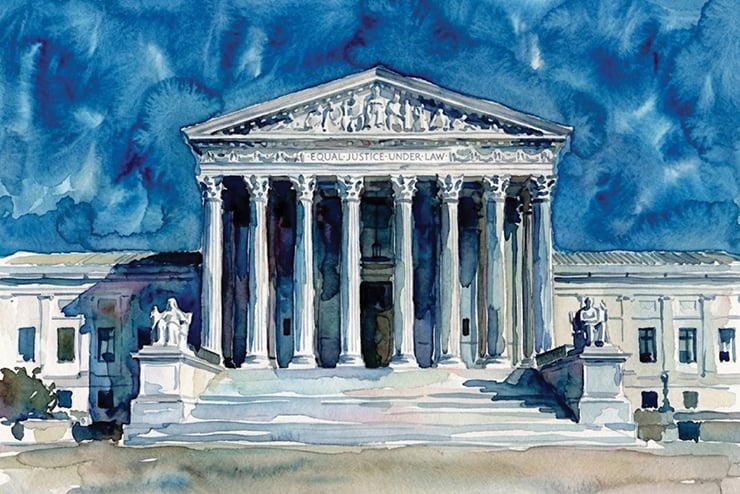
It’s no longer enough to choose candidates for the nation’s highest court with perfect résumés who mouth the principles of originalism. They must have shown their courage in fighting for those principles, especially when it has cost them personally.
Great men do not audition to get picked as the next great man. They are already in the arena. They are already carrying burdens, taking fire, making arguments, and paying prices. Great offices find them because they have shown themselves worthy. That is as true of the Supreme Court as anywhere else in our constitutional order.
The Court bears a heavy responsibility. It “labors under the obligation to succeed,” as the legal scholar Alexander Bickel wrote in The Least Dangerous Branch (1986). So do the men who would sit on it. The office of Supreme Court justice is too weighty to be treated as the capstone of a perfectly curated career. If a man wants the office badly, that is not a qualification—it may be a warning sign.
The future of Supreme Court selection should not be framed as a choice between judicial independence and constitutional courage. We need both. We need justices who are independent from presidents, parties, editorial boards, and elite social pressure. But we also need justices who will do what the law requires when the case is hard, the question is politically charged, and the consequences are real. The right answer to a timid judiciary is not a political judiciary. It is a judiciary of courageous constitutionalists in the model of Justice Clarence Thomas.

For years, conservative legal circles have rightly emphasized fidelity to the text and original meaning of the Constitution, as well as its separation of governmental powers. Those commitments remain indispensable. A justice should not go beyond those bounds to become a legislator in robes. He is there to interpret the Constitution and laws of the United States according to their original meaning and to remain faithful to those laws when deciding cases. But method, however important, is not enough. A judge may know all the right doctrines, speak all the right language, and still fail to do what the law demands when the pressure is greatest. What is too often missing is “judicial fortitude”—a trait we have too often assumed rather than tested.
In my first Congress on the Senate Judiciary Committee, and with Missouri receiving a record number of federal judicial nominees, I have thought a lot about judicial selection. I care deeply about originalism, textualism, and the proper role of the judiciary. But in Senate Judiciary Committee hearings, I try to probe something harder to script—courage. I want to know whether a nominee has ever defended a legally correct position when the kitchen was hot, when it was unpopular, when standing firm came with real professional or personal cost. That is not always easy to test in a committee hearing, especially when you do not know the nominee well. But it matters because a good judge needs more than intelligence and polish. He needs steadiness. He needs the calm disposition to apply the law fairly and impartially under pressure. He needs the fortitude to be a courageous constitutionalist. That is why I value battle-tested lawyers and judges so highly. When I have seen someone up close in major constitutional fights, I do not have to guess whether he has courage. I already know.
The central problem of our time is not merely bad adjudication in isolated cases. It is the slow transfer of legislative, executive, and ultimately judicial power to an unaccountable administrative state with an ideology fundamentally at odds with our American founding.
My own thinking on judicial selection is inseparable from our broader constitutional fight. The central problem of our time is not merely bad adjudication in isolated cases. It is the slow transfer of legislative, executive, and ultimately judicial power to an unaccountable administrative state with an ideology fundamentally at odds with our American founding. If judges are unwilling to say what the law is—if they defer when they should decide, if they blink when managerial power presses forward—then the separation of powers becomes a slogan rather than a structure. That is why judicial selection is not just about methodology. It is about whether a nominee understands the constitutional moment we are in and has the courage to meet it.
Too often, our selection system has rewarded a different set of traits. It has favored the man who has spent his life positioning himself for the office: picking the right school, the right clerkship, the right judges, the right conferences, the right speeches, the right silences. He knows how to sound like a future justice because he has been auditioning for the role for years. He has learned how to avoid controversy, preserve his viability, reassure the legal guild, and impress the people who make short lists. That may be a recipe for advancement. But it is not the same thing as fitness for the Supreme Court.
If anything, it indicates the opposite. The office of justice should find the man; the man should not spend his life chasing the ultimate robe. If someone wants to be a justice too badly, that is not a feature of their “internal programming”—it is a bug. A great office should come to a man whose record proves he can bear its burdens, not merely to a man who has structured his life around obtaining its honors. The Supreme Court is not supposed to be the final prize for a perfectly curated legal career. It is supposed to be a place for men of judgment, discipline, and character.
That is why one of the most revealing questions to ask any judicial nominee is one of the simplest: When have you shown courage? Not, “When have you said the right thing in a hearing?” Not, “When have you published the right article for the right audience?” When have you shown courage? When did you take a legally correct position that was unpopular? When did you stand for constitutional principle and pay a price for it? When did you resist pressure from the press, your peers, the academy, or the broader legal culture? A successful judicial selection process is one that looks across a nominee’s entire body of work and asks when he stood for principles and paid the price. The key question is not whether a nominee can recite the catechism of originalism. The key question is whether he will actually be a courageous constitutionalist when doing so is difficult.
Are you willing to get side eyes at D.C. cocktail parties? Can you endure the quiet shuns that come with doing the right thing, when the more politically palatable option is to take a half measure? Will you use procedural dodges, like declaring a lack of standing, to avoid difficult cases?
Justice Thomas helps clarify why this matters. Courage is not an ornamental virtue added atop legal method. It is the quality that makes the method meaningful when the cost of applying it becomes real. Plenty of lawyers know what the law requires. Plenty of judges can identify the right answer in the abstract. The dividing line is whether they will still hold to it when the press howls, the legal guild panics, and the political class demands retreat. Justice Thomas has long embodied the opposite instinct. He has understood that the right answer does not change because the room gets hostile. “North is still north,” he said in a speech to the Heritage Foundation in 2007. “People can yell at you, north is still north. It doesn’t change fundamental things, and in this business, right is still right, even if you stand by yourself.” That is the spirit we must identify.
Judging is about more than just jurisprudence; it is about exercising judgment, which requires the proper temperament and rock-solid courage. When judicial selection processes have selected candidates with both a constitutionalist jurisprudence and a courageous temperament, they have succeeded. Few justices have embodied that combination more clearly than Justice Thomas.
Courage matters because ours is an age where judges will be confronted with lawfare, administrative improvisation, and relentless pressure campaigns against anyone who resists elite orthodoxy.
Courage is not some generic character trait floating above the law. Courage matters because ours is an age where judges will be confronted with lawfare, administrative improvisation, and relentless pressure campaigns against anyone who resists elite orthodoxy. We must remember that sound jurisprudence is never detached from the constitutional order it exists to preserve. Our jurisprudence must preserve and uphold our foundational principles in the context of our constitutional moment.
America First jurisprudence must therefore be one of courageous constitutionalism. It must be a common-sense approach to the law across every legal institution—from the Supreme Court, to state courts, to the Justice Department, to state attorneys general, to private attorneys—that faithfully applies the Constitution’s original meaning, understands the way America’s unique legal tradition protects our core national interests, and rejects procedural cowardice, false moral neutrality, lawfare, and the entrenchment of fundamentally anti-American,
progressive legal concepts.
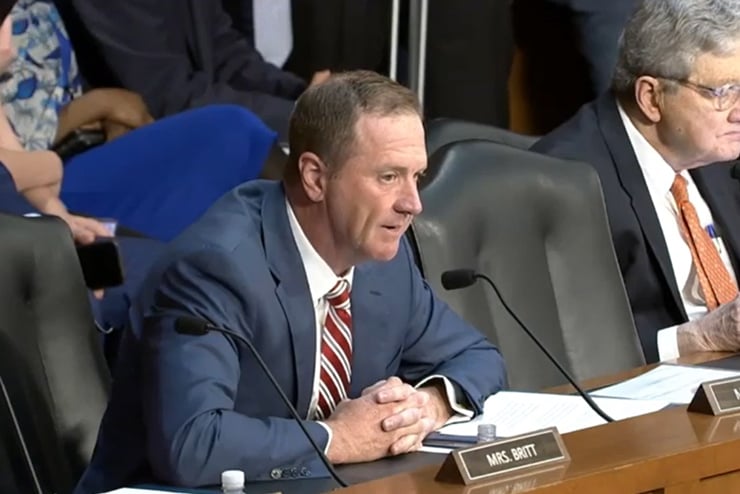
A judge today will face social, political, and professional pressure to back down. The right nominee is the one who has already shown, in real constitutional fights, that he will not. That is why I have cared so much about ensuring battle-tested lawyers and judges are nominated and confirmed to the federal bench: not because they know how to talk about courage, but because I have seen them in action.
Courage is not an abstraction in our legal tradition. The best judges are often formed in real institutions, around real mentors, in offices where they learn early that public service means taking hard stands and living with the consequences.
Justice Thomas’s pre-Supreme Court career is a reminder of what judicial selection ought to reward. He was not the product of a lifelong audition for the bench. He started in the Missouri Attorney General’s Office under John Danforth, worked in private practice, served in the Senate, led civil-rights enforcement at the Department of Education, chaired the Equal Employment Opportunity Commission, and then served on the D.C. Circuit before joining the Supreme Court. Long before he became Justice Thomas, he had already been tested in the institutions where law, politics, bureaucracy, and constitutional conflict meet. He had already shown that he could carry responsibility, withstand pressure, and hold fast in contested terrain. That is the point: He had demonstrated the fortitude necessary to be a courageous constitutionalist.
This is the real divide that should structure judicial selection. On one axis is constitutionalist jurisprudence: Does the nominee believe in the Constitution, its text, and its original meaning, as well as our history, constitutional structure, the nation it created, and the limited judicial role? On the other axis is courage: Will he actually apply those principles in hard cases, or will he hide behind narrowness, delay, or procedural escape hatches when the stakes rise?
The ideal Justice scores high on both axes. A judge with courage but bad jurisprudence is dangerous. But a judge with excellent jurisprudence and no courage can be just as disappointing in practice. He name-checks the right concepts, gives the right speeches, but then finds an off-ramp when a hard case arrives. He prioritizes the institution’s comfort over discharging its duty.
Some of the most important decisions of the last decade show what courageous constitutionalism on the Court looks like.
- In Dobbs v. Jackson (2022), the Court rejected the precedent set by Roe v. Wade and ended the unconstitutional abortion regime, which had no basis in the text, history, or structure of the Constitution.
- In New York State Rifle & Pistol Association v. Bruen (2022), a majority opinion written by Justice Thomas rejected the two-step interest-balancing framework lower courts had used to water down the Second Amendment and restored the primacy of text, history, and tradition in constitutional adjudication.
- In Students for Fair Admissions v. Harvard (2023) (2023), the Court refused to continue to allow colleges and universities to hide racially discriminatory practices behind the bureaucratic language of “diversity, equity, and inclusion.”
- In West Virginia v. EPA (2022), Biden v. Nebraska (2023), and Loper Bright Enterprises v. Raimondo (2024), the Court showed a renewed willingness to police the administrative state and insist that agencies cannot discover powers of vast political and economic significance in old and ambiguous text.
- In this year’s Louisiana v. Callais decision, the Court made clear that states cannot invoke the Voting Rights Act to justify otherwise unconstitutional racial gerrymandering.
The need for courage is especially great in an era of nationwide injunctions, lawfare, and politically motivated delays imposed by lower courts. In the Federalist Papers, Alexander Hamilton described the judiciary as possessing “neither FORCE nor WILL, but merely judgment.” That remains the right constitutional ideal. But in practice, the federal judiciary can exercise enormous power simply by slowing the political branches to a crawl. Delay at the Supreme Court is not neutral when it allows rogue lower-court judges to defeat a lawful presidential mandate. The Supreme Court is not exercising proper restraint when it avoids questions that lower courts have answered aggressively and prematurely. A justice who reflexively hides behind the idea of judicial restraint and procedure in order to avoid addressing abuses of the lower courts perverts the meaning of those concepts, and is anything but “apolitical.” He may be helping decide the controversy through delay rather than judgment. This appears to have occurred recently, as liberal justices slow-walked the decisions in Dobbs and Callais to benefit Democrats, as alleged by Mollie Hemingway in her recent book, Alito, and by The Federalist in subsequent reporting.
In practice, the federal judiciary can exercise enormous power simply by slowing the political branches to a crawl. Delay at the Supreme Court is not neutral when it allows rogue lower-court judges to defeat a lawful presidential mandate.
I have firsthand knowledge of the difference between courageous and cowardly jurisprudence from the cases I worked on as Missouri Attorney General. In Biden v. Nebraska, Missouri and other states challenged the Biden administration’s attempt to cancel hundreds of billions of dollars in student-loan debt by executive fiat. The Supreme Court agreed that the relevant statute did not authorize the Secretary of Education to rewrite the student-loan program on that scale.
In Missouri v. Biden (later renamed Murthy v. Missouri), Missouri and Louisiana exposed a vast federal censorship enterprise in which White House officials and multiple federal agencies pressured major social-media companies to suppress protected speech. The Fifth Circuit agreed that federal officials had likely coerced or significantly encouraged censorship in violation of the First Amendment, even though the Supreme Court ultimately disposed of the case on standing grounds.
And in the COVID mandate cases—including Biden v. Missouri (2022) and the broader litigation culminating in NFIB v. OSHA (2022)—Missouri and other states forced the courts to confront the basic question of whether federal agencies could seize breathtaking new powers under the cover of a health emergency.
That is why President Trump’s second-term judicial selections matter. He’s been doing an excellent job, despite media commentary to the contrary, which has focused on whether his administration is drawing more heavily from lawyers who fought in Trump’s personal and political legal battles. Critics describe that as a loyalty test. But they fail to grasp the significance of what those lawyers showed in their defense of President Trump during a time when the media and judicial system were focused on his downfall. It’s not a question of personal loyalty; it’s proof of character shown through legal combat. They are battle-tested lawyers who operated under enormous political pressure, defended constitutional structures in hard fights, and withstood elite hostility. That kind of record provides better evidence of judicial courage than a man who spent 25 years cultivating the perfect résumé. We need judges who have shown they are loyal to the law even when it costs them personally.
Following the fall of the outdated post-war consensus, judicial selection will play a central role in determining whether the next era is worthy of the Constitution. We cannot reclaim self-government from the administrative state with judges who speak the language of originalism but lack the courage to enforce it. The point of judicial selection now is not merely to find bright lawyers. It is to find courageous constitutionalists who understand that reclaiming the Constitution from the administrative state is a generational project—and who are willing to do their part in that fight.
We cannot reclaim self-government from the administrative state with judges who speak the language of originalism but lack the courage to enforce it.
What would a better model of Supreme Court justice selection look like?
First, it would preserve the good: originalism, textualism, structural constitutionalism, and judicial independence.
Second, it would broaden the feeder pool. Instead of looking only at the most manicure-ready appellate judge résumés, it would look more seriously at attorneys general, solicitors general, public-interest litigators, executive-branch constitutional lawyers, and judges who have already demonstrated fortitude in hard cases.
Third, it would ask better questions. Not just: “Is he brilliant?” Not just: “Did he go to the ‘right’ school?” Not just: “Is he confirmable?” Not just: “Has he said all the right things?” But: “When did he show courage?” “What did it cost him?” “Did he stand on constitutional principle under pressure?” “Does his record suggest that he seeks duty rather than honor?”
The country deserves justices who did not spend their lives trying to imitate Justice Thomas in their words, but who proved through their actions in hard fights that they possess the courage, discipline, and constitutional seriousness to follow his example.
That is why the deepest principle here is still the simplest one: the office of justice should find the man. The man should not covet the role. Not ambition for the office, but fitness for the office. Not a life spent auditioning for elevation, but a life spent proving oneself worthy of responsibility. We should recover an older, healthier instinct that great men do not audition to get picked as the next great man. They are already in the arena. They are already laboring under an obligation to succeed. Great offices should find worthy men, not reward lifelong auditioners. The future of the Court belongs to courageous constitutionalists.
Leave a Reply