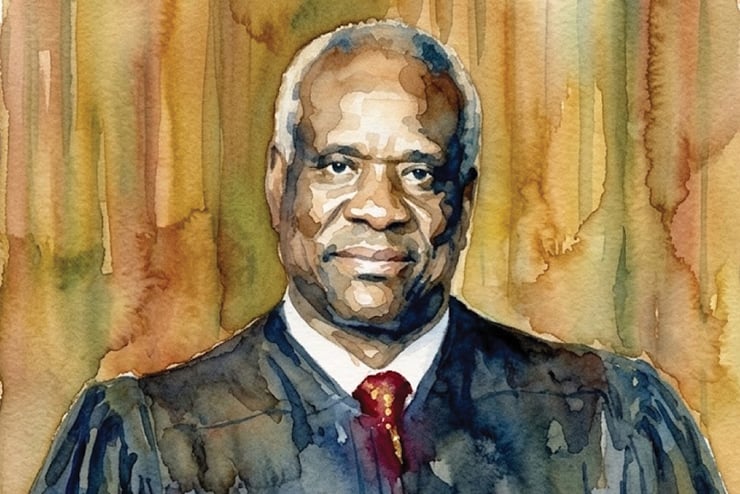
Neither wavering from his principles nor afraid to stand alone, Justice Thomas has made his originalinst jurisprudence the majority opinion of the Supreme Court.
In May, Justice Clarence Thomas became the second-longest-serving Supreme Court justice in American history, with a tenure of 34 years and counting. God willing, he will become the longest-serving justice in May 2028, with more than 36 years on the Court, and serve for many more years after that. Not only is he one of the longest-serving justices in American history, he’s also one of the most consequential.
Since joining the Court in 1991, Thomas has pulled the Court’s jurisprudence back to the Constitution’s original meaning and steered the Court itself back to its proper role. At the start of his tenure, Thomas laid out a jurisprudence that started with lone dissents, but over time, he has swayed the Court in his direction. Those principled dissents became concurrences and are now majority opinions.
In this year of our nation’s 250th anniversary, we should celebrate Thomas and his commitment to the original meaning of the United States Constitution. In building a future Supreme Court of superb justices, we should seek to emulate what makes him exceptional. Thomas was born into the most trying of circumstances and overcame those challenges. The difficulties he faced forged an unequaled courage and love for our nation’s founding principles.
The importance of courage was the theme of Thomas’s April speech at the University of Texas at Austin, celebrating the 250th anniversary of the signing of the Declaration of Independence. In that speech, he discussed how he understood the lofty and indeed revolutionary phrase set forth at the beginning of the document, “We hold these truths to be self-evident, that all men are created equal, that they are endowed by their Creator with certain unalienable Rights, that among these are Life, Liberty and the pursuit of Happiness.”
Thomas noted that these would have been mere words if the Founding Fathers and Americans throughout our history had not had the courage to live them.
He also drew attention to the last sentence of the Declaration of Independence, “And for the support of this Declaration, with a firm reliance on the protection of divine Providence, we mutually pledge to each other our Lives, our Fortunes, and our Sacred Honor.” Thomas said, “Nothing in the Declaration of Independence, I now realize, matters without that final sentence. Without that sentence, the rest of the Declaration is but mere words on parchment paper. Nice words, but, nonetheless, just words. What changed the world was not the words, but the commitment and spirit of the people who were willing to labor, sacrifice, and even give their lives.”
Thomas demonstrated courage through his unyielding adherence to the original meaning of the Constitution. He is not only the most consistent originalist in modern times. More than any other justice, he has been willing to overrule long-standing precedent if it is not consistent with the Constitution’s commands.
For those who would question why he would not give more respect to precedent, it is useful to refer to his April speech, in which he castigated the Justices who did not have the courage to overturn Plessy v. Ferguson. That was the 1896 decision that made possible the “separate but equal” principle undergirding segregation, which lasted for 60 years until overturned by Brown v. Board of Education. He said:
It could not have taken my Court 60 years to know that Plessy was a hideous wrong and that racial segregation was grossly incompatible with our colorblind Constitution. The Justices must have known it all along. The right thing to do, as Justice Harlan spelled out in his lone dissent at the time, was obvious as it so often is. What stood in the way was cowardice… So, for 60 disgraceful years, they made American children like me grow in racial caste system because it was easier to do nothing than do the right thing.
Thomas suffered from the effects of a regrettable Supreme Court decision and its legal ramifications. That left him with zero respect for poor precedents that impact people’s lives for generations.
Thomas never accepts any case that he considers to have a flawed premise. He recognizes that the moment a judge accepts such a premise, he will reach a defective decision. A judge is doomed if he begins a Second Amendment case by accepting that the Second Amendment does not confer an individual right, or examines a commerce case while accepting that there are no policeable limits on the federal government’s power over commerce. Nor should he begin an Establishment Clause case while accepting that the First Amendment establishes a rigid wall of separation between church and state. Equally dubious would be to judge an environmental case while imagining that anyone can get into court by speaking about “aesthetic” harm. Thomas would also be skeptical that courts could second-guess presidential decisions about national security.
Instead, in every case, Thomas starts with the Constitution as originally understood as his binding guide, rejecting any anti-constitutional premise, no matter how ensconced in flawed precedent and congenial to elite legal circles.
From the start of his tenure, Thomas anchored himself to his principles and held to them, often alone and despite the scorn and insults thrown at him by the left-wing press. While most justices drift toward a centrist opinion over time, Thomas’s extraordinary tenacity has pulled the Court’s center toward him.
For example, in the 1994 case of Holder v. Hall, Thomas wrote a concurring opinion (joined by Justice Antonin Scalia) dismantling arguments that Section 2 of the Voting Rights Act authorized courts to effectively take over state redistricting efforts, which left-wing partisans used to amplify the black vote and benefit the Democratic Party. Over three decades later, Thomas’s opposition to such racial gerrymandering was vindicated in May 2026 by a six-justice majority opinion in Louisiana v. Callais.
And, in the 1997 case of Printz v. United States, Thomas observed in a lone concurrence that the premise that the Second Amendment confers only an abstract right to militias to bear arms is grievously flawed. Decades later, in the 2008 case of District of Columbia v. Heller, he was vindicated when the Court held that the Second Amendment does in fact confer an individual right, and in the 2022 case of New York State Rifle and Pistol Association v. Bruen, Thomas was again vindicated and, writing for a six-justice majority, cemented the Second Amendment as a core individual constitutional right on the same plane as the First Amendment.
In no area has Thomas had so personal and so profound an influence as in ending racial discrimination against all Americans. Early in his tenure on the Court, Thomas issued lone opinions, such as in Missouri v. Jenkins, which decried the willingness of courts “to assume that anything that is predominantly black must be inferior.” He also expressed, in Adarand v. Pena, his disagreement “with the premise underlying” the opinions of other justices “that there is a racial paternalism exception to the principle of equal protection.”
Over the decades, Justice Thomas has remained anchored in the principle that the laws should not favor any group of Americans, as he argued in Grutter and Fisher, cases challenging racial affirmative action in higher education. All the while, his former law clerks worked assiduously to build the perfect case to end affirmative action. The culmination of decades of steadfast work was evident in Students for Fair Admissions v. Harvard, where the Court, in a 6-3 majority opinion, finally struck down affirmative action in higher education. Justice Thomas joined the chief justice’s opinion and wrote a concurring opinion observing that the Declaration had been vindicated at long last:
While I am painfully aware of the social and economic ravages which have befallen my race and all who suffer discrimination, I hold out enduring hope that this country will live up to its principles so clearly enunciated in the Declaration of Independence and the Constitution of the United States: that all men are created equal, are equal citizens, and must be treated equally before the law.
These are just a few examples of Justice Thomas’s positive influence on American jurisprudence. From abortion to race-based affirmative action, to the administrative state, to the Commerce Clause, to environmental law, to the Eighth Amendment, to the spending power, to the Seventh Amendment, to habeas corpus, to the very way in which the Court approaches its duty to the original Constitution, what began as Justice Thomas’s lonely concurrences or dissents now command majorities on the Supreme Court.
Justice Thomas’s opinions are just the beginning of his influence. He has also assiduously fostered an amazing coterie of clerks, who have gone on to become lawyers and judges and have promoted Thomas’s principles of originalism. His former clerks went on to become lawyers who successfully argued before the Court in the Dobbs abortion case that overturned Roe v. Wade, the Harvard case against race-based affirmative action, and the Skrmetti case upholding state laws banning the use of puberty blockers and hormone therapy on children.
No group of clerks has ever been so devoted to furthering their former boss’s originalist aims. Thomas’s one-time assistants have disseminated his ideas far and wide, from the executive branch to academia, to state government, to Congress, to businesses, to public interest groups. It’s no wonder that today more of his clerks serve as federal judges than those of any other justice.

Clarence Thomas was born into abject poverty in Pin Point, Georgia, in the segregated Deep South of 1948. His parents were illiterate, and his father left when he was two years old, forcing Clarence’s mother to raise three kids under the age of five on her own. He lived in a shanty with no indoor plumbing and one light bulb.
At seven, he went to live with his grandparents. His grandfather, who owned his own small fuel oil business and was a stern taskmaster, sent his grandsons to St. Benedict the Moor, an all-black Catholic school. It was run by Irish nuns, who incurred disapproval for teaching black children. Like young Clarence’s grandfather, these nuns did not coddle their students, despite the challenging circumstances they faced. “At home, at school, and at Church, we were taught that we are inherently equal,” Thomas said in his April speech. “That equality came from God, and that it could not be diminished by man.”
This foundation imbued Justice Thomas with the strength to carry on the cause of America’s Founders. In his April speech, Justice Thomas observed that people show who they really are when they are faced with the pressures of public office in Washington, D.C., which are always encouraging them to “moderate” (which, in D.C.-speak, means to move to the left). About life in Washington, he said:
Since the day that I arrived in Washington, there was never a shortage of people espousing noble purposes.… These people can be just as high-minded as the men who signed the Declaration. They can mouth the words of the Declaration and parrot its principles.… But once in the spotlight, in that combat, many people fall prey to the lures that are set up to turn them away from their previously untested principles. They become controlled by criticism, so fearful of negative attention that they find ways to avoid doing the right thing. Or, they fall prey to the enchanting siren songs of flattery, and become so bewitched by praise that they will desperately seek to conform accordingly. They are enticed by access to things that were previously unavailable to them. They get so swept up in the euphoria of acclamation and acceptance that they put aside their convictions. They water down their message, negotiate against themselves, vote against their principles, and hide in the tall grass. They recast themselves as institutionalists, pragmatists, or thoughtful moderates, all as a way of justifying their failures to themselves, their consciences and their country.
In stark contrast to the city’s spirit of compromise, Thomas has always stood firm in his convictions, even in the face of vicious attacks. When Thomas joined the Reagan administration and became director of the Equal Employment Opportunity Commission, he took on the National Association for the Advancement of Colored People (NAACP) and the entire black civil rights leadership, including both white and black Democrats in Congress. He castigated them for promoting race-based affirmative action and other destructive policies that were harming, among others, black Americans, even if most blacks didn’t recognize those ill effects. He called out the corrupt grift practiced by the civil rights lobby to this day. His reward was being savagely attacked as an Uncle Tom by “civil rights” leaders.
Democrats in Congress retaliated by summoning him to testify countless times and tried to intimidate him into changing his legal philosophy. But he never did, for a simple reason. He believed that he was adhering to the explicit meaning of constitutional texts and refused to accept the “policy-oriented” precedents so dear to leftist activists.
Thomas had his battles with his Reagan administration colleagues, too, who had different ideas about how he should approach policy issues. When they began a conversation telling Thomas that he had to take certain actions, he cut them off and said, “There are only two things I have to do: stay black and die.” He was fiercely independent. He was devoted to his principles, and he lived them, no
matter what.
When Thomas was nominated to the Supreme Court in July 1991, the left launched an unprecedented assault to stop him. The media circus culminated in the doubtful testimony of law professor Anita Hill, who alleged she had been sexually harassed by Thomas years earlier. Hill, whom the left rewarded with professional advancement for her defamatory services, enjoyed the frenzied support of National Public Radio and other less-than-objective news services.
Despite the best efforts of the media and Democratic operatives, Hill’s accusations never seemed particularly credible, nor was the form of harassment ascribed to Thomas (that he once made lewd remarks to her) damning. In the end, Thomas was confirmed by a vote of 52-48. The partisan ferocity with which Democrats went after him from the confirmation proceedings onward suggests that they fully understood that Thomas threatened their use of the courts to “legislate” their social policies.
Thomas didn’t waver in the face of the media’s attacks; he leaned into the battle. “I’d rather die than withdraw. If they are going to kill me, they’re going to kill me,” he said during the confirmation hearings, when asked if he would reconsider his nomination. “I don’t like bullies, I’ve never run from bullies, I never cry uncle, and I am not going to cry uncle today, whether I want to be on the Supreme Court or not.”
Even after Thomas was confirmed, the left continued its nonstop attacks on him. Journalists at major newspapers persisted in running him down. The media drew on antiblack stereotyping, portraying the highly erudite justice as dumb and incompetent. One magazine depicted Thomas taking direction from his fellow justice and originalist Antonin Scalia. A newspaper editorial cartoon depicted Thomas wearing a KKK robe. The leftist black elite was even more vicious, with one magazine depicting Thomas as a lawn jockey. Judge Leon Higginbotham, a black judge who had been active in the civil rights movement in the 1960s and served in the 3rd Circuit, sought to prevent Thomas in 1998 from speaking to the National Bar Association, the nation’s largest association of black attorneys.
Thomas was not deterred and delivered a riveting speech, which contained these bold lines:
I have come here today not in anger or to anger, though my mere presence has been sufficient, obviously, to anger some. Nor have I come to defend my views, but rather to assert my right to think for myself, to refuse to have my ideas assigned to me as though I was an intellectual slave because I’m black. I come to state that I’m a man, free to think for myself and do as I please. I’ve come to assert that I am a judge and I will not be consigned the unquestioned opinions of others.
The left’s attacks on Thomas have continued for more than 30 years. Shortly after the Dobbs decision of 2022, for which Thomas had laid the groundwork in his dissents, starting with the Casey decision in 1992, the billionaire-funded left-wing website ProPublica launched an investigation into Thomas’s vacation with his close friends. Despite leftist Justices like Justice Ruth Bader Ginsburg and Stephen Breyer flying all around the world on third-party tabs, the media accused him of improperly disclosing gifts in kind that he had received by going on those vacations. The attacks led to a partisan and baseless investigation by the Democrat-controlled Senate Judiciary Committee. In January 2025, the Judicial Conference, the governing judicial ethics body, put the matter to rest, rejecting the request of Democratic senators to have Thomas investigated by the Justice Department and ruling that he had complied with all relevant ethics rules.
No justice in history has ever been subject to such glaringly unfair abuse. Throughout these battles, Thomas has always been a man full of gratitude. He has repeatedly thanked his grandparents for saving his life. In fact, he titled his memoirs My Grandfather’s Son.
He also never forgot the nuns who taught him in the still-segregated South that everyone was created in the image of God. For many years, while he was on the Supreme Court, Justice Thomas and I made an annual visit to the retirement convent where many of his former teachers lived. His eighth-grade teacher, Sister Virgilius, lived to the age of 100, and we attended her funeral.
In a seminal speech celebrating the Declaration of Independence, Thomas quoted this aphorism attributed to Franklin Roosevelt, “Courage is not the absence of fear, but rather the assessment that something else is more important than fear.”
This wisdom has guided Thomas’s judicial career. He has persisted in his fight for the plain meaning of the Constitution, despite continuing vilification. In this undertaking, he has faced the adamant hostility of the unified left that has used the courts to inflict on this country its preferred social policies, which have then been turned into precedents. Thomas has rejected their dishonest, unconstitutional game and has done so with courage and defiance.
Leave a Reply