
The recent disintegration of the Assad regime in Syria, after a few shoves from a rickety coalition of Islamist militias, is only the latest chapter in a larger story unfolding in the Middle East. After a century of failures, the modern Arab state republics have nearly all collapsed. Only the Arab tribal monarchies have survived the winds of change.
Across the Middle East and North Africa, it is increasingly evident that all attempts to create an Arab-speaking polity with at least the minimal qualities typical of modern states, such as Slovenia, Belize, or Malaysia, have failed utterly. In the last generation, all 10 Arabic-speaking “republics” of the Arab League have witnessed brutal coups and convulsions, or full-on civil wars, that have left them in shambles.
In fact, only three of them—Algeria, Tunisia, and Egypt—survive and limp on as barely solvent, army-backed, civilian dictatorships with unpromising futures. The other seven, Libya, Sudan, Yemen, Lebanon, Syria, Iraq, and the Palestinian Authority, are suffering varying stages of decomposition, either as fractured failed states or as permanently divided ethnic or religious enclaves, over which a notional central government has little to no authority.
Meanwhile, the eight Arab monarchies—Bahrain, Jordan, Kuwait, Morocco, Oman, Qatar, Saudi Arabia, and the United Arab Emirates (the UAE federates seven minuscule princedoms dominated by Abu Dhabi)—have fared somewhat better. To date, they have not only survived the winds of change that swept away most of the “republics” in the last two decades, but in most cases appear to be relatively stable in social and political terms. However, it is crucial to understand that the relative stability of Arab monarchies is only possible because they are not states in the modern sense, but essentially premodern tribal entities.
None of the Arab monarchies is a constitutional or even semi-constitutional regime; they lack the rule of law, independent institutions, safety of property, civil society, or any other characteristic associated with modern polities. Rather, these monarchies exist as the personal fiefdoms of a royal clan, which rules by endlessly maneuvering tribal allegiances, local factions, financial resources, dynastic marriages, and, sometimes, a supposedly sacred descent from the Prophet Muhammad. In other words, they are polities far more akin to medieval potentates than to modern political societies.
To be sure, all Arab republics and monarchies display the paraphernalia of the modern state, with cabinets, parliaments, courts, written constitutions, universities, stock exchanges, foreign embassies, and the like. But appearances need not fool anyone, for all these ostensive state accessories are mere decorations, while real power always resides in only two places—the military and tribal clans. Everything else, like elections, political parties, media outlets, and written laws, is mere window-dressing for autocrats whose rule relies only on soldiers and tribal chiefs.
This is obviously true of the monarchies (where the army is headed by tribal chiefs close to the king or from his very own clan), but not less so of the “republics,” which, despite their appellation, are all controlled by de facto monarchs (usually former generals) who often attempt to set up a new clan-dynasty. Although only the Assad clan succeeded for a time in transmitting power from father to son in a republic, virtually all Arab “republican” autocrats attempted it, from Libya’s Muammar Gaddafi and Iraq’s Saddam Hussein to Yemen’s Ali Abdullah Saleh and Egypt’s Hosni Mubarak.
Ironically, Arab “republics” are weaker than the monarchies because the trappings of the modern state characteristic of republican systems inevitably clash with societies that remain essentially tribal systems. Trying to look like a republic impedes the explicit, unrestricted exertion of tribal-based rule. Facing this contradiction, most Arab “republics” eventually collapse and splinter into a patchwork of local potentates and enclaves. In such dismembered “republics,” an internationally recognized government often controls little more than 50 percent of the country in places like Syria or Sudan, as little as 30 percent in Libya or Yemen, and even less than that in the case of Lebanon.
This disintegration is so pronounced and uniform that to deny the demise of the Arab State is simply to ignore reality. Unfortunately, in Western capitals, opportunism or self-delusion has thus far precluded any open admission of this reality. This has resulted in repeated attempts to stitch back together, Frankenstein-style, the dismembered limbs of long-defunct body politics. All such efforts, which ignore the facts on the ground, are not only doomed to fail but eventually only produce additional monstrosities. This approach is not only intellectually inept, it also significantly contributes to prolonging the suffering of so many in the region, precluding them from attaining even a reasonable measure of security for life or property, let alone any prospect of prosperity.
Let us look at the real lay of the land in the region and then consider achievable policies and objectives.

The Arab State was born after World War II, as Britain and France’s colonial dominance in the Middle East and North Africa waned unexpectedly and swiftly. For a decade after the war, both powers attempted to retain some regional influence, but gave up after they failed to stand up to the United States and the Soviet Union during the Suez Crisis of 1956. Areas formerly ruled as protectorates (Egypt, Sudan, Morocco, Oman, and 10 tiny Persian Gulf sultanates), mandates (Syria, Iraq, Lebanon, Transjordan, and the Arab part of partitioned Palestine), and colonies (Libya, Tunisia, Aden, and Algeria) alongside a couple of isolated desert sheikhdoms (Saudi Arabia and Yemen), were gradually granted international recognition as independent states. The prevailing expectation was that they would become Arabic-speaking versions of modern states, following something like the path already trodden by many countries from Japan to Turkey and from India to the Philippines. It was not to be.
Most of the newly independent Arab states started up as monarchies, but within one generation, many of the monarchs were ousted and replaced by “republics.” However, none of these notional republics ever succeeded in developing anything like functioning political institutions, let alone a civil society. All quickly came to be ruled by strongmen. The best that the residents of such a republic could hope for was a relatively stable and benevolent civilian despot, like Habib Bourguiba in Tunisia, while in the worst cases they found themselves ruled by bloodthirsty, erratic megalomaniacs like Libya’s Gaddafi and Iraq’s Hussein. Those countries that tried to diverge from this pattern, like Lebanon and Syria, were soon enmeshed in endless rounds of coups, countercoups, and civil wars, until a strongman emerged or they came under foreign dominance.
Was this colossal failure inevitable?
Perhaps the Arab State was doomed to fail from the start, because most of its borders were arbitrary creations by colonial powers, encompassing various distinct and often adversarial communities with little to no shared identity or allegiance. Within such a state structure, politics turn into a poisoned, zero-sum game, where the only definite asset is possession of military coercive power.
Or perhaps Arab states, or at least some of them, may have had an initial chance to build themselves into stable polities? But this prospect was fatally undermined by a political culture obsessed with the twinned chimeras of Pan-Arabism and wiping out Israel.
Pan-Arabism, also known as Arab nationalism, is a political ideology that, since the 1940s, has proposed that Arabic-speaking countries unite into one political entity to overturn their humiliating recent history of debility and stagnation, and to claim a deserved place among great powers. This ideology also posited that the very notion of a tiny Jewish state existing at the geographic center of the purported “Arab World” was ultimate proof of the Arabs’ enervation. This predicament allegedly could be healed only by Pan-Arab unity leading to the destruction of the “Zionist entity.”
By the 1950s, the ideology of Arab nationalism had become dominant in Arab-speaking countries, when its claims were seemingly confirmed. This confirmation came, on the one hand, by seven separate Arab armies failing to defeat the fledgling state of Israel in the 1948 Arab-Israeli War. And, on the other hand, by the gratifying delusion positing that Gamal Abdel Nasser’s nationalist Egypt repelled on its own an invasion by Britain, France, and Israel in the Suez War of 1956. In fact, the invasion was halted and rolled back by the combined pressure of the U.S. and USSR. Still, the conceit about Nasser’s purported victory persisted and utterly poisoned Arab political minds for two generations.
The combination of inbuilt internal weakness and of external Pan-Arabist rhetoric (with the concurrent anti-Israel obsession) undermined from day one the very fabric of modern Arab-speaking polities. For decades, all Arabic-speaking states, and especially the republics, paid at least lip-service allegiance to the Pan-Arab ideology. In truth, the Pan-Arabist bombast served to mask the dearth of substantial social and economic progress. At the same time, most resources were diverted towards armies and security apparatus. This was supposedly for the purpose of preparing for war with Israel—but actually, the military was mainly used to crush internal dissent.
Two generations of Arab regimes avoided blame for their abject failures by ascribing responsibility for all their ills to the very existence of the state of Israel. The Jewish state was conferred with a demonic status, as both the devious tool by which Western powers purportedly exerted overt and covert evil machinations that weakened the Arabs, as well as the objective impediment to Arab political unity—a Western wedge stuck at the very heart of a purportedly “Arab World.” Every Arab strongman, from Nasser to the many later wannabees, found in the existence of the Jewish state the eternal scapegoat for their every failure.

We cannot fully detail here the road to failure taken by each Arab state. But the overall trajectory was broadly the same for all: Within one generation of independence, all Arab “republics” had become dictatorships (except for Lebanon, ruled from its beginnings by fluid coalitions between religious groups and feudal clans). They were all purportedly committed to some version of Arab nationalism, touting the creation of a pan-Arab superstate that would have a seat at the table of great powers. And, in practice, they were all military-backed dictatorships, in the service of some clan or of a corrupt circle of officers and their clans. Finally, within one more generation, they were all floundering or failed states.
Meanwhile, those monarchies that survived military takeover, in Morocco and around the Persian Gulf, fared relatively better in terms of stability and economic well-being. They were stable and functional for the most part, but none of them progressed on a substantive social or political scale or developed any significant cultural or industrial achievement other than exporting fossil fuels.
The stability achieved by the monarchies is mainly due to their being fundamentally based on a tribal, pre-modern political structure. When a country is formally named “Saudi” Arabia or “Hashemite” Jordan, its name states explicitly that political society is an appanage of the Saudi or Hashemite clan and that there is no modern state, let alone nation, behind it. So, while the Arab monarchies also rhetorically kowtowed to the pan-Arabist and anti-Zionist screeds in their public pronouncements, their political foundations did not rely on those ideologies.
Although the Arab monarchies mostly avoid the extreme veering between deep instability and cruel repression that characterizes Arab “republics,” and are not prone to the socialist follies that have bankrupted the latter, they nevertheless do not seem to represent a viable alternative in the long run. The monarchies are as corrupt as the “republics” and, if anything, more capricious in their policies. Moreover, it is not a coincidence that the only two Arab monarchies that do not rely on oil wealth, Morocco and Jordan, have ruling houses that found their legitimacy on alleged descent from the Prophet Muhammad. Moreover, we must assume that the survival of most Arabic-speaking monarchies depends mainly on a continual flow of massive fossil fuel revenues. The oil-rich monarchies are not only completely reliant on the accidental circumstances that have gifted them with fossil fuel deposits incommensurate to their population size, but at the same time find their social and cultural development deeply stunted by their total reliance on that very fossil fuel wealth.
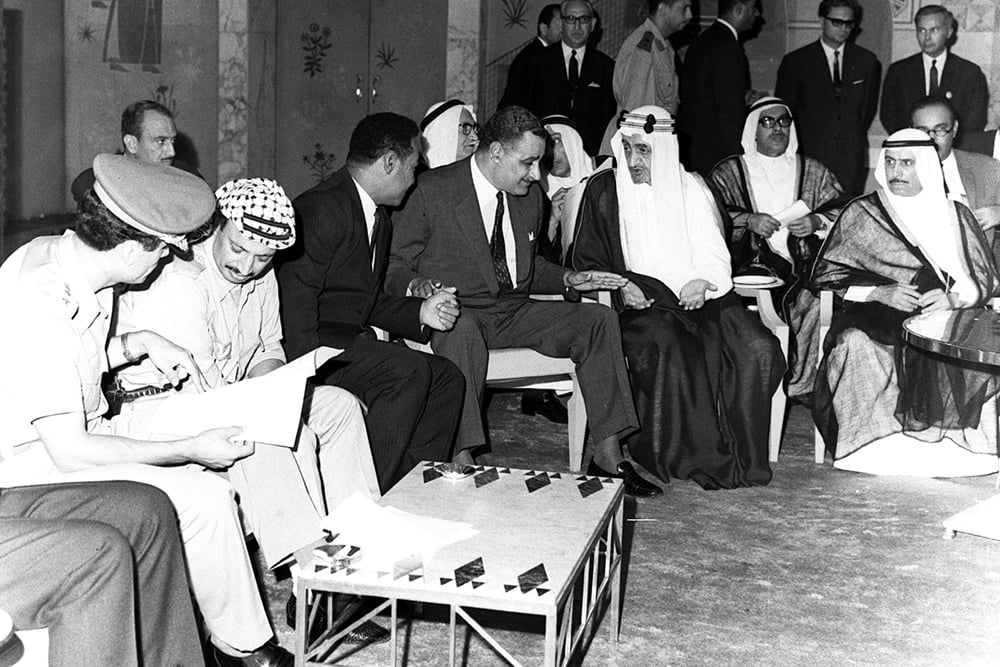
Organisation), Jaafar al-Nimeiri (Sudan), Gamal Abdel Nasser (Egypt), King Faisal (Saudi Arabia) and Sheikh Sabah (Kuwait)
(Unknown / Wikimedia Commons)
Nothing reflects this stunted development more than the sad fact that most of the productive sectors of the workforce in these fossil fuel sheikhdoms are foreign workers. In some cases, they are more like resorts than real countries, with foreign workers making up more than 70 percent of the population in Qatar or the UAE. But, even in Saudi Arabia, where about a third of the population are foreign workers, their presence has dire consequences on the substantial development of the country. The monarchies pay for all basic needs of their population. They buy off internal political dissent as well, and have enough left over to also buy some prominence on the world stage. But when depletion or alternative energy sources eventually downsize the value of their fossil fuel deposits, the Arab monarchies will find themselves unable to maintain their prosperity or stability, and will probably follow into oblivion most of the crowned heads who did not benefit from fossil fuel wealth to prop them up.
Why is it, then, that neither Pan-Arab ideology nor the various Arab states that swore allegiance to its ideas ever succeeded in creating a stable polity that could rely on the allegiance of the population? The essential problem with Pan-Arabism, the reason why it became a stumbling block for the Arabic-speaking countries, is that this ideology never corresponded to the reality of the societies and peoples of those countries. The Middle East and North Africa, but especially the area lying between the Mediterranean and Persian Gulf, the Suez Canal, and the Indian Ocean, is characterized by an exceptionally diverse population, probably unmatched anywhere else. The attempts to establish centralized states, with a generic Pan-Arab political culture that identified with Arab Sunni history, clashed with this reality.
The Middle East is home to three major divisions of Islam—Sunnis, Shia, and Ibadis (the latter a majority only in Oman)—as well as scores of Christian denominations, some with millions of followers, some with only a few thousand. And then there are the more ancient traditions, the Jews and Zoroastrians, still here after thousands of years.
But that is only the beginning of the Middle Eastern mosaic. Alongside these are scores of esoteric sects, some of them offshoots of Islam, Christianity, and Judaism, some combining elements from several, some completely unrelated to them. The more familiar among those are the Druze and Bahá’ís, the Sufi sects and Ismailis, the Samaritans and Karaites, the Alevis and Alawites, and the Yazidis and Yarsanis.
Then there are also many ethnic and national identities, sometimes overlapping with religious identities, at other times completely separated from them—from speakers of languages that are “Arabic” in the philological sense, but most of which are mutually unintelligible, to speakers of Kurdish, Turkish, Azeri, Persian, and many, many other languages. There are also groups who have a combined national-religious identity, like the Jews, obviously, but also the Armenians, Arameans, and others. Some of these groups are thriving and growing, others are dwindling or on the verge of dying out. All this is before we consider the many millions of foreign nationals in the region, from as far as India and the Philippines, who, in the fossil-fuel-rich sheikhdoms around the Persian Gulf, are the majority of the workforce, albeit devoid of even minimal rights or recognition.
Reliable demographic data is hard to come by in much of the Middle East, not least because most regimes try to avoid the political consequences of such data, for example, those indicating a majority Shia population in the oil-rich regions of Sunni-ruled countries. However, broad demographic lines can be described. In North Africa, there is probably a majority that is Arabic-speaking and Sunni Muslim, although with very significant minorities, from Coptic Christians to speakers of Berber and other non-Arabic languages from Morocco to Sudan. While in the core Middle East, Arabic-speaking Sunnis are only a plurality, the largest sect in a region marked by
religious diversity.
Not unlike many other countries in post-World War II Asia and Africa, most Arabic-speaking states began with artificial borders that enclosed multiple communities that shared very little sense of a common national identity. This challenge was exacerbated by the combination of Pan-Arabism, which undermined the very idea of separate national identities, and the gradual erosion of public trust in formal state institutions that occurred due to clan and military rule. As a result, there isn’t even a single case in which an Arab state can be said to have built up a homegrown civil, industrial, economic, or educational institution of note. Neither in the economy nor in the arts and sciences was anything of independent worth allowed to grow, for everything had to serve the vainglory and graft of the rulers.
The only institutions in which there was real and sustained investment were the Arab armies, purportedly benefiting the phantom of Pan-Arabism, while actually functioning to crush internal dissent. But even the Arab armies were riddled with so much corruption and incompetence that, in most cases, when faced with an even mildly competent and confident enemy, they revealed themselves to be useless. That was the case with the Iraqi and Syrian armies when they faced a few thousand ISIS militants, the Lebanese Army when it fought local militias, and the Saudi military, which was unable to overcome the barefoot Houthi rebels of Yemen.
Repeated cycles of despotic rule, breakdown, and renewed repression have left most Arab “republics” in ruins—they are now failed states, divided into more-or-less permanent enclaves. Since politics, like nature, abhors a vacuum, these enclaves are particularly susceptible to manipulation by outside influence and, in many cases, turn into proxies serving foreign powers, such as Iran and Turkey.
The unintended consequence of the murderous surprise attack by Hamas upon Israel in October 2023 has been the debilitation of most Iranian regional proxies, from Hamas to Hezbollah to the Assad regime in Syria, supplying Arab countries with temporary relief from what was their most immediate threat. But everyone in the region knows this won’t last long—the power vacuum will be filled, one way or another. The recent parade of Arab wealth, moderation, and unity performed for the benefit of President Trump and his new administration should not deflect from the certain facts: All Arab republics are failed or barely functioning states, while the Arab monarchies that pull all stops to dazzle American visitations are essentially thin, gold-leaf façades, behind which lie fundamentally unstable regimes sitting upon rotting social and political fabrics.
Arab regimes may deny their structural crises in an attempt to ensure outward regional stability, but this will only backfire when their inherent weaknesses eventually bring about another sudden eruption, like the “Arab Spring.”
But while the reckoning for the Arab monarchies may wait for another day—indeed, one that might come only decades from now—this is not the case with the Arab “republics.” The proliferation of failed states and sub-state militias is the inevitable result of the death of the Arab State, and this predicament will only spread and metastasize further, unless a way can be found to stem the decay. This poses a challenge that is certainly significant, but it can be addressed if its root cause is tackled—the attempt to impose a fictional unitary “Arab” appearance on diverse and complex societies. Failed liberal attempts at regime change, as well as the pointless “realist” attempts to impose stability by supporting some new thug on the block, have shown that such efforts are a dead end.
Therefore, the first and foremost step in addressing this challenge is to recognize that most Arab states are currently wholly fictitious entities, and in many of them, real power over their territories resides with some sub-state group. Instead of denying the very real internal fissions, Arab states should seek alternatives to the repressive, centralized forms of government common to
the region.
In countries where the unitary Arab State structure has already completely collapsed, governance models like a federal or a loosely confederated structure should be considered and, indeed, encouraged. Thus, various regions, religions, communities, or ethnic minorities that command the allegiance of their population might exercise a high degree of self-rule, while leaving the center with only the minimal necessary tools for keeping the peace. This option neutralizes the centrally controlled instruments of oppression that have been the blight of the Middle East. In the long run, decentralization would allow communities to build governing institutions in a framework that rewards cooperation rather than coercion.
Granted, in some cases, decentralization might lead to outright separatism—it is not always possible to put Humpty-Dumpty back together again. In some places, it may suffice to grant a region limited self-government, like the Kurdish Regional Government in Iraq, established in 2005. In other cases, such as Lebanon or Yemen, a completely federal system might be preferable. In some circumstances, complete separation is inevitable, like Sudan in 2011, when, after decades of blood-soaked religious and regional conflict, a partition brought about the creation of a Christian-majority South Sudan alongside a northern, mostly Muslim, state of Sudan. In such cases, smaller states that are more coherent and more manageable will have a better shot at finding their own way and will, at the very least, lessen the incessant strife and bloodletting that are the lot of failed states.
Even in the case of Arab states that are currently still relatively functional, Westerners need to temper their expectations of Arab competence. “Republics” like Egypt, Tunisia, and Algeria, where a central government is currently more or less functioning and stable, are nevertheless very limited in their capabilities. Before long, they may also fall prey to the disintegration to which so many of their neighbors have succumbed.
Meanwhile, the Arab monarchies, as noted, are doing better, but they, too, are essentially wary of their own populations, and prefer to replace them where possible with foreign workers. Several of these monarchies, such as Jordan and Bahrain, are surviving only due to substantial foreign economic and military support.
It goes without saying that no Arab state currently has any realistic option of becoming even a mildly functioning democracy. Indeed, even their development into stable and productive polities seems unlikely in the foreseeable future. Therefore, Westerners should seriously recalibrate what they expect of Arab states. They should carefully approach political or economic agreements with Arab states, keeping in mind that such initiatives may even jeopardize the states’ continued existence.
Leave a Reply