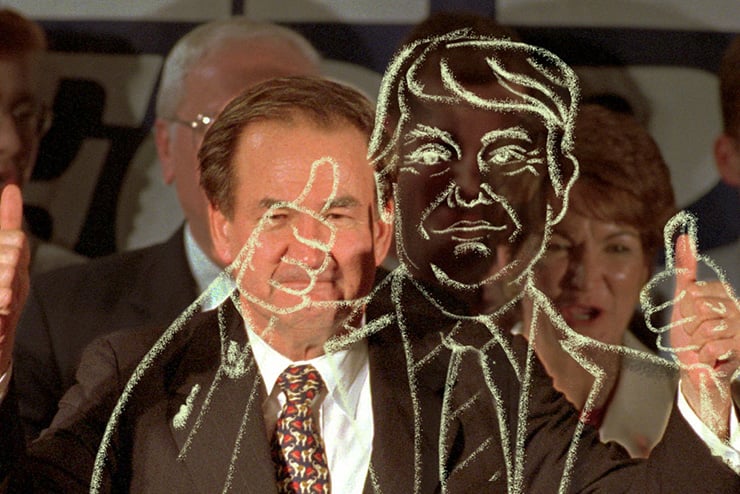
Ronald Reagan’s old “three-legged stool” model of the conservative movement is giving way to Trump’s conception of a movement united by economic nationalism, immigration restriction, and halting the advance of cultural leftism.
Donald Trump is the first leader since the end of the Cold War to move American politics to the right. Newt Gingrich and the Republicans who won control of Congress in the 1994 midterm elections delivered some signal policy victories for conservatives, notably in the shape of welfare reform. Yet in that same era, the GOP converged with Bill Clinton’s Democratic Party in a bipartisan (or simply uniparty) embrace of globalism. The vaunted “three-legged stool” that movement conservatives began to invoke as a symbol of ideological orthodoxy significantly did not include immigration restriction as one of its legs, while “a strong national defense,” for them meant the opposite of national defense—it meant unending international obligations and foreign wars, which only made America poorer and weaker.
The three-legged stool was, in fact, created to stop a leader like Trump from emerging. More than a decade before the fall of the Berlin Wall, a populist “New Right” had already begun to challenge the conservative movement that had been built around figures like William F. Buckley, Jr. and Barry Goldwater in the 1950s and ’60s. The Christian component of the New Right, known as the “religious right,” recognized early on that Goldwater and his brand of conservatism were not going to be reliable allies in a fight to overturn Roe v. Wade or to check the gay-rights movement. A new generation of hot-blooded Cold Warriors, meanwhile, saw Buckley as a former ally of Joseph McCarthy who had traded his right-wing bona fides for a friendship with Henry Kissinger and respectable standing with fellow members of the Council on Foreign Relations. The New Right of the 1970s was anti-Communist with a distinctly nationalist twist, which came through in debates over whether America should keep control of the Panama Canal. Buckley sided with the Jimmy Carter administration against the New Right on the Panama question—a question that Trump, tellingly, has now reopened.
Asserting a devotion to “a strong national defense” and “traditional family values” would become a way for the conservative movement to paper over its cracks. But the third leg of the stool, involving the “free enterprise system,” was an enforcement mechanism. New Right theorists like Kevin Phillips and activists like Heritage Foundation co-founder Paul Weyrich had already begun in the late 1970s and early 1980s to question conservatism’s relationship to corporations, the rich, and capitalism itself. There were, after all, great reservoirs of nationalist and anti-leftist sentiment among the American working class, while big business, in the pursuit of profit, often adopted practices and sold products that harmed families and undermined morality. Before the New Right of the 21st century began to doubt whether it should be allied with the “tech right,” the New Right of the 1980s and 1990s was asking whether it made sense for conservatives to be more solicitous of Walmart’s interests than the Teamsters’.
Three things worked to keep the Reagan-era New Right aligned with free-market conservatives, however. The rise of a new grassroots anti-tax movement, galvanized by the campaign for Proposition 13 in California—a tax-limiting amendment to the state’s constitution—was a populist phenomenon with obvious appeal to supporters of free markets and smaller government. Simultaneously, unorthodox policy thinkers conceived of “supply-side economics,” which would largely sideline traditional small-government conservative concerns about federal deficits in favor of generous tax cuts to promote economic growth. The third bridge between the New Right and free-market types was Ronald Reagan himself, who was beloved by both sides for their own reasons. Reagan had opposed the turnover of the Panama Canal. He regretted his past support for abortion and appeared to be the champion that the religious right had been hoping for. And he was a supply-sider, a tax-slasher, and a firm believer in the market economy.
But what would happen after Reagan’s two terms were up? Would another Republican be able to keep the New Right and Buckley-Goldwater conservatives together?
As the 1988 Republican presidential primaries approached, tremors could already be felt along the fault line. Pat Buchanan considered running against George H. W. Bush that year but decided against it. Jack Kemp, heir apparent to the leadership of the supply-siders, did challenge Bush—and showed by his poor performance just how electorally feeble free-market “sunny-side up” conservatism would be on its own. A Bush challenger who went much further that year was the paladin of the religious right, Pat Robertson, running on an agenda defined by social conservatism. Bush, however, was Reagan’s vice president, and in the last days of the Cold War his experience in foreign policy afforded him an advantage over Kemp or Robertson.
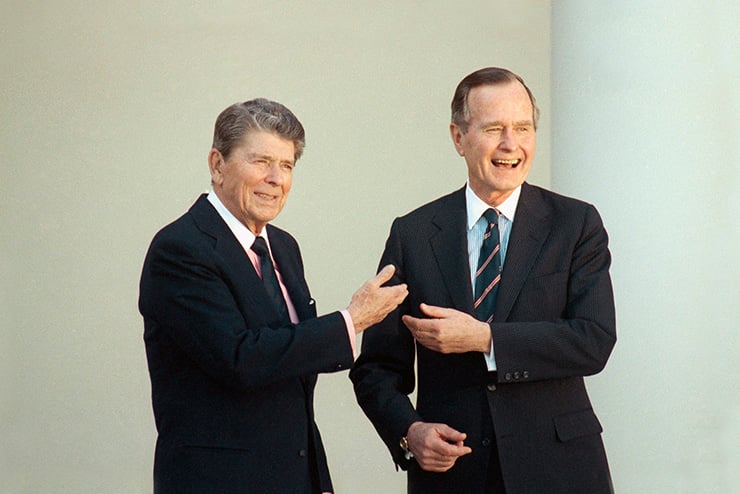
And then in 1989, the Berlin Wall came down. Suddenly, the conservative movement—which by this time was almost indistinguishable from the Republican establishment, thanks to the conjunctive effects of the Reagan and Bush administrations—was threatened by a divide over foreign policy even more serious than the cracks that were showing in economics. The nationalist and internationalist factions of the conservative coalition had been united, if sometimes uneasily, in their anti-Communism. Now nationalism would mean America first, while the internationalists, without the threat of the Soviet Union to contain them, would be free to indulge in a positively activist foreign policy: expanding NATO, promoting “democracy,” policing the Middle East (and everywhere else), and ultimately undertaking “regime change” and “nation-building” whenever the opportunity was available.
George H. W. Bush, who had betrayed anti-tax populists by raising taxes and never won the trust—let alone love—of social conservatives, now committed his administration, and by extension the GOP and movement conservatism, to an open-ended internationalism. The implications of this for a “strong national defense” were obvious, but the collapse of the Soviet empire also changed the relationship between the “market economy” leg of the stool and foreign policy. Richard Nixon’s engagement with Communist China, the beginning of the intimate economic relationship between China and America that has reshaped our economy over the last half-century, was a Cold War maneuver that succeeded. There was a Cold War dimension to President Reagan’s thinking about free-trade agreements as well. But after 1991, was there any reason for conservatives to support expanding trade with China or agreements like NAFTA with anyone?
Just as the disappearance of the Soviet impediment unleashed a new interventionism in Washington, the new international order made the creation of a global market possible. With George H. W. Bush defining a “strong national defense” in globalist terms, it’s hardly surprising that the conservative movement increasingly conceived of a “market economy” in the same terms. But a truly free global market would mean the movement not only of capital and consumer goods across national borders, but the movement of people as well—a globally integrated labor market, with jobs and workers freely passing from one land to another. Not one, but two legs of the Republican “stool” were props for globalism and reinforced each other.
As for the third leg, “family values,” there were two ways to keep it attached. One was to frame globalism as the essence of 21st-century Christianity. If Westerners were losing its religion, China, Africa, and Latin America would restore the faith. In the case of Latin America, the argument meant telling Catholics that obviously they should welcome more of their co-religionists as immigrants to the United States. For Protestants, the message morphed into reassurances that Catholicism was losing ground to charismatic Christianity in Latin America and that immigrants to the U.S. would soon become evangelicals. The other way to keep the Christian right on board with economic globalism and a planetwide conception of “national defense” was to play up the holiness of Israel and the desire of Muslims for Western-style liberty; and in general, to cultivate millenarian and Manichean attitudes on the religious right.
Pat Buchanan finally did challenge George H. W. Bush in 1992, and thereafter he continued to offer a populist, economically nationalist, and noninterventionist alternative to the institutional conservative movement’s “three-legged stool.” Movement gatekeepers used the stool’s ideological formula to read Buchanan and his supporters out of the conservative coalition. Tariffs had been a feature of American capitalism all the way back to the Founding, but voters who trusted the conservative movement were told that Buchanan had sinned against the leg of the “free-market economy.” And because he was preoccupied with this nation’s defense, rather than defending other countries’ borders and seeking out monsters to slay abroad, he was an apostate to the gospel of “strong national defense.” And weren’t Buchanan’s restrictionist immigration policies and his opposition to exporting American values a sign that he wasn’t Christian enough, for all his culture-war rhetoric? National Review writer David French, not Pat Buchanan, was the movement’s idea of a values conservative.
Buchanan’s friends and admirers, like the man himself, were not surprised when the conservative stool collapsed under the weight of Republican globalism. George W. Bush’s foreign policy delivered anything but a “strong national defense”—his administration failed to protect America on 9/11, turned what should have been a punitive hit on al-Qaeda into a 20-year occupation of Afghanistan that ended with the return of Islamists to power, and invaded Iraq on specious pretexts and with appalling results.
The experience of the global “market economy,” meanwhile, turned a generation of Americans toward the socialism of Bernie Sanders and Zohran Mamdani. The only lesson most economists derived from the Great Recession at the end of the Bush years was that our financial institutions are “too big to fail” and need the occasional half-trillion-dollar bailout.
As for those “traditional family values,” the elite liberalism that globalist conservatives did so much to empower at “the end of history” simply redefined “family” to include same-sex marriage, “polycules,” and pets. Global market integration and an imperial (not to say Orwellian) definition of “national defense” advanced for some 25 years, while social conservatism did not. Never in that quarter-century did the conservative movement rethink its stool.
The stool worked—it didn’t make our national defense strong or maintain the traditional family, nor did it defeat big government. But it did keep the right in check, so successfully in fact that today’s “New Right” has virtually no knowledge of the earlier, Buchananite New Right.
That’s because the stool worked—it didn’t make our national defense strong or maintain the traditional family, nor did it defeat big government. But it did keep the right in check, so successfully in fact that today’s “New Right” has virtually no knowledge of the earlier New Right of the 1970s and ’80s. When Trump launched his 2016 presidential campaign on themes that included restricting immigration, getting out of NAFTA, and not getting into more wars like those in Iraq and Afghanistan, the conservative movement hit him with the stool. But by then it was too rotted and splintered after two decades’ wear to knock out the populist intruder.
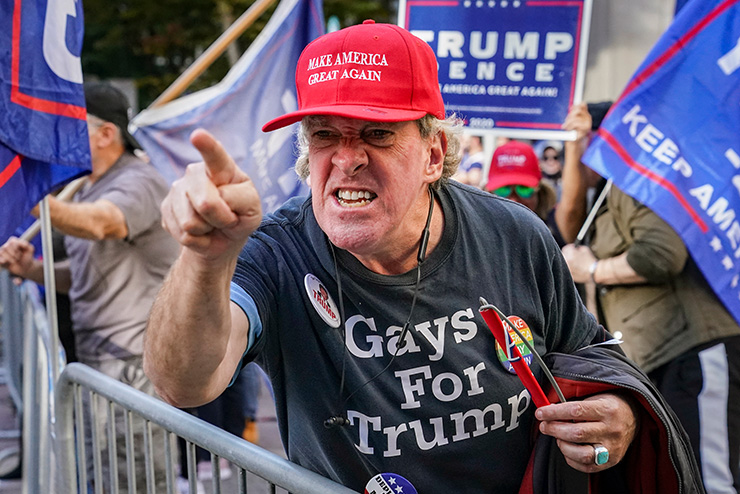
Trump has built his coalition on nationalist legs—economic nationalism, immigration restriction, and a foreign policy that prioritizes the nation-state in war and peace alike. His stool is four-legged, however, with social conservatives lending it further stability. Trump is less hypocritical than the “family values” Republicans of old, however: he hasn’t promised a restoration of what’s “traditional,” but he has fought more effectively against the present vanguard of radicalism—transgender ideology—than the family-values Republicans ever did against the redefinition of marriage.
A critical difference lies in Trump’s unwillingness to defer to judges: when voters again and again defeated same-sex marriage in referenda, judges overruled their votes, and the movement conservatives acquiesced. Trump’s indelicate view of the Supreme Court has also delivered Christian conservatives the victory that always eluded them before—the end of Roe.
What’s worth saving about the old movement conservatism must now be integrated into the legs of Trump’s populist seat, for example, by showing how free-market economics can serve economic nationalism and need not lead to globalism.
What’s worth saving about the old movement conservatism must now be integrated into the legs of Trump’s populist seat, for example, by showing how free-market economics can serve economic nationalism and need not lead to globalism. The legs of the new system are not all equally firm, with “national” defense still involving hard choices about how to cultivate an international strategic environment favorable to America’s interests.
For now, it suffices that Trump and the MAGA movement are opposed to follies on the scale of both Bushes’ wars. Immigration restriction is perhaps now as unifying a priority as fighting Communism was during the Cold War. But where values are concerned, there is a tension between those who are content to prevent further erosion of traditional morality and those who yearn to see it restored. Many New Right intellectuals, or at least “influencers,” say they will settle for nothing less than restoration. Voters, and Trump, seem to be satisfied if the radical left goes no further.
The old three-legged stool wasn’t something Reagan devised. Conservatives of the Cold War era recognized a tension between libertarian and traditionalist tendencies on the right, but they did not need to enforce an orthodoxy of free-market, anti-Communist, and family-values platitudes. Conservatives had real intramural debates from the days of Joe McCarthy to the time Reagan left office. It was only afterward that the movement, sensitive to its weaknesses, tried to force the right to sit on its dunce’s stool. Today’s right is stronger and must argue about strategy and principles honestly, if its new legs are to hold up the nation.
Leave a Reply