
Reagan, Trump, and the Art of Political Seduction
Men may construe things after their fashion,
Clean from the purpose of the things themselves.
–Cicero, in Act I of Shakespeare’s Julius Caesar
If an ambitious, persuasive man’s personal constructs are convincingly projected onto external reality, he greatly increases his chances to seize the day, for ends good or evil. Think Caesar in 49 B.C., Napoleon in 1799, Hitler in 1933. Think Reagan in the 1980s and Trump in our own time.
Ronald Reagan presented his vision “after his fashion” indeed, promising an era of renewal, of restoration of values which harked back to his own romanticized childhood. He did it with flair, and it resonated. The longing for order after Watergate and the strain of almost two decades of relentless cultural revolutions at home paved the way for his two impressive electoral victories. As for abroad, he vowed to overcome America’s post-Vietnam malaise and the sense of weakness under Carter. His “Morning in America” would shine brighter still with lower taxes and fiscal responsibility.
The result was Reagan’s Stool. Its first leg was composed of social and cultural conservatives, comprising primarily the Christian Right, white working class, and paleocons. The second leg was made up of national security conservatives, made up of two mutually hostile groups: socially conservative anti-Communists and the military industrial/neoconservative alliance. Fiscal conservatives, laissez-faire capitalists, and right-libertarians made up the third leg, arguably the weakest one.
The Stool worked well for about a decade. It did not work as the foundation for a radical reduction of the administrative state, alas, but primarily as the Republican Party’s mechanism of winning elections. At the end of his two terms, Reagan’s actual record of delivering to these three core constituencies was unsatisfactory.
The social and cultural appeal to an American ethnic (i.e., white) demographic core, based on the sense that the revolutions of the previous 15 years had veered out of control, drew to Reagan’s camp two large, traditionally Democratic constituencies. They were northern, urban working-class whites, largely Roman Catholic “ethnics,” many of them labor union members; and Southern working-class whites, overwhelmingly Protestant.
The former went for Richard Nixon in 1968 and 1972, but many returned to their roots and voted for Jimmy Carter in 1976. They became the core of the “Reagan Democrats” in 1980, however, and hardly ever looked back.
The latter supported a Republican, Barry Goldwater, for the first time in 1964. They opted for George Wallace in 1968, then voted en masse for Nixon in 1972. They backslid for Carter in 1976, but once they went for Reagan in 1980, they never looked back. By that time, party identification in the states that were part of the Old Confederacy had become increasingly contingent on race.
Reagan delivered for this blue-collar constituency in word, but not in deed. His nostalgic image of an America anchored in old moral certitudes was attractive to “Reagan Democrats,” but his two terms in office did very little to advance their social, cultural, or economic interests and concerns.
On abortion, of the four Supreme Court justices Reagan appointed, one was not approved (Robert Bork), one voted to uphold Roe v. Wade (Anthony Kennedy in 1992), and one belonged to the enemy camp (Sandra Day O’Connor). On reverse discrimination, he said he opposed “quotas,” but his administration went beyond the call of duty in its enforcement of existing affirmative action mandates. On demographics, in 1986 he granted blanket amnesty to more than 3 million illegal aliens. On working-class economic security, Reagan delivered free trade policies and presided over the financialization of the economy, with increasing dominance of the financial sector at the expense of blue-collar jobs.
As for the second leg of the stool, national security conservatives initially fell into two sub-camps, old-school (“ideological”) anti-Communists and Eisenhower’s military-industrial complex (MIC). In the late 1970s and early 1980s, the latter forged an alliance with the neoconservatives. The neoconservatives were, for the most part, former Trotskyites who understood that painting a permanently apocalyptic picture of the outside world and advocating global U.S. hegemony would bring in lavish federal grants. This unholy alliance demanded, and got, a substantial increase in military spending under Reagan.
Reagan delivered rhetorically for the paleo anti-Communists, labeling the Soviet Union “Evil Empire” and calling on the Soviet leader to “tear down this wall.” He delivered materially for the MIC/neocon axis with greatly increased defense budgets, which benefited but a small percentage of industrial workers amid the overall deindustrialization of the economy.

Ronald Reagan was no neoconservative, however. He did appoint neocon zealots like Elliott Abrams and Bill Bennett to senior positions in his administration, but at the same time, he was committed to arms control and summit diplomacy, and he was reluctant to use military force in pursuit of foreign policy goals. As a result, an unhappy Norman Podhoretz (an arch-neocon and editor of Commentary) in 1982 accused Reagan of “following a strategy of helping the Soviet Union stabilize its empire,” instead of “encouraging the breakdown of that empire from within.” (This is arguably the most inane quote in the history of American punditry.)
Reagan’s three military interventions—Grenada, Lebanon, and Libya—were limited in scope and short in duration, with little or no potential for escalation. His support for anti-Communist forces in Afghanistan and Central America projected a sense that America’s post-Vietnam malaise was over. His personal relationship with Mikhail Gorbachev, coupled with the Soviet elites’ rapid loss of nerve, paved the way for the end of the first Cold War under his successor, George H. W. Bush.
National security conservatives were naturally pleased with Reagan. To this day, GOP stalwarts are obliged to invoke him at least once in every major speech on foreign affairs. Neoconservatives have been trying ever since (mendaciously, as is their wont) to attach a Reagan bumper sticker to their Panzerwagens. On balance, America’s 40th president was a realist, driven by the belief that America is, or should be, an example to others; but that she is not, and must not, become a globally crusading hegemon imposing its writ on faraway peoples.
The deepest gap between Reagan’s promises and his eight-year record relates to fiscal discipline. Reaganomics rested on tax cuts to stimulate growth and thus bring in more revenue and on reduced domestic spending. Total federal revenue did double between 1980 and 1990, from half a trillion to just over a trillion dollars. However, to get his tax and military priorities enacted by the perennially Democrat-controlled House of Representatives, Reagan had to back off on domestic cuts. Spending on entitlement programs subsequently rose by 84 percent between 1980 and 1987. Other domestic programs also grew by double digits. The result was that under Reagan, the national debt nearly tripled, from $1 trillion in 1981 to just under $3 trillion in 1989.
Trump’s base rests on broadly similar constituencies as Reagan’s, though they do not carry the same weight now that the demographic results of the 1965 Immigration Act are much more evident. In 1980, whites constituted around 80 percent of all U.S. residents. In 2024, they accounted for 58 percent, and are projected to drop below 50 percent by the middle of this century.
Trump is not a social or cultural conservative. His distinctive blend of often offensive language and behavior, coupled with an assertive disdain for “elite” institutions, nevertheless has a strong emotional appeal to the heirs of the Reagan Democrats. As with Reagan, his actual delivery on social and cultural issues to this constituency has been a mixed bag. He has appointed Supreme Court justices who overturned Roe v. Wade, but he has repeatedly changed positions on abortion and declared that he would veto a federal ban. He has reined in some DEI excesses while maintaining an overall LGBTQ-friendly posture. His positions and policies on these issues are determined by expediency.
Trump is not a social or cultural conservative. His distinctive blend of often offensive language and behavior, coupled with an assertive disdain for “elite” institutions, nevertheless has a strong emotional appeal to the heirs of the Reagan Democrats. As with Reagan, his actual delivery on social and cultural issues to this constituency has been a mixed bag.
On immigration, Trump’s promised wall on the southern border did not get built in his first term, and it is uncertain whether it will be built in the second. He declared during the campaign that there would be mass deportations of illegals, but a likely estimate of 300,000 ICE deportations in his first year is far short of the target of 1 million, he heralded, and well below the record set in 2012 with 410,000 removals.
The administration and its advocates claim the illegal population has nevertheless declined by 1 million largely due to self-deportations. Even if that figure is correct, it cannot be maintained for long because all those willing to take that path will soon be gone. As for the remaining 14 million or so illegals, it would take 47 years to remove them at the current rate of ICE deportations. Trump’s score is arguably as positive as can be expected—considering that Democratic district judges have relentlessly blocked any attempt to deport what they see as future Democratic voters—but the Great Replacement has not been reversed.
None of the above mattered much to the solidity of Trump’s base, however, before the Epstein affair suddenly re-erupted on July 7. On that day, MAGA loyalists who had accepted Trump’s campaign assurances that he would open “the files” were suddenly told that there was nothing in them—no suicide foul play, no blackmail “client list.” Trump even told his “former supporters” that they should move on from the Epstein “hoax” and that if they did not do so he did not want their support anymore. His response was driven by the simple expectation that his faithful would forget it and move on. Several polls in August indicated, however, that more than a third of Republicans disapprove of how he handled the Epstein case.
That was a very rude awakening for millions of people, in whose minds Trump had acquired the status of a messianic leader who can do no wrong. The base reacted with incredulity, followed by anger. Trump had tried a barrage of distractions, but for once his nothing-to-see-here-but-look-over-there! tactics were not working. His response to the crisis was driven by no clear strategy other than an irrational expectation that his faithful, and the nation, would forget it and move on.
Trump has complained that the affair had pushed his allegedly successful handling of the economy into the background, but the overall picture is far from idyllic. In the absence of a plan to encourage domestic production, or to start national infrastructure revitalization—which was promised but not delivered in the first term, and is still unmentioned in his second—Trump’s tariffs alone cannot kick-start the revival of American manufacturing. No prudent CEO will make major long-term investments in U.S. manufacturing based on this administration’s transient policies.
With the enactment of the Big, Beautiful Bill, all pretense that federal spending or the national debt can be brought under control was gone. It was, above all, a big tax-cut bill that could have come from the old-guard GOP. The Congressional Budget Office estimated in August that the bill will add $4.1 trillion to the national debt (a figure that includes increased interest costs) over the next decade. That will keep the budget deficit above 6.5 percent of gross domestic product effectively forever, and raise the debt-to-GDP ratio to an enormous 125 percent nine years from now. It will probably mean more expensive mortgages and falling house prices, with little to show for it.
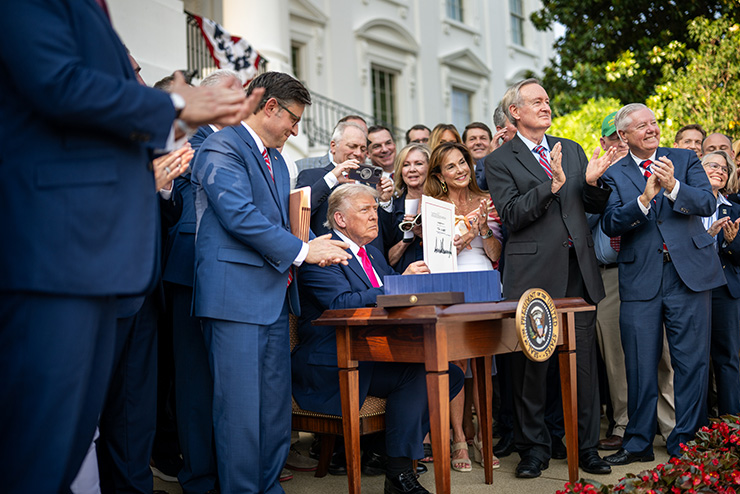
on Friday, July 4, 2025, during the Fourth of July picnic. (Daniel Torok / White House)
The bill was clearly detrimental to Trump’s blue-collar base and his rural supporters. Mid-summer polls indicated that just 38 percent of Americans approved of Trump’s handling of the economy. With the construction, manufacturing, and transportation sectors effectively in recession, the U.S. economy is propped up by only one industry: Big Tech. As for the deficits, Trump will likely continue kicking the can down the road and hoping the day of reckoning will come after he’s gone.
Trump’s foreign and national security policy is a disappointment to millions who voted for him primarily because he promised to be an anti-war president. “We will measure our success not only by the battles we win, but also by the wars that we end, and perhaps most importantly, the wars we never get into,” he pledged during his second inauguration speech.
Whatever congruence of outlook existed during Reagan’s time between ideological “America Firsters” and “defense hawks” is long gone. Trump rhetorically appealed to the former with his “no more new wars” promises. At the same time, he promptly let the hawks—representing the old alliance of neoconservatives and MIC watercarriers—dictate his agenda, to the nation’s detriment.
The writing was on the wall even before the inauguration. As I wrote in these pages eight months ago (“We Were Right About Foreign Policy,” January 2025), one of the pillars of Trump’s 2024 campaign was the promise that he would end the war between Russia and Ukraine, but his newly appointed team—packed with neocon Trojan horses—have done their best to prolong that war indefinitely. At the same time, I warned, Trump’s team was already considering airstrikes to stop Iran from developing nuclear weapons:
With the neoconservative takeover of the transition team, it is becoming somewhat clearer why Trump was allowed to win… The contours seem clear: Trump has given in to the deep state on foreign policy strategy and he will accept the narrowest possible range of global options prepared for him… [I]t would be more than desirable for America to come home… cured of the psychotic ideas of exceptionalism, messianism, and the global-hegemonic “primacy” obsessions of its ruling class. We know now that this will not happen anytime soon, certainly not in the next four years.
This assessment has been validated by events. Instead of passing the Ukraine hot potato to “our NATO partners” and walking away, Trump has become deeply entangled in it. After the summit with Putin, it is yet to be seen whether he is a bold peacemaker who will tell the Europeans—in no uncertain terms—that he does not own this war and that if they insist on continuing it, they will be on their own.
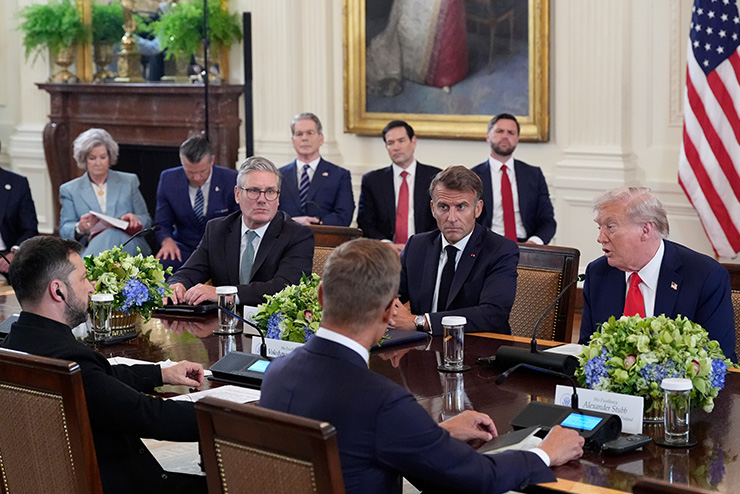
Trump has tied himself more tightly to Israeli interests than any of his recent predecessors. He has used force in Iran in support of distinctly Israeli military-strategic objectives. The relationship is anomalous and historically unprecedented. The equivalent of Reagan’s sharp condemnation of Israel’s 1981 “preventive strike” on the Iraqi nuclear reactor at Osirak is literally unthinkable today. Trump is unable or unwilling to entertain the possibility that Israel’s strategic objectives may be at odds with American geopolitical interests, partly because he does not appear to have a coherent understanding of those interests.
On all fronts, domestic and foreign, Trump is effectively redefining what it means to “Make America Great Again.” In his reelection campaign, he had turned the catchy MAGA slogan into his own version of the “three-legged stool” based on three key tenets: ending wars and entanglements abroad, ending the cultural leftist “weird stuff” at home, and ending the immigrant deluge. All three clearly implied a long struggle against the deep state. Trump’s voters believed that in his first term, his hands were tied, but that this time he would be unleashed. His record so far is mixed on two of the three legs, and on foreign affairs, it is underwhelming.
Ronald Reagan won the support of so many Americans not because he put into words some complex ideas about what the United States ought to be, but because his countrymen liked his image of what “true” America is—and because they trusted his personal integrity. During his eight years in office, he was perceived as remaining loyal to that image even when he fell seriously short of applying specific policies based upon it. Reagan failed to deliver a lot, but thanks to his near-magic ability to avoid blame, he was forgiven. Even his political foes could not help liking him.
Trump, by contrast, is a man without fundamental principles. This was an advantage in attracting support from individuals and groups of very different backgrounds and with very different, often incompatible expectations. He was happy to let them believe that he would grant their wishes, that MAGA was a broad church and its high priest a miracle worker. He is also willing to overlook their concerns equally when he considers it necessary.
It is tempting but perhaps too facile to conclude with a wry smile that Trump is just another president, and to complain that he is turning millions of deplorables into embittered cynics. In reality, it is debatable to what extent he is an independent political actor, considering the extent to which the American left runs the country’s organs of power within public administration, the education system, and the media.
The horrid possibility remains, of course, that Trump’s administration is but a temporary lapse in the Gramscian march through the institutions of totalitarian woke globalists, which will resume with a vengeance in 2029. Whether he will be able to prevent that, and thus to accomplish much more to rein in the forces of darkness than Reagan did two generations ago, is still unclear. The jury is out. The verdict won’t be known until the end of this decade.
Leave a Reply