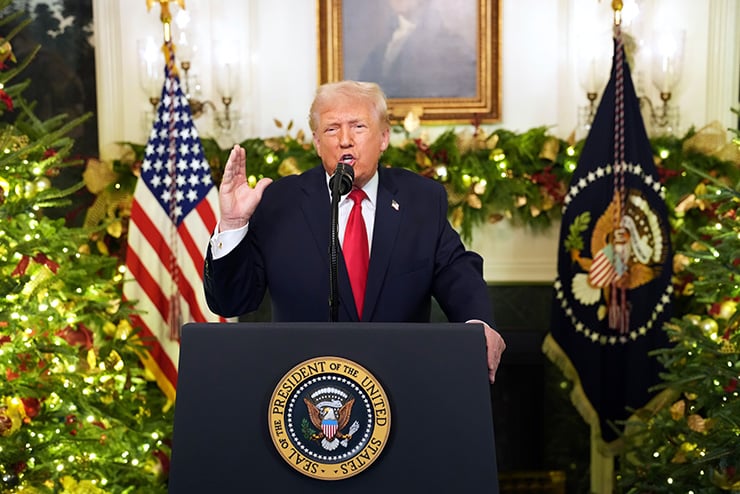
President Trump delivers on promises and spurs expectations.
Donald Trump’s first year of his second White House term scrapped all previous expectations of what’s possible for an American president. I didn’t think he would do many of the radical things he’s done so far, such as pardoning the J6ers, instituting a dramatic tariff regime, and granting refugee status to Afrikaners. The second term is certainly no repeat of Trump’s listless first tenure. In fact, it makes his previous four years in office look like a failure by comparison.
Trump has shown much greater zeal in delivering progress on immigration, anti-wokeness, and trade than he ever did in the 2010s. There have been serious gains in right-wing policy in just the first year.
However, not everything has been perfect. The economy is sluggish. Trump, at times, veers from his America First message to suggest support for mass immigration and other suspect causes, dampening his base’s enthusiasm. The president has also been hit with scandals, such as the furor over the Epstein files, which has distracted from his administration’s priorities. His foreign policy, while an improvement over Joe Biden’s, has left much to be desired.
That said, the second Trump administration has been the best presidential administration in my lifetime—and we’re only one year in.
It’s necessary to highlight where Trump has been successful and where he could improve. There’s a good chance President Trump can put America back on the right path. He just needs to stay focused on what matters and not get swept up by the torrent of social-media buffoonery.

Immigration is one of the areas where the Trump administration has been most effective, in spite of some of the president’s bizarre statements defending H-1B worker visas and student visas for Chinese nationals.
Further illegal immigration has been effectively shut down. The first year of Trump’s administration has witnessed border crossings reach historic lows. The fiscal year of 2025 witnessed the lowest number of border apprehensions since 1970. The numbers are even lower when excluding Biden’s final months in office. As Breitbart reports:
In the nine months of President Donald Trump’s second administration (January 21 through October 31), agents apprehended a total of 106,134 illegal aliens. This is less than the single-month average of the Biden-era border crisis, when agents encountered an average of 155,485 illegal aliens per month, officials stated.
Unlike with Biden, nearly all illegals encountered at the border are detained and slated for deportation. From April to October, not a single apprehended migrant was released into the country. If these figures hold steady for the next three years, we may finally demonstrate control over our borders and stop illegal immigration.
Obviously, preventing further illegal immigration is only part of the equation. Trump promised mass deportations when he campaigned for office. It’s debatable whether the deportation numbers meet those expectations. By the end of October, the Department of Homeland Security claimed it had deported 527,000 illegals from the country. That’s significantly more than were deported in the fiscal year 2024 (271,000), but it falls short of MAGA’s expectations.
High-profile raids and transferring the worst illegals to an El Salvador supermax prison did, however, convince a large number of migrants to self-deport. DHS reports that at least 1.6 million migrants have left of their own accord. The U.S. immigrant population significantly decreased in 2025 for the first time in 50 years. That’s a notable achievement.
The White House also made it harder for migrants to come here legally. It instituted visa restrictions, imposed fees to make migration more expensive, applied greater scrutiny to migrant applications, reinstated the public charge rule to block welfare-dependent immigrants from obtaining green cards, and significantly raised the standards for obtaining a visa through the diversity lottery. The administration placed strict restrictions on gaining asylum, which was widely abused under Biden. The White House has revoked “temporary protected status” for hundreds of thousands of migrants. Refugee admissions have been cut to historic lows. Even H-1B visas, which Trump at times has said are necessary, are now harder to obtain thanks to new, steep fees and tougher rules. Student visas, another area Trump sometimes sounds shaky on, are also subject to greater scrutiny and fewer are
being granted.
The president pledged to pause third-world immigration in response to a deadly shooting committed by an Afghan migrant against National Guardsmen. His administration subsequently expanded the travel ban to additional countries, paused all immigration applications from those countries, promised a thorough review of all previously admitted Afghan migrants, halted the asylum process, and restricted work permits for foreigners.
Trump’s offer of refugee status to Afrikaners is a complete reversal of 60 years of American immigration policy—which now overwhelmingly favors white migrants. Trump’s advocacy for the Afrikaner cause is one of the highlights of his administration, because it was once thought impossible. Merely suggesting that the Afrikaners might be subject to racist persecution at the hands of South Africa’s black majority was deemed racist in itself. Trump faced such accusations when he noticed the problem in his first administration, but in his second administration he put his words into action.
Naturally, there was much shrieking in the mainstream media, but it didn’t dissuade the administration. Trump focused the world’s attention on South Africa’s anti-white racism. His White House meeting with the country’s president, Cyril Ramaphosa, focused primarily on the calls to take white property, public calls to “Kill the Boer,” and the horrifying farm murders directed against Afrikaners. No other recent president would’ve done such a thing.
President Trump declared “wokeness is dead” in his joint address to Congress last March. That was a bit presumptuous, as elements of woke are still apparent in American society. Corporations still celebrate Pride Month, and PBS still puts out documentaries calling the Founding Fathers “racist.”
Still, Trump has done a remarkable job as president in rolling back wokeness. The administration’s crusade against “Diversity, Equity, and Inclusion” has produced significant results. Trump signed executive orders that terminated all DEI offices and positions within the federal government, scrapped DEI-focused grants and contracts, pressured government contractors and corporations to eliminate DEI practices, and targeted DEI at universities. Several major companies and colleges have subsequently removed policies and positions devoted to diversity. The administration even encouraged its own employees to zealously enforce these new anti-DEI rules and report any hint of DEI’s continued practice to their superiors. Moreover, the administration now considers foreign nations that pursue policies like DEI to be violating human rights and will consider appropriate action against potential violators.
The administration is laser-focused on crippling affirmative action and anti-white discrimination. One of Trump’s most important executive orders revoked the 1965 Lyndon B. Johnson directive that helped establish affirmative action. Johnson mandated that federal contractors consider race and gender in their hiring practices, creating the framework for implementing quotas. Trump also issued new rules designed to eliminate “disparate impact” standards because they unfairly punish entities using neutral policies when the result delivers outcomes deemed bad for minorities. Honoring disparate impact standards suggests unequal results are inherently discriminatory, even if no discriminatory intent can be established.
By focusing on punishing those who continue to violate the spirit of meritocracy and discriminate against whites, the Trump administration is making the restoration of meritocracy possible. The Department of Justice has launched multiple investigations into and filed lawsuits against universities and companies that attempt to favor racial minorities in admissions and hiring.
Transgender promotion is one of the key tenets of wokeness. The White House pushed back against this in its first year. The president issued executive orders recognizing only two genders, banning trans individuals from the military, prohibiting federal money for sexual reassignment surgeries, mandating schools remove services advising students to transition, and banning trans athletes from women’s sports.
The administration also stands up to censorship and cancel culture. One of Trump’s first executive orders prohibited government officials from pressuring tech companies to censor “misinformation” and other views that the previous administration wanted to suppress. Several of the administration’s hires and nominations, such as DOGE staffer Marko Elez and State Department official Darren Beattie, endured attacks from online mobs after expressing politically incorrect views. Unlike in the first administration, where people like Beattie were fired for such offenses, the White House now stands by them. Many right-wingers have managed to gain prominent roles in the second Trump administration, in spite of complaints from the mainstream media that they’re too controversial to work in government.
Wokeness is still embedded within the culture and many of our prominent institutions. But Trump has done as much as any president can to curtail it.
Foreign policy proved to be one of Trump’s biggest challenges, and it is the one area where he’s not shown as much success as the MAGA movement would prefer.
To be sure, there have been high points. The administration defunded USAID, an agency primarily dedicated to spreading social liberalism around the world. Taxpayers now no longer need to fund DEI advancement in Serbia and LGBT activism in Guatemala. This is an agency most assumed would be a permanent part of the U.S. government. The new administration challenged that assumption by effectively ending it.
The Trump administration also makes a necessary stand against Europe’s attempts to suppress its right-wing nationalist parties. The censorship practiced by the continent’s governments is regularly denounced and challenged by administration officials. Vice President JD Vance called out attempts by the German government to ban the Alternative for Germany Party (AfD) as an affront to democratic values. American pressure may be the only reason the German government stopped short of banning the AfD outright and settled for labeling it as “extremist.” Moreover, in a complete reversal of previous U.S. policy, the Trump administration is now encouraging Europe to restrict immigration.
It’s good that our government now wants Europe to have better policies. However, Trump has had a harder time dealing with two of America’s most pressing foreign concerns: Israel and Ukraine.
Trump did broker a long-sought ceasefire between Israel and Hamas in the Gaza War. That’s more than Biden achieved. Whether it will lead to a long-term peace remains to be seen. Other than this one major achievement, Trump has been unable to control events in the Middle East. Israel has been eager to expand conflict with its regional rivals since Trump has been in office, launching a bombing campaign against Iran in June. While urging Israel to scale back and show restraint, Trump also allowed the U.S. to join in the bombing. Israel has also bombed the new Syrian government, which America supports, on dubious grounds. Israel continues to entertain the annexation of Gaza and the West Bank, even though the administration fully opposes these reckless actions. On top of all this, the administration, in spite of its support for free speech, is eager to go after “anti-Semitism” on American college campuses out of loyalty to Israel.
If a permanent peace deal is reached over Gaza, it will mark a high point for Trump’s presidency. But he’s so far struggled in this region.
The same goes for trying to achieve peace in Ukraine. Unlike Biden, Trump shows a serious commitment to ending that war on terms agreeable to both parties. The previous administration was more committed to undermining any attempts at peace. Trump, on the other hand, took the risk of meeting with Russian President Vladimir Putin and moving the process forward. So far, however, there has been no peace. Trump has increased American involvement on the Ukrainian side as part of his attempts to convince Putin to end the war. While America has drawn up a peace deal, it’s unclear at the time of this writing whether it will be accepted. The continuation of the war after he’s been in office for a year is a mark against Trump. But at least the president has tried to end it.
While Trump campaigned as a realist opposed to reckless foreign interventions, his administration has entertained military interventions in Venezuela and Nigeria. Venezuela is a clear problem for the U.S. The Maduro regime was happy to push its criminals and other undesirables into our country. The socialist government hates the U.S. and works with our geopolitical foes. It’s understandable that America would prefer to deal with someone other than Maduro. But a military intervention, which the administration is considering, would likely destabilize the region and intensify the ongoing migrant crisis.
Intervening in Nigeria makes even less sense. The African country became a center of focus for conservatives after neoconservatives began highlighting the persecution of Christians there to distract from the Gaza War. Fox News eventually covered it, which persuaded Trump to threaten military action. There is no worse idea than getting America bogged down in an African quagmire.
It’s not likely that Trump will intervene in either country. But the fact that interventions are even being considered should concern those who want him to put America first.
The economy is one of the chief problems for Trump’s second term. In his first term, the economy was booming, but the media convinced much of the public that Trump was a horrible, fascist dictator despite the prosperity. The media is in a much weaker position now, and cannot whip up the same levels of discontent against the president that it could in the 2010s—but an uncertain economic outlook and elevated prices are doing that work for them.
Much of this is due to long-term changes beyond Trump’s control, such as a declining birthrate, massive government debt, permanent effects wrought by COVID policies, the transition to AI causing job losses, inflation, and other causes. But Trump’s chief economic priority hasn’t helped matters, even if it is something many of his ardent supporters back. Trump’s tariff agenda represented a fulfillment of one of his core campaign promises. He’s championed economic nationalism for as long as he’s been a public figure. For decades, Trump has urged the country to impose high tariffs to counter foreign competitors. He campaigned on tariffs in all of his presidential bids. In 2025, he was finally able to do what he promised.
The problem is that his tariff regime has been constantly shifting and the benefits would only come after years of stability. Tariffs were pitched as a way to increase manufacturing jobs, but those benefits will only come as business owners are enticed to make new investments, which they are reluctant to do because of the uncertainty. Hiring has stalled as a result, and fewer jobs means greater public discontent. This is likely one of the factors animating growing criticism of the president from his own base, even though they still show support for Trump’s tariffs in polls.
The economic uncertainty caused by Trump’s tariff negotiations probably also explain his comments in favor of H-1Bs and student visas. Many of the nations with which he is negotiating insist on these forms of immigration as a quid pro quo. Trump, always the dealmaker, seems to be making a concession on immigration in order to advance trade deals that include tariffs. In this instance, he seems to care more about keeping out foreign goods than foreign nationals.
One of the other major problems for Trump has to do with how his administration has handled the controversy over Jeffrey Epstein. Many Trump officials, such as FBI Director Kash Patel, Deputy Director Dan Bongino, and Attorney General Pam Bondi, said they would release the Epstein files once they took the reins of power. Soon after assuming power, however, they changed course and tried to claim there were no files, provoking a backlash from the public and the MAGA movement. By the time they finally got around to releasing the documents concerning the convicted sex offender, the damage had already been done in terms of support for the administration among young men—a demographic that went strongly for Trump in 2024—and among many other supporters.
The administration only has itself to blame for this situation. It was foolish of Trump officials to make promises that couldn’t be delivered. The issue may eventually blow over as the files are released and the public moves on to other matters, forgetting about the whole thing in the process. But it still represents an unforced error for the administration.
Trump’s second administration is a success. We’ve never had a president try to end illegal immigration, sharply cut the number of unelected bureaucrats in D.C., eliminate affirmative action, and wipe out wokeness. President Trump has done all those things, and more. The president isn’t perfect, but he’s far better than Kamala Harris, Joe Biden, and the Republicans he defeated in 2016 and 2024. The first year of his second term proves that.
Leave a Reply