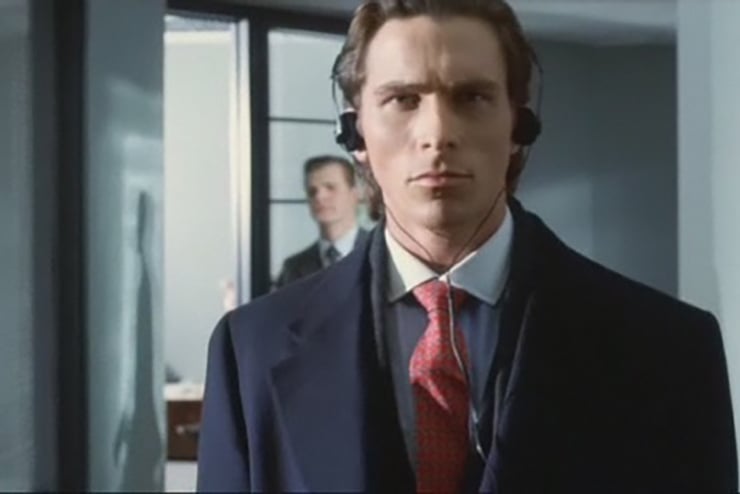
It’s been 25 years since the world first met Patrick Bateman, the inimitable villain of American Psycho. Intended as a feminist critique of masculinity and yuppie-era excess, director Mary Harron crafted a meticulous portrait of a wealthy Wall Street banker whose polished exterior masked the deranged killer within. Despite Harron’s clear intent to satirize, however, the film has been unironically embraced by the very men it sought to skewer.
To this day, Harron remains “mystified” by the popular misreading, expressing frustration in a recent interview over the failure of American men to see that she’s “very clearly making fun of them.” Yet it’s perfectly clear why the film didn’t land its intended punch. In Harron’s feminist worldview, masculinity stands at the root of all evil, so Bateman’s satirical excesses naturally coalesce in a murderous rage. For anyone who doesn’t share her particular resentments, however, Bateman stands as an aspirational archetype misaligned with his violent character arc. Consumed by her own hatred, Harron still fails to recognize that she didn’t satirize a villain but caricatured an ideal.
On the surface, Bateman (a perfectly cast Christian Bale) is everything a modern young man should, and often does, aspire to be: fit, handsome, conscientious, professionally successful, and engaged to a beautiful socialite (Reese Witherspoon). Yet his perfect life proves too much for him, and as the film unfolds, we see him crack under the pressure to both conform to societal expectations and exceed his peers in the most marginal ways. “There is no real me,” he tells us in an ode to conformity, “only an entity.”
This manifests in an almost pathological display of vanity. Bateman obsesses over big-name restaurant reservations, designer suits, and his extreme fitness and skincare routine, always with a nod to outdoing his equally vain colleagues. So, when he perceives his co-worker’s off-white business card to be superior to his own virtually identical card, his insecurity at this fact sets off the first of many murders. He stabs a homeless man, a decidedly inferior specimen, to regain control over and an escape from the anxiety, but ultimate banality, of clout-chasing masculine competition. It’s all “very, very gay,” Harron dismissively explained of her intent to frame this “extreme competition” between men.
Not content to simply lambast the extremes of the yuppie male ego, she goes even further, implying that the masculine ideal is nothing more than an illusion of the ego itself. Behind every alpha male is nothing more than a beta nerd.
In the infamous axe-murder scene—where Bateman finally gets his “revenge” against the colleague whose business card enraged him—he turns on the Huey Lewis anthem “Hip To Be Square” and expounds a theory of the song to his victim. If the song, itself a satire of yuppie conformity, means anything in the context of the film, it’s that people who excel in the realm of fashionable trends tend to be the biggest “squares” deep down. True to Harron’s intent, Bateman is “dorky and ridiculous,” which becomes painfully clear whenever the mask slips. His long-winded music criticism and cringe-worthy dance moves reflect a genuine affection for pop music—traits unfitting for a stoic alpha male. We see this vulnerability repeated through several enthusiastic monologues, followed by an equal number of gleeful kills.
At the end of the film, we’re left wondering if the murders really happened, or if they were all just the violent fantasies of a viciously repressed ego. The idea is that Bateman’s relentless will to dominate in terms of power, status, and ultimately violence—the age-old sins of the “patriarchy”—is but a coping mechanism for his insecure, nerdy, and probably gay self, which cannot be kept at bay forever. The murders, or ideations of murders, serve as an inevitable pressure relief valve to this false male consciousness.
If they’re real, his actions go unpunished; he’s lost forever in a sea of interchangeable Wall Street bros and the impunity of his own “male privilege.” If imagined, they expose the impotence of his ego, trapped in a cycle of unfulfilled desire. Whether he’s a murderer at the end or not makes no difference; either way, he’s lost his mind—a victim of the very culture he simultaneously rejects and clings to. And either way, Harron viciously resents him for it.
“I don’t think . . . I ever expected [the film] to be embraced by Wall Street bros, at all,” she explained. “That was not our intention. So, did we fail?”
Yes, Harron, with her cynical view of men, failed to see what normal people see: that Bateman and his social milieu don’t really deserve this scorn; that his existence is not so miserable as to engender such personal repression, murderous or not; and that there’s plenty of room for individuality within the masculine ideal, even if Harron can’t see it.
It’s undeniably cool to go to trendy, exclusive restaurants, where landing a reservation means you’re an insider. It’s pleasant to indulge in the finest of wares and have the resources necessary to do so. And it’s admirable to have the requisite sense of self-worth to care about one’s own appearance, let alone the willpower to maintain it. Sure, losing it over a business card simply reflects a level of extreme vanity that is counterproductive. But at his core, Bateman’s characteristics rightfully denote masculine status—in access, in wealth, in beauty, and all the innate qualities needed to get a man there in the first place. Since the beginning of time, humans have been hardwired to seek such goods. It is normal to want to be appealing and, from an evolutionary biology point of view, this makes perfect sense. Anyone who tells you otherwise isn’t just lying but seeking the same sort of privilege under a different structure that caters to their own, less impressive, characteristics.
The idea of this “extreme competition” is threatening to the anti-male feminist not only because she perceives it as a way to dominate the forces she believes lead to her oppression, but because she cannot relate to the structure it inhabits. Women, on average, are significantly less competitive than men. Where Harron sees violent cruelty and a will to dominate for its own sake, men see a drive to excel in physicality, to secure victory, to hone the necessary skills to become master of the self, as well as the universe. No matter how much activists litigate their way into the “boys club,” this natural drive remains outside of social control. They must then call it “gay,” aiming to delegitimize it on what they believe to be its own terms, selling the idea that masculinity can never be anything more than an illusion.
Instead of contradicting his alpha status, however, Bateman’s dorkiness serves as a kind of earnest counterbalance to it. Showing genuine interest in something, even something conventionally “dorky,” endears the character to the audience because it reflects the authenticity and vulnerability of a real person—a real man. Revealing your true self, unfiltered by societal expectations, signals one has confidence to be seen as a whole person, flaws and all. “You’re sweet,” a model tells Bateman outside a nightclub after he talks about music, awkwardly fumbling as he tries a little too hard to impress. Obviously, the film suggests this woman’s instincts are off, but in the real world, the opposite is more likely to be true. Far from an epic own of the fragile male ego, making Bateman a little bit dorky ended up making him even more appealing to both men and women. Indeed, all these years later, viewer scores of the character among women rate even higher than they do for men.
The feminist pulse of the film not only resents Bateman when he’s “toxic” but even when he’s not. The real outrage in life, according to women like Harron, is that men like Bateman exist at all. If the goal is to overthrow masculinity entirely, there’s no better propaganda than to frame evil as a logical corollary to good. Yet the film failed as propaganda for precisely this reason: Harron overplayed her hand, stretching a critique of excess machismo and socially destructive appetites to a scorching indictment of what normal people recognize as natural, even good, masculine aspirations. As the male ideal came increasingly under fire from an anti-male left over the ensuing decades, it’s no surprise that Bateman’s laudable traits and instincts simply overshadowed his villainy. Yet in its failure to tear down men, the film inadvertently pulled back the veil on feminism itself, revealing its own twisted and resentful lust for domination.
The end game of feminism is not equality between the sexes, but a new feminized hierarchy where its proponents and captains come out on top. And while feminism has made great strides toward this end since American Psycho debuted 25 years ago, I imagine Bateman would be quite pleased to know he wasn’t part of the reason why.
Leave a Reply