
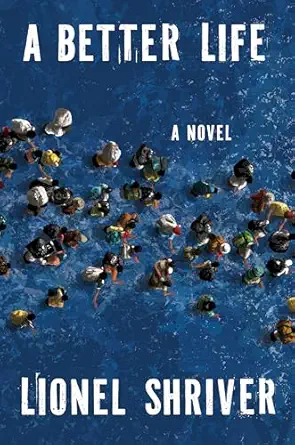
by Lionel Shriver
Harper
304 pps./ $20.20
In his 1987 novel The Bonfire of the Vanities, Tom Wolfe lampooned 1980s New York City—including its rampant street crime, self-important bond traders, race hustlers, biased media, and feckless elected officials—in a manner that was both scathing and funny. Lionel Shriver’s A Better Life gives the same mordant treatment to Brooklyn’s anti-ICE, open borders do-gooders. In the process, it exposes the overall softness, feminization, and vulnerability of blue America in the 2020s. The difference is, A Better Life is only funny in the way that dark comedy can sometimes be funny. The disturbing pathos Shriver deftly presents in the fictional household of the divorced Gloria Bonaventura and her 26-year-old unemployed son, Nico (who returned home four years earlier after completing his engineering studies at Fordham), presents a grim and disquieting morality tale, not a satire.
Just as the nation was overwhelmed by illegal alien invaders under Joe Biden, in A Better Life Brooklyn (and the upscale Bonaventura household, in particular,) comes under siege from Honduran “asylum seekers” attracted by a cornucopia of free stuff and “birthright citizenship” for their offspring. Many young white men in America, unaccustomed to struggle, have become passive, lazy, and celibate—devoid of drive and ambition. Females have surrendered to the suicidal empathy of raw emotion. TDS is ubiquitous. Male adults are strangely absent; the police are useless; estrogen and timidity prevail. Foreign-born immigrants hold Americans in disdain, and uber-macho Hispanic men are not afraid exploit their hosts’ gullibility and lack of resistance.
The characters—really, caricatures of certain easily-identified demographic types—are presented to powerful effect and illustrate the tragic consequences that can occur when gullible residents become victims of Democratic politicians’ supporting open borders policies, especially in “sanctuary” jurisdictions such as NYC. Gloria is depicted as a 62-year-old bleeding-heart liberal who compulsively mouths progressive platitudes. A Smith alum, Gloria is the “queen bee” of her book club, and dutifully volunteers to collect food and clothing for the masses of “migrants” being housed in NYC. She mindlessly laps up every morsel of Democratic propaganda spewed by the left-wing media.
Her ex-husband, a successful conservative journalist, dismisses Gloria’s politics as an “ideological fad”—a vainglorious exercise in performative virtue-signaling. Leftism, we can see, has become the religion of blue urban residents, especially women.
Nico, living rent-free with his mother, nurses a small inheritance from his grandfather to avoid holding a job. Now an incel who watches porn and masturbates in lieu of dating, Nico’s social life at college wasn’t much better. By Nico’s junior year, Fordham was in the grip of #MeToo. In the first appearance of Shriver’s voice, the omniscient narrator intones that “Now that pity conferred a higher status than achievement, white girls had latched on to ‘sexual harassment’ as their sole (and rather slender) grounds for getting people to feel sorry for them.” One of Nico’s friends gets caught up in a “fake rape case” before a campus “kangaroo court” and is expelled. “The lesson-once-removed wasn’t wasted on Nico: flesh-and-blood females were too much trouble.”
Nico chose to live with his mother when his parents divorced while he was still in high school (a divorce triggered by his mother abruptly getting “woke”). Nico’s official story is that he “felt sorry for her”; but subconsciously, Nico may have been influenced by the fact that Gloria did not nag him as much as his father did about his future plans and the need for him to grow up. Even as Nico grumbled about his mother’s “ostentatious altruism,” her acceptance of his “failure to launch” enabled his continued sloth. Nico lives in the basement and doesn’t drive. He is effectively a child.
Nico’s vague life plan is to wait for his mother to die, at which point he reasons he will inherit a house worth $2.5 million, a decent nest egg even when split with his two (childless) female siblings. In the meantime, Nico revels in the “sumptuous monotony of his days, and the luscious absence of demands.” It is as if time is standing still: “He was suspended, without a care, in an eternity.”
In this book, Nico represents a generation of lost young men. He is not part of the “gym bro”/UFC crowd, who crave actual or online company, but the solitary legions who live in disengagement and eschew exercise as “mindless physical repetition.” Nico surreptitiously watches right-wing podcasts at home, while mostly keeping his opinions to himself. Shriver describes this state of limbo as a “hovercraft repose”—an exemplar of an over-indulged generation afraid of failure, or willing to use that as an excuse for idleness.
Into this world Nico’s enabling mother soon introduces a stranger—a hard-working, conniving (and loquacious) female immigrant from Honduras named Martine who Gloria invites to share the large house she had obtained in her divorce from Nico’s father. Shriver is sly about Gloria’s true motivation for participating in the fictional city program, “Big City, Big Heart,” in which residents would receive $110 per night for hosting a migrant in their homes. Gloria is a knee-jerk leftist, but she is also unemployed and her alimony is about to run out. It is also implied that her decision may have been, in passive-aggressive fashion, calculated to elicit her ex-husband’s disapproval.
To avoid spoiling the plot, I will not reveal specific details. The book is not so much a suspenseful drama as an explication of stereotypes and an object lesson in the wages of racial guilt in a world without borders. This theme is reminiscent of French author Jean Raspail’s 1973 dystopian novel The Camp of the Saints, just re-released with a new translation by Ethan Rundell. The introduction to the new edition, written by scholar Nathan Pinkoski, explains that Raspail:
unveils the perverse logic that pervades late Western civilization, throwing into sharp relief the nihilism of guilt. Too spiritually weak to appreciate their own distinction and to defend themselves, Westerners welcome their own destruction under the guise of creating a perfect world cleansed of their past sins…. The new civic liturgy of Western nations is submission to the morally superior non-Western ‘other.’
It is civilizational suicide, in other words.
Shriver’s dialogue, and the arresting insights of the book’s all-knowing narrator, make A Better Life a MAGA-themed novel that presents the West’s folly in stark, if brutal, terms. The arrival of Martine’s uninvited “brother,” the thuggish Domingo, signals an escalation in the abuse of Gloria’s hospitality. With Shriver’s omniscient narrator providing sotto voco reality checks to the Bonaventuras’ delusional embrace of Third World squatters, the drama moves toward a predictable—if unsettling—climax.
Throughout A Better Life, Nico reveals the capacity for clear-thinking discernment but is impotent to act. Nico’s father, Carlin, is a peripheral figure who—along with his male Boomer posse, including Carlin’s old friend and former colleague, Vernon—is the only authentic adult American man featured in the book. Carlin’s sensibility—and willingness to act—are in marked contrast with the behavior of the rest of his family. Carlin is described as “a competent grown-up of a sort they didn’t apparently make anymore.” The posse includes what in the heartland is ubiquitous but in Brooklyn is considered exotic: “hunters and crack marksmen.” Carlin and Vernon speak the Trumpian truth in sharp monologues, but the unflinching critique of America comes out of the mouth of the tattooed Alonso, Domingo’s shady Honduran “business partner.”
Alonso lectures Nico:
The peoples live here [in America], they are suckers…. Americans, they give clothings, they give doctors, they give money. Your mama, she even give her house. Best of all, they give their country! You think you, Nico, you come to Honduras and we give you our country? You try to take our country, this is when we punch you in your face….
You think we look up to nicey-softy peoples, who let us into your nicey-softy country…. No, no. We think you have the stupid country. You have no control. You let peoples take from you. That don’t make us admire you. That make us contempt you.
President Trump ended the open border debacle, but the mentality that created it—and in some quarters still defends it—persists. Ever the provocateur, Shriver brilliantly skewers that mindset in A Better Life. The book is a must-read and a wake-up call. I hope some capable conservative filmmaker turns it into a movie.
Leave a Reply