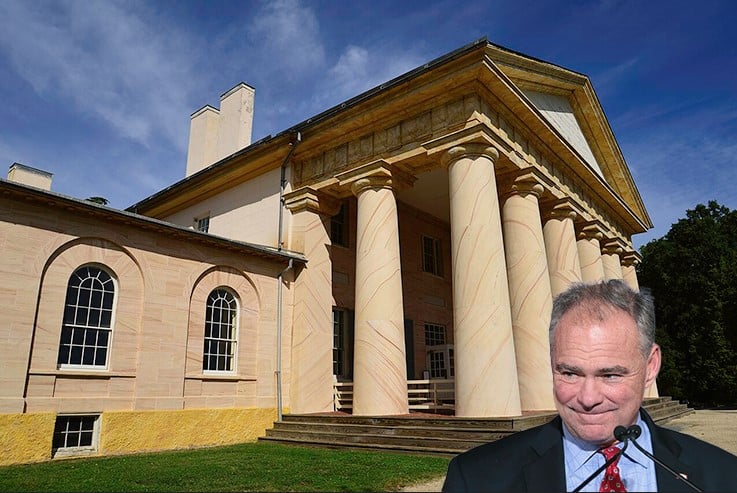
Earlier this month, Virginia Senator Tim Kaine introduced legislation to change the name of “Arlington House, The Robert E. Lee Memorial” to “Arlington House,” removing all references to Lee.
The historic home, built between 1802 and 1818 by George Washington Parke Custis, a grandson of Martha Washington and the future father-in-law of Robert E. Lee, was the Confederate general’s home at various points in his life prior to the outbreak of the Civil War. It is now administered by the National Park Service and sits within Arlington National Cemetery.
Explaining his reasoning, Senator Kaine wrote on X: “The names of our national sites should honor individuals whom we can all look up to.” The senator’s tweet was pilloried on X, with comments accusing him of everything from grandstanding to being far less a model for Virginians than General Lee. As City Journal’s Stu Smith replied:
Arlington House was Robert E. Lee’s house. Pretending otherwise doesn’t elevate our values. It just signals how far we’ve drifted into symbolic politics and historical vandalism dressed up as virtue.
As chance would have it, the very afternoon that Senator Kaine introduced that legislation, I traveled to visit Arlington National Cemetery, as I try to do every time I am in the nation’s capital. But that day, for the first time, I also planned to visit the residence in question. (Unfortunately, other visitors and I were denied entry to the cemetery on that day by a police officer on account of the previous week’s snowfall.) The desire to visit Lee’s home had been prompted by my recent reading of Allen C. Guelzo’s 2021 biography of Lee a reading choice that had been inspired by having read that many historical figures, including presidents of the United States, had regarded Lee as one of the greatest Americans ever to have lived.
President Harry S. Truman regarded Lee, along with George Washington and the Roman general Cincinnatus, as among the men from history he most admired. During the Korean War crisis, the president noted in his diary his wish that General MacArthur was more like “Robert E. Lee, John J. Pershing, Eisenhower, and Bradley.” Later, President Dwight Eisenhower would defend his frequent praise of Lee, perhaps most pointedly in a 1960 letter to a New York dentist who took issue with the president displaying a portrait of the Confederate general in his office. After acknowledging that, in the early 1860s, secession was still an unresolved constitutional question, Eisenhower praised Lee, including for being “forbearing with captured enemies,” and, contra Senator Kaine, explicitly encouraged American youth to “strive to emulate [Lee’s] rare qualities.” He also praised Lee’s urging of reconciliation at the war’s end.
Other presidents from Theodore Roosevelt to Gerald Ford also spoke respectfully and, at times, reverently of Lee, appreciating his skill as a general, his character, and, crucially, his conciliatory spirit at the conclusion of hostilities. In his August 1975 remarks upon posthumously restoring American citizenship to Lee, President Ford commended Lee’s “dedication to his native State of Virginia” as well as Lee’s post-war desire to heal “the wounds of the North and South.” As Lee wrote in 1865, “I believe it to be the duty of everyone to unite in the restoration of the country and the reestablishment of peace and harmony.”
Similarly, while reading Guelzo’s account, I was struck by how nearly everyone who interacted with Lee regarded him as a great man. This is true, also, for those who study him—including Guelzo himself, which is notable because Guelzo is a critic of the antebellum South. According to Guelzo, Lee was mannerly, respectable, and “dignified without hauteur.” Kate Merritt, who met him only briefly at a party, recalled him as “one of the most charming and gracious gentlemen I ever met.” And though most children love their parents, it seems his daughter Mildred Childe Lee might have been speaking for many when she wrote of her father: “To me, he seems a Hero—& all other men small in comparison.”
Critics like to point out that Lee was implicated in a controversial 1859 whipping incident involving his father-in-law’s slaves, though privately, he denied involvement. Unlike many aligned with the Confederacy, however, Lee regarded slavery as profoundly immoral, describing it to his wife Mary in 1856 as a “moral & political evil.” He also worked to fulfill his late father-in-law’s will, which required that his slaves be freed within five years of his death. While one might reasonably argue that Lee only paid lip service to slavery’s evil and did not actively work to phase it out before the Civil War, it is nevertheless clear that he lacked, say, Alexander H. Stephens’ or Nathan Bedford Forrest’s explicit commitment to preserving the institution.
Although his critics may not see it this way, it is more than possible that a fine man was caught in an extremely difficult situation. When offered command of the federal army in April 1861, he told Francis P. Blair that he could not draw his sword against his home state of Virginia, and as the nation teetered toward war, he urged his fellow Virginians against secession.
In 2017, while still a student at Yale University, I condemned in a Hartford Courant op-ed the university’s decision to rename Calhoun College. Regardless of one’s views about the quality of John C. Calhoun’s arguments in political theory, there is something most unsettling about whitewashing history in a period of revolutionary ecstasy.
In this case, we ought to remember that whenever activists demand the renaming of something—be it Lee’s home, Washington and Lee College, the Jefferson-Jackson Dinner, Columbus Day, or, more prosaically, the Cleveland Indians—this unsettling feeling is precisely the point for those pushing it.
Even so, it is also crucial to recall, as the presidents cited above understood, that the Civil War was perhaps the darkest chapter of American history, leaving upwards of 750,000 Americans dead (according to more recent estimates, the oft-cited 618,222 figure was too low). And we ought not let spectacle-driven politicians re-inflame wounds by besmirching the reputation of a man so many Americans admired, even as we acknowledge his historical complexity.
Leave a Reply