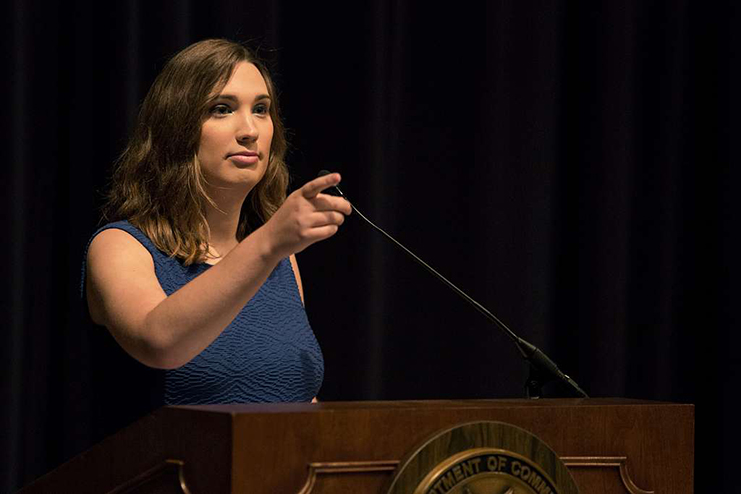
Open up the May issue of Washingtonian magazine, and you find a hagiographic article about Sarah McBride. McBride is the 35-year-old transgender representative from the state of Delaware, who went under the name Timothy Ryan McBride for the first 21 years of “her” life. The title of the Washingtonian profile is “Sarah, Full of Grace.”
The Washingtonian photographed McBride at the top of a lavish stairwell, a golden yellow lamp producing a saintly nimbus. The article summary reads:
The nation’s first openly trans congresswoman, Sarah McBride, believes in kindness, tolerance, and reaching across the aisle. But in the face of vilification from the right—and some disappointment from the left—her faith his being tested.
In other words, the Washingtonian is comparing a person suffering from gender dysphoria, a man who insists on dressing like a woman and using women’s private spaces like bathrooms and showers, to the Blessed Virgin Mary.
Actually, they may be comparing McBride to Joan of Arc. Writer Sylvie McNamara describes how two weeks after being elected in 2024, McBride discovered that Republicans on Capitol Hill had passed a rule restricting bathroom use in the Capitol to those whose sex at birth matched the restroom they use. McBride complied with the rule, angering left-wing activists. “I think the thing I am proudest of is that in the face of a very concerted effort to try and derail me and turn me into a caricature, I have remained disciplined and focused and try to fight for a politics of grace.”
This is the second time in 2026 that McNamara has written about McBride for the Washingtonian. In January, she got together with McBride to watch Queer Eye for the Straight Guy. “A freshman Democrat from Delaware—and the first out-trans member of Congress—she’s long been a proponent of ‘a politics of grace,’” McNamara then wrote of McBride, “of meeting differences with kindness and curiosity and giving people space to grow.” Then McBride said Republican leader Mike Johnson should be featured on Queer Eye.
The McBride canonization in Washingtonian is noteworthy because it reminds people that the media is not only out to lie, but to wage a spiritual war—and one that promotes evil. Sure, some people, even conservatives, might say, McBride and the bathroom issue are important, but the controversy doesn’t reach the level of, say, the war in Iran.
In fact, it does. As I once explained in an essay about the film The Exorcist, even more than geopolitical conflicts, human sexuality is a target for demonic exploitation. The point of the demonic in The Exorcist was not to levitate bodies or vomit on priests; it was to convince human beings that they are nothing but base, animalistic creatures unworthy of God’s love. To convince us of this, the demon in the film attacks people in vulgar, sexual terms, even to the point raping the victim, a young girl named Regan. The demon makes God’s beautiful design ugly, disfiguring the face of a beautiful young girl. The devil cannot create; it can only imitate and destroy.
William Peter Blatty, the author of The Exorcist, based his 1971 book on a real case of demonic possession that occurred in Maryland in the 1940s. He always argued that the most important part of the novel was left out of the film. This section was so important to the story that it caused a rift between Blatty and the film’s director, William Friedkin. Near the end of the book version, Father Lankester Merrin, an older priest, is explaining evil to Father Damien Karras, a young Georgetown Jesuit. The demon’s target, Fr. Merrin says, is not the innocent girl he takes over. The target “is us.” He continues: “I think the point is to make us despair, to reject our own humanity, Damien, to see ourselves as ultimately bestial; as ultimately vile and putrescent; without dignity; unworthy.”
Fr. Merrin then explains that the devil is not so much involved in our wars or great geopolitical dramas, but in the small, quotidian cruelties: “in the senseless, petty snipes; the misunderstandings; the cruel and cutting word that leaps unbidden to the tongue between friends, between lovers.” Enough of these, he says, and “we don’t need Satan to manage our wars.”
In the Washingtonian article, McBride claimed to be shocked that the left turned venomous about the choice to obey bathroom rule. You’d think someone described as “full of grace” and photographed like a Catholic saint would better understand the nature of the demonic.
It’s also telling the author of the profile, Sylvie McNamara, previously wrote about a visit to a Franciscan Monastery in Washington, D.C. In that piece, she explicitly refused to use holy language to describe her experience. “I am not a religious person,” she wrote. “I don’t pray. I’d come to this hilltop in Brookland not to grow closer to my faith, but to myself—to hear myself think, to be alone inside my own mind.” McNamara confessed to feeling troubled and noted she had:
tried to fix it—with therapy, sobriety, exercise, Klonopin. Microdosing psychedelics. Burying myself in work. But intuitively, I figured I just needed some time alone. In solitude, I could offer myself up to the rapacious birds of my thoughts, and maybe, once picked clean, I’d have some peace.
She almost gets there on the third day:
Towards the rising sun, grapes grew over a chain-link fence, sheer fabric draped around them, protecting them from pests. The sunrise swept long, angular shadows onto the grass. And then it happened—I felt astonished, pierced. Here, like in the laundry poem, was an angel: White fabric hung over cascading bundles of grapes, lit and shining, as if the fruit were luminescent itself.
Then the cop out: “Describing it seems to demand a religious vocabulary ‘sacred,’ ‘ecstatic,’ ‘miracle,’ ‘grace.’ But really, I was only seeing, experiencing the world as it is.”
Of course. Holy language is reserved for one of the incorruptibles, like Sarah McBride.
Regular readers may be interested to know that the Sarah McBride canonization comes on the heels of Washingtonian magazine spiking another profile: one of me. For over six years the writer Cathy Alter had been begging me to submit myself to a profile for Washingtonian, and for six years my answer was “no.” Cathy, whom I’ve known for 30 years, always emphasized that the story would be about my life as a Washingtonian and not really about politics. I told her the same thing I have been telling others: that I was over talking about the 2018 Supreme Court battle that had made me briefly famous, that friends and colleagues told me to stop talking about it, that they were sick of hearing about it, and that I was writing about other things and moving on.
Two or three times a year over those six years, I would hear from Cathy. She would re-up her request for me to do it, and every single time I said no.
Then finally I said yes. My agent convinced me that the story might, in fact, be what Cathy was dishing—a human-interest profile that was very light on politics. So I met with Cathy, showed her my childhood home, and talked with her about my faith and Georgetown University.
Then, in late March of this year, I was informed that the profile had been spiked. Cathy texted me:
Hey there. I wanted to tell you as soon as I heard (in a phone call today with the editor), Washingtonian is killing the story. I’m tied up now with a list of crap to finish but I wanted to let you know. How about I take some of my kill fee and treat you to a fancy meal? I’m really sorry. And really disappointed.
After the Washingtonian was killed, I heard from an editor at Quillette, the free speech website founded by Claire Lehmann. They are interested in publishing the piece that Washingtonian spiked. Cathy pursued me and this profile for over six years. She spent weeks with me and even more time in phone interviews and in-person meetings with old friends and colleagues. She got me to show her my childhood home, open up emotionally, and requested art, including a painting my father had done. She expressed disappointment that the piece was killed. Would she take the opportunity, now, to actually have it published?
We all know the answer to that question. But perhaps we can look forward to Washingtonian’s third profile of Sarah McBride.
Leave a Reply