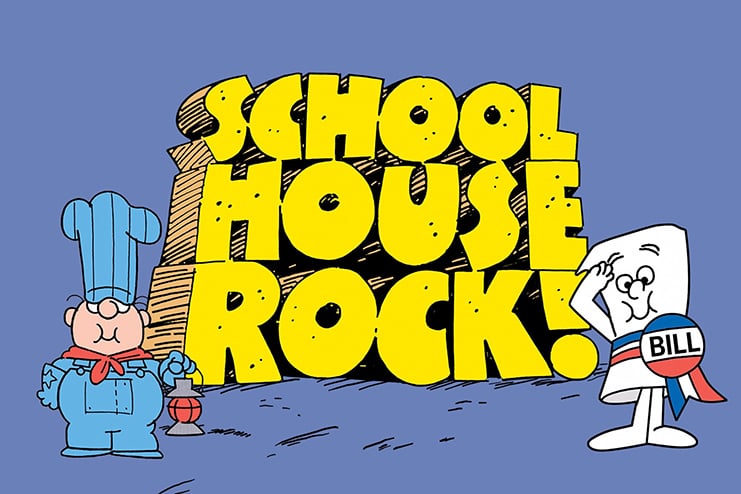
Back in October, failed candidate for the U.S. vice presidency, Tim Walz, made a post to X invoking a blast from America’s beloved cartoon past—the 1970s favorite Schoolhouse Rock! Walz intended it to show his support for the inane “No Kings” protests happening at the time, by sharing an old episode titled “No More Kings.”
I responded to Walz’s post on another social media app that had reposted him:
“Hey Tim Walz, thanks for invoking Schoolhouse Rock! as a source of authority on American history and culture. I like this one too. How about you?”
That text was followed by a link to the “this one,” another Schoolhouse Rock! short, “Elbow Room.”
That cartoon describes the American movement across the continent of North America with the following lines, among others:
It’s the West or bust, in God we trust…There were plenty of fights, to win land rights, but The West was meant to be, it was Manifest Destiny.
Walz, in all likelihood, did not see my response, but it would be surprising given his age (he is just a few years my senior), if he does not know enough about Schoolhouse Rock! to know how incompatible the worldview of that series is with much of what he and his friends on the left want to do to the country.
The Schoolhouse Rock! shorts started production in the early 1970s, aiming at aiding elementary education by combining it with catchy songs. The creator, David McCall, was an advertising executive who realized his son, who was having difficulty memorizing multiplication tables, nonetheless managed to commit a bunch of rock music lyrics to memory. A team of talented songwriters and singers was assembled and nearly 30 segments were produced between 1973 and 1977 (and more in later years). These early episodes dealt first with math and numbers, then moved on to grammar rules, and finally treated topics in American history.
The series began when I was in the first grade, and I knew just about every one of these first two dozen plus episodes by heart. They played in commercial breaks on Saturday morning children’s television and, in many cases, were equally enjoyable. They also embraced a full-blown traditionalist and patriotic view of American life that contemporary leftists like Walz seem to live to denigrate.
“The Preamble of the Constitution” turns the Preamble into a beautifully memorable melody that I am confident many in my generation can still sing today, as I can. In that episode, the “Founding Fathers” (not the genderless “Founders” of today) are unapologetically invoked as those responsible for the “principles that [are] known the world around.” No apologizing for any of the supposed grave flaws in the American project about which the contemporary left never tires of screeching.
“Elbow Room,” already noted above, is a loving account of how the United States came to occupy its present territory. Jefferson struck a deal with Napoleon to “sell a mile or two” as American citizens called out their need to “get us some elbow room.” The narrative of further Western expansion is told in just the traditional way I learned it as a boy:
The trappers, traders, and the peddlers
The politicians, and the settlers
They got there by any way they could
The Gold Rush trampled down the wilderness
The railroads spread across from east to west
And soon the West was opened up for, opened up for good
And now we jet from east to west
Goodbye New York, hello L.A.,
But it took those early folks to open up the way.
At the conclusion of the episode, the ever intrepid and adventurous Americans are heading off to look for more elbow room “up on the Moon.”
The episode to which Walz referred, “No More Kings,” is similarly patriotic and culturally conservative—in ways that would have Walz scrambling to cover his left flank if he were forced to confront it in full. America’s origins are depicted unproblematically as “the pilgrims [who] sailed the sea…in their ship Mayflower” (native Americans are shown cowering behind a rock as they arrive) and “Mother England” to whom these pilgrims initially “swore their loyalty” are described working out the evident founding culture of the country without a bit of multiculturalist overcomplication or relativism.
In “The Great American Melting Pot,” a story is told of a grandmother from Russia and a grandfather from Italy who had
…heard about a country
Where life might let them win
They paid the fare to America
And there they melted in
Lovely Lady Liberty
With her book of recipes
And the finest one she’s got
Is the great American melting pot.
The song is a straightforward embrace of the old American assimilationist view of immigration, where, yes, people from different cultures may come here, but then agree to voluntarily assimilate to the baseline Anglo-English culture that founded the country. In one scene, the immigrants are literally jumping right into a pot to be made one with American culture.
Even in the math episodes, a wonderful cultural conservatism—now decimated by the stupidities of our woke revolution—could be observed. The very first episode “Three is a Magic Number” encouraged children to identify the number with “the ancient mystic Trinity” and the threesome of “Faith and Hope and Charity.” And then there was this lyric, which would have those who swear primary loyalty to LGBTQ ideology furious: “A man and a woman had a little baby; Yes, they did; And they had three in the family.”
Right there among Saturday morning cartoons, the basic elements of the Christian faith, were unapologetically and proudly proclaimed.
Hard to believe it today, but it happened. I know. I was there.
Leave a Reply