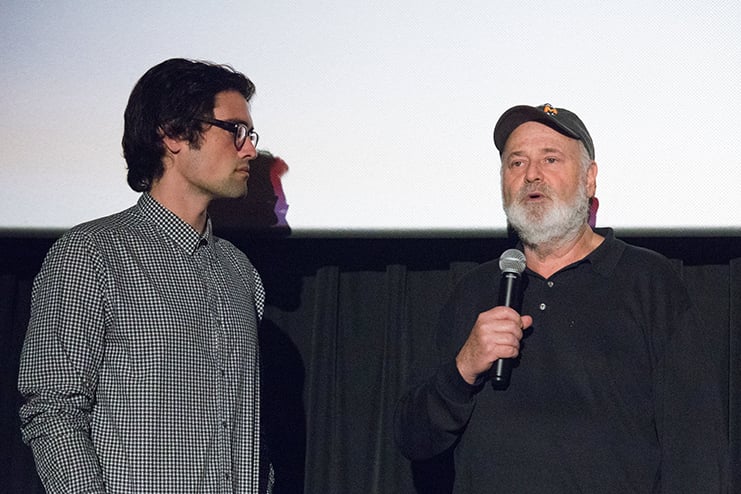
I never found Donald Trump to be particularly offensive. He talks no worse than most of us do behind closed doors. But his strangely sarcastic eulogy for murdered director Rob Reiner managed to do what most Trump posts don’t: It bothered me.
Still, that doesn’t mean the right should join the chorus attacking him for it. Moral handwringing over Trump’s distasteful comments only serves the vanity of the handwringer. And it plays into the left’s hands as they continue to set the terms of America’s moral discourse.
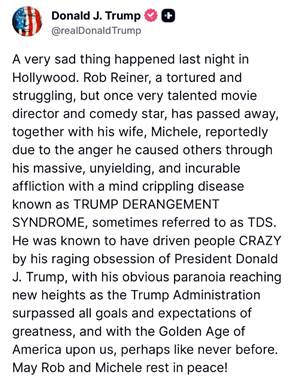
Trump’s point may have landed if the Reiners had passed away under natural circumstances—age, illness, or even an accident. But it is an extremely odd thing to say about a couple who were just allegedly stabbed to death by their own son.
To know anything about Trump, however, is to know this was meant as a troll. There is perhaps some malice involved; Reiner was one of the more outspoken Trump-hating celebrities over the past decade. Although in true Trump fashion, the post was mostly his attempt to rile up the left. Most of the time, Trump’s trolling riffs are funny, uniquely perceptive, and mildly self-deprecating as he slams his political enemies. He’s a New Yorker of his era, and an inheritor of Borscht Belt comedy style, although the left pretends (in his special case ) not to understand this. The main problem with the Reiner post is that the joke didn’t land. It was too awkward, given the very unfunny circumstances. And it just doesn’t make sense: there’s no workable logic that relates TDS to deliberate murder.
If the riff was part of a stand-up bit, you would have heard crickets. Yet the appropriate human response is to cringe—not gasp in moral revulsion as if Trump murdered the Reiners himself—while the savvy political response is to remain silent and focus on the more important work of defeating our enemies. Still, some on the right embraced moral handwringing in leftist fashion.
“It is gross and beneath the office of the presidency to mock and rant about a man who was just killed,” tweeted libertarian journalist Brad Polumbo.
“I guess my elected GOP colleagues, the VP, and the White House staff will just ignore [Trump’s post] because they’re afraid?” wrote Republican Congressman Thomas Massie.
Even the streamer Nick Fuentes, certainly not one to be shy about embracing controversial comments, denounced Trump for his post: “It’s despicable to make fun of that.”
Once you get in the habit of denouncing Trump’s nasty remarks, it becomes difficult to set a limiting principle. Is there really that much difference between the Reiner comments and any of the other uncouth things he’s said?
There is one strategic argument to be made for countersignaling Trump in this instance, however. Reiner was not primarily a political figure, but a beloved director known for films like When Harry Met Sally… and The Princess Bride which, as Pedro Gonzalez has noted, are seared into the American cultural psyche. Average Americans do not feel the same political scorn for him as they do toward figures like Dick Cheney or Ruth Bader Ginsburg. Denouncing Trump’s comments puts the right on the popular side of what is likely an 80/20 issue.
The problem with that argument is that Trump’s flippant remarks are just not that important. For the last decade, Trump has said things that people feel the need to condemn, and each hysterical controversy disappears quickly in the next news cycle. The casual political observer has become so desensitized to fabricated media histrionics that even a genuinely distasteful comment is likely to go unnoticed. Denouncements from the right tend to accomplish the opposite of their intended purpose, possibly one reason the left is so eager to draw them out. Rather than highlight the bonafides of so-called Good Republicans, they simply draw additional attention to Trump’s original remarks, adding new angles that keep the news cycle alive. Republican infighting is even more newsworthy than Trump being snarky.
Comments like these are mostly just self-indulgent: a chance to signal one’s goodness in contrast to the man deemed by every legacy institution as the existential political villain of our time. It’s an unfortunate impulse in a culture where the dominant left sets the tone of moral discourse. We all instinctively understand what is considered good and bad by the norms and standards of progressive liberal morality; it shapes our schools, workplaces, and personal relationships. Racist and obscene remarks by leftist celebrities, like Joe Biden or Jasmine Crockett, won’t even get reported, outside of Republican media. Even if the right doesn’t subscribe to every aspect of it, we all understand how to operate in this system because our personal and professional relationships often depend on it. With this socialization, it becomes exceptionally hard to think neutrally about Trump: the most common defense is that yes, he’s an amoral jerk—but his behavior is necessary and his policies are good. Rarely does one hear a staunch independent defense: Trump is a good guy, actually.
The occasional self-distinction signals that one is still a good person within the terms of the current zeitgeist. In doing so, it reinforces the left’s hold over moral discourse that has been weaponized against the right for decades. The only way to finally break the left’s cultural power is to just stop caring about what they have to say.
Leave a Reply