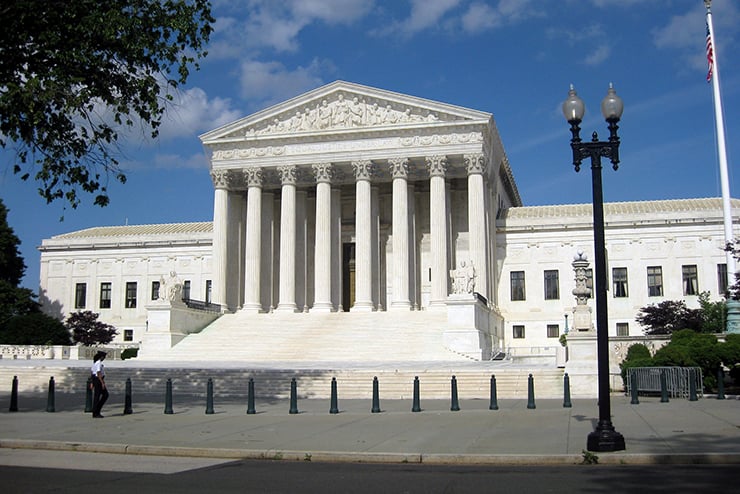
The president of the United States has strongly suggested that the six justices of the Court who joined together to invalidate his signature tariffs should be ashamed of themselves. He is quite correct.
International trade law is a complex area, and it would not be surprising if the president’s advisors may have slipped in advising him of precisely what authority he possessed under the International Emergency Economic Powers Act, but anyone who takes time to read Justice Brett Kavanaugh’s dissent in the case will understand that there is a very powerful argument that what the president did was perfectly legitimate. To boil it down to its essentials, the statute under which the president acted permitted him to impose restrictions on trade with other countries, up to and including embargoes, and Kavanaugh reasoned that if that plenary power was provided, then surely the lesser power of imposing duties (tariffs) ought to be understood to be included.
Chief Justice Roberts’s opinion for the majority of six, again boiled down to its essence, is that tariffs are the same thing as taxes, and the power to tax belongs only to Congress, not to the president. According to Roberts, then, to allow President Trump to levy tariffs willy-nilly would be a fundamental violation of the separation of powers. But even a force as impressive as the Supreme Court cannot make an apple an orange, and there are important differences between taxes and tariffs. Tariffs (or to be more historically precise, duties—a tariff is simply a list of duties) are levies imposed on imported goods. And while a tax is also a demand for payment, it is more commonly understood as a levy on domestically earned income or domestic sales.
One can’t help but wonder if the chief justice suffers from some rare disorder that causes him to discern the existence of taxes where none are to be found. That was, after all, his exercise in judicial legerdemain when he rescued Obamacare from unconstitutionality in the notorious NFIB v. Sebelius case, where he—contrary to President Obama’s public protestations—declared that the financial penalty enforcing the mandate requiring Americans to purchase insurance was a “tax,” and that while the congressional power to regulate commerce was limited, the power to tax was not. In fact, that penalty was not a tax, as that term is usually understood, nor were the tariffs imposed by President Trump.
Again, to state a basic, essentially political rather than constitutional or legal point: Since the 1930s, it has been the practice for presidents, understood and apparently authorized by Congress, to use tariffs as tools of international trade negotiation and as a means of securing a favorable balance of trade. This was precisely what President Trump was doing, and there were, as Justice Kavanaugh made clear, precedents for presidential action, even before the 1930s, including those of Presidents Lincoln, McKinley, Polk, and Nixon, when presidents used duties on imports as tools of foreign policy.
It is hard not to wonder whether the particular species of Trump Derangement Syndrome that causes its sufferer to believe that Donald John Trump is some kind of unhinged authoritarian has infected the chief and his five concurring justices. If so, they certainly have cause for shame, since the president’s foreign policy and his concomitant use of tariffs have been among his most impressive achievements—not only generating many billions in revenue but also resulting in multiple favorable trade pacts.
As Kavanaugh’s dissent also made clear, the majority’s decision plunges us into uncertainty regarding whether and when the president’s tariffs, now ruled illegal, must be refunded, and to whom. This is likely to rattle markets for months, and to tie up lower federal courts for years before the Supreme Court may again have to step in.
There once were recognized doctrines of judicial restraint—such as that cases involving purely political questions should be resolved on their own by the branches in question—but in the last 70 years or so, the Court has tended to think that its job is to resolve all conceivably moral, political, legal, and social questions on top of its duty to resolve constitutional questions. It has seen itself as the nation’s Supreme Authority, not just its Supreme Court. This, presumably, was what Justice Roberts himself meant when, in his dissent in the gay marriage case, he quite properly asked, “Who do we think we are?” That’s a question he should have asked himself in the tariff case as well.
There is one other possibility here that we should not discount, however. Perhaps the Court is about to release a number of decisions that will (as it has done with some other of Trump’s initiatives) uphold many presidential actions, and the chief justice (and some of his other colleagues, perhaps Amy Coney Barrett and Neil Gorsuch) believe they need to take this step so as to appear to be more even-handed, and not in the president’s pocket. Trial lawyers often encounter judges who behave similarly, trying not to appear overly favorable to either side. This, too, would be shameful if at least understandable from a fallen human nature point of view.
Leave a Reply