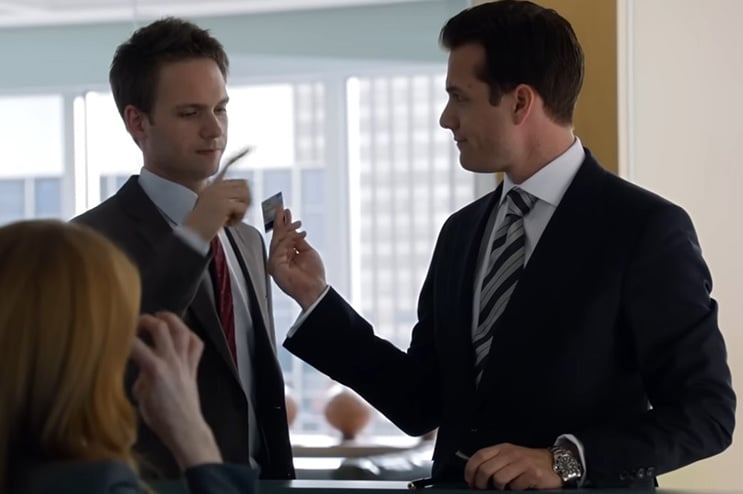
While the TV series Suits had a devoted fanbase in its early years, the show’s popularity exploded once it became known as the show that starred Meghan Markle before she met Prince Harry and Netflix subsequently added it to its streaming catalogue. Despite its acclaim, many people fail to appreciate the show’s unique place in recent entertainment history.
Suits was one of USA Network’s great accomplishments during a time that produced a slew of bingeable hits—Monk, Psyche, Burn Notice, and White Collar—a period that spanned the George W. Bush years, Obama’s two terms, and Trump’s first administration. These shows had the trademark USA qualities of being light-hearted, fun, and mostly character driven. In many ways, they represented pre-COVID entertainment in its purest form.
They also happened to be quite conservative by today’s standards. Unlike the gritty, morally ambiguous shows on HBO and elsewhere, the USA protagonists acted morally and were generally wholesome. Family, friendship, and competence were always emphasized, gender roles were clearly defined, and the love stories were strictly heterosexual. The casts were selected because of their talent and good looks—there was no forced diversity. Even religion was treated with respect instead of ignored or derided.
Running from 2011-2019, Suits was the last successful series in the USA pantheon. These were also the years, sadly, when most television shows began caving to two advancing trends. The most obvious was the great migration of entertainment to streaming platforms. By the end of the 2010s, and especially during the COVID lockdowns in 2020, it made little sense to maintain a cable subscription, tolerate commercial breaks, or wait for a new episode to come out each week.
The less obvious trend, at least as it was happening, was the subtle and gradual insertion of progressive cultural preferences (otherwise known as wokeness) into every show and movie being produced. While the other USA shows mentioned above had concluded before this agenda became ubiquitous throughout entertainment, it became apparent that Suits would not be permitted to escape this pressure from the top.
This makes the show an ideal test case for more in-depth consideration today because it gives us a much-needed way to track a phenomenon that still remains stubbornly nebulous and hard to pin down—what is woke, exactly?
If the series The Good Place showed us how wokeness not only killed a show, but the entire sitcom genre (see my analysis here), Suits suffered a similar fate—though its death brought with it the official end to the fun-loving USA-style television genre.
It certainly didn’t start this way. In the first season the two protagonists were likable and admirable: a suave, hotshot attorney at a high-powered law firm, Harvey Specter (played to perfection by Gabriel Macht) ends up mentoring and hiding the secret of Mike Ross (played well enough by Patrick Adams), a young man with a photographic memory who poses as a lawyer despite lacking the credentials. While Harvey conceals Mike’s true identity and teaches him what he needs to know about the business, Mike helps Harvey win big cases through his encyclopedic knowledge of the legal code and relative anonymity. Even as their relationship begins as one of opportunity, the pair soon develop a sincere and brotherly affection that sets the tone of the series.
As such, Suits was once a very male-centric show, verging on macho. Besides their opponents in the courtroom, the main antagonist of the show was usually Louis Litt, an insecure and catty colleague of Harvey’s (also played to perfection by Rick Hoffman). Louis is deeply jealous of Harvey and of his star pupil, Mike. Litt regularly pulls rank, abuses his authority, and looks for dirt on his two rivals. His abrasive effeminacy signals to the audience to root against him and take joy in seeing him thwarted time and again by Harvey and Mike.
While there are female characters to round out the main cast, their real purpose is to support the male leads. Along with the paralegal Rachel Zane (played by Meghan Markle) who enjoys her work for what it is, there is Harvey’s boss, Jessica Pearson, and his secretary, Donna Paulsen, who continually bail him out and cover for him. The female characters are given their share of sassy quips—usually poking fun at Harvey and Mike for landing in difficult situations—but they also clearly appreciate the virtues of the dynamic duo and defer to their expertise even as they chuckle at their methods. They are also played by attractive actresses, which adds to the show’s appeal.
Sadly, this jovial arrangement could not endure the changing times. By the third season it was clear that the men would have to be taken down many pegs to elevate the women who were now less jovial and, apparently, now aware of having been marginalized. The once debonaire, confident, and supremely talented Harvey is brought low with mommy issues, and the kind-hearted young legal genius Mike is increasingly tied up by his own lies and is conflicted about his life choices. Meanwhile, Rachel decides she wants to go to law school, Donna assumes more roles and becomes a boss herself, and Jessica contends with rival law firms while dealing with increasingly toxic male subordinates.
As for Louis, his character veers all over the place. Occasionally, he is the comic relief. Other times, he is the hero. And then there are times when he’s even portrayed as an unfortunate victim of Harvey and Mike’s schemes. Hoffman shows his range as an actor by meeting these many demands from the writers, but his character inevitably becomes ever more insufferable and superfluous.
To the show’s credit, the writers seem to do their best to moderate the woke agenda, only gradually incorporating more themes relating to feminism and race (both Jessica and Rachel happen to be black) But the series hardly touches LGBT themes. It takes a good five seasons to fully humiliate and sideline the men and turn two of the women, Donna and Jessica, into verifiable girlbosses. For her part, Rachel mostly cries and whines her way to success (thereby, perhaps, revealing the true Meghan Markle). Race is referenced in a mostly neutral fashion with the black characters excelling and the white characters treating them as equals without much fuss. All of it mirrored common sensibilities o about sex and race during the 2010s. In contrast with the rhetoric of leftists who were busy at that time deifying Obama, campaigning for Hillary Clinton, and staging BLM protests and Women’s Marches, this was pretty tame.
Although the series completely exhausted itself by the end of six seasons, it continued lamely for another three seasons. After Mike, Rachel, and Jessica left the show by this point, only the diehard (or incredibly bored) fans would bother keeping up with Donna, Harvey, and Louis who had all long since become caricatures of themselves.
It was as if people knew there would never be another show like Suits and didn’t want to let go. As streaming took over and wokeness prevailed, everyone saw how the new shows would be led by openly obnoxious girlbosses triumphing over weak men, male bonding would either be homosexual or nonexistent, heterosexual romance would vanish, and everyone would have mental and emotional hangups. Additionally, casts would either be unrealistically diverse and often unattractive, or they would be old, dull, and thoroughly unlikeable (see my review for Your Friends and Neighbors). As a result, all attempts at being lighthearted and wholesome necessarily became artificial and virtually impossible to pull off.
Despite the claims that wokeness is dead and the excessive optimism aroused by Sydney Sweeney’s recent homage to an earlier era in showing off her cleavage to sell jeans, it remains to be seen whether modern television really has recovered from its advanced case of woke culture poisoning. So far, nothing has replaced the old shows people are still rewatching for lack of better options. It’s almost certain that fans of The Office will continue their annual binges of the show and ignore the upcoming woke spinoff The Paper. The same goes for the new Suits spinoff Suits LA that debuted this year.
The rise and fall of the original Suits demonstrates what really happened to television and why wokeness, even a mild conservative-coded form of it, is utterly incompatible with entertainment. Wokeness has to be rejected completely, or the majority of the audience will be turned off despite their loyalty to the brand (see: the lackluster box-office performance of Superman and Fantastic Four films).
Unless and until producers and filmmakers rediscover the perennial appeal of strong men who are good at their jobs, good-looking women who respect them, the occasional romance between them, and a healthy sense of humor, people will have to make do with rewatching old stuff on repeat. Otherwise, they may just give up and stop watching television and movies altogether.
Leave a Reply