Fifty years ago, my mother, my two sisters, and I pulled into our local drive-in theater to see a newly released comedy about a little league baseball team. I loved baseball, as did nearly everyone I knew—and certainly every other boy at the time—so I was pretty sure I would like the movie.
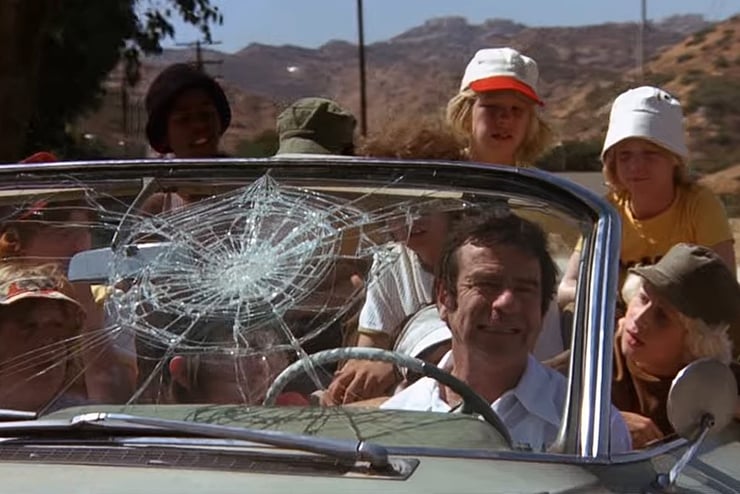
The movie was The Bad News Bears, and I was right. I enjoyed it immensely. So when I learned about the film’s anniversary this year, I decided to see it again for the first time since 1976. This time, I came away convinced it is a very fine statement about a central problem in American society and a loving portrait of the kind of character America once loved and would do well to embrace again.
The first thing I loved about the film, upon seeing it again, is how scandalous it now appears to contemporary progressive moral standards. I noticed that some discussion leading up to the anniversary made sure to apologize for the “unacceptable” elements of the film. These frail flowers, of course, were fretting over the politically incorrect language (The shortstop Tanner, especially, throws around racial epithets with great avidity, in a way that was not at all uncommon in the 1970s). One sees kids smoking (which also actually happened back then), and the sometimes-brusque treatment of the team by Coach Buttermaker (Walter Matthau). Kids in the film curse, have a sip of beer, and talk openly about sex. Buttermaker, we learn, is an alcoholic, and he spends a good deal of the first half of the film verbally berating his team, who are, I remind you, kids.
I am not, of course, saying that I advocate more smoking and beer-drinking by 12-year-olds, or that I approve of or desire more brutal behavior by adult coaches of kids’ teams. My point is that these things existed in 1976, and so a film from that era depicting the reality of the time is not a scandal so much as an ethnographically accurate account. It is how things were, and somehow most of us survived it. But then, I admit I am easily entertained in this way. Anything that gets the 2026 facemask-wearing, BLM-bumper-stickering white progressive all riled up is something that is practically guaranteed to please me.
But it is not just this angle of the film that made it so wonderful to see again. The story and the characters reveal some deep truths about American culture that are rarely recalled today. Amanda Whurlitzer, the lone girl on the team, is the daughter of Coach Buttermaker’s ex-girlfriend and a splendid pitcher because Buttermaker, a former minor league pitcher, has trained her. Amanda is a sympathetic character to everyone who grew up in that generation in a broken home like hers. She is someone with whom we instantly empathize on a profound level. She wants Buttermaker to return to her life and to her mother’s life, even if he is far from perfect, simply because she longs for a father. Most of us who, in the 1970s, suffered because of the advent of no-fault divorce and the massive increase in single-parent households, know exactly how she feels.
Amanda’s character, interpreted by a youthful Tatum O’Neal with the kind of acting skill that should have been well beyond her years, is strongly consistent with what many of us saw in the ’70s from the girls around us. Indeed, it is not too much to argue that the harsh conditions into which all the Amandas of that time were born—the radical revolution within marriage and the family—are what produced in them the heartbreaking combination of longing for emotional love and protection while presenting to the world a hard and rough toughness that was difficult to penetrate. How many American girls did we turn into this archetype of the tough-talking walking wounded by cutting fathers out of families and laughably endeavoring to replace them with the agencies of the State?
The main plotline of the film, of course, is the underdog, outcast struggle of the Bears to overcome the bullying domination of their league’s version of the Yankees. I am an academic, and I admit I am prone to overreading texts. Yet I do not think it is too much of a stretch to see the Yankees and their manager, perfectly played by the late Vic Morrow, as the symbolic representation of American elites—haughty, self-righteous, dismissive of those below them, and committed to an ethic of all against all. The Yankees and their manager display no human kindness, which might get in the way of their total victory. The speech one of the Yankees makes to the Bears following the championship game—and to which Tanner so perfectly responds with, “Take your trophy and your apology and shove it straight up your ass!”—is delivered with aesthetic perfection. It is dripping with the familiar sarcasm and loathing elites have for those below them, for those whom they will never willingly allow to walk with equal respect in their midst.
The Bears are from the popular classes, earthy, unsophisticated, and lacking talent in the elite game of kill-or-be-killed, but they are full of vibrant energy and populist loyalty to their fellows. Buttermaker himself, a loser in life by the elites’ standards, gets caught up in this vicious win-at-all-costs ideology. It is the kids who remind him of the more human and communitarian ethic that should guide them. In the end, the weakest of the Bears—Timmy Lupus, a shy and unathletic wisp of a boy, so tiny he practically has no strike zone—gets to participate in the team’s fortunes. It would take a truly hardened heart to imagine the team would have been better off with him permanently on the bench.
The bond that grows between the Bears throughout their season-long struggle is beautifully illustrated in their mutual defense against the Yankees’ depredations and the culture they represent. The spunky rebel Tanner initially despises Lupus, but when Yankee players pour ketchup in his cap, Tanner explodes in anger and rises to defend his teammate. Even Kelly, who seems like the most aloof and independent of the outsider Bears, comes to identify intimately with his fellows and to stand up vigorously for them. When the Yankees and Bears fight after Amanda is spiked by a Yankee player, there is a brilliantly understated exchange between Kelly and Tanner that shows both their emerging working-class macho independence and their allegiance to one another in just a few words, deployed with economy.
The sneaky way the film comments on what adults were doing in the mid-1970s to make life difficult for children through divorce and broken families, as well as playing out their competitive games through their kids, was evident to me even as a 10-year-old viewer. My own family had just been torn apart by a divorce, and I had already seen the ways in which youth sports were being ruined by too much of the “only winners count” hyper-capitalist philosophy. I completely identified with the external toughness of these kids, which served as a shield over our vulnerability but never extinguished our desperate desire to be loved. And I found Tatum O’Neal sublimely adorable, as did most of the rest of the country. She and Walter Matthau together are magic in this film.
Leave a Reply