There are those who still labor under the delusion that the world, and especially the United States, is somehow governed by an international law to which it has never consented. These naïfs argue that the extradition of President Nicolás Maduro and his wife by American forces operating inside Venezuela was “illegal.” There is no need to burden readers with detailed evidence for this point of view, such as appeals to old International Court of Justice opinions, or to note the absence of a UN Security Council mandate. Neither is it necessary to get bogged down in a discussion of whether what we saw was an act of self-defense triggered by Venezuelan narco-terrorism.
The “extraction mission” in Caracas merely confirms that, in a Hobbesian world devoid of a supranational authority that enjoys a monopoly on violence, international legal norms count for little. Of course, that had been the case for some millennia before President Donald Trump started his second term, even—or especially—during the ascendency of the post-Cold War “rules-based international order” (1991-2024). The list of transgressions against the so-called rules during that period is long and ugly. It includes NATO’s Kosovo war against Serbia, U.S. attacks on and occupations of Afghanistan and Iraq, and other interventions or regime-change operations all over the Middle East and Eastern Europe. It is absurd to claim that over the past year Trump has somehow upended an otherwise well-ordered world governed with respect for international legal and moral norms.
In a famous passage from Thucydides’ History of the Peloponnesian War, known as the Melian Dialogue, we are told of an incident in 416 B.C., in which Athens demanded the surrender of the neutral island of Melos. It promised clemency for submission but threatened annihilation for disobedience. The Athenians declared that justice exists only between equals; the Melians, appealing to divine justice, refused. Athens attacked them, killed all the men, and sold the women and children into slavery.
Trump’s actions in Venezuela show he understands the significance of that paradigmatic episode. Melos is relevant not only to Venezuela’s submission today or to Greenland’s new status tomorrow, but to interstate conflicts in all epochs, civilizations, and latitudes. International relations find their most tangible expression in the bent of strong states to impose their wills on weaker ones. Violence is inherent to man and state. It reflects the relative immutability of human nature, regardless of the political context or technological development. The fact that there exist no communities in which conflict, coercion, violence, or the threat of violence do not exist indicates that what is not in human nature is not in accordance with it. As Thucydides famously remarked, “The strong do what they can, and the weak suffer what they must.”
To understand what happened in Caracas on Jan. 3, therefore, it is necessary to accept realism as a concept and analytical framework. A realist is free from the contrived vision of the world as it should be and from the illusion that human nature is subject to improvement. His vision is grounded in the historical experience of the world and men as they are. He accepts that the Melian Dialogue reflects the reality of our own time just as faithfully as it did in the fifth century BC.
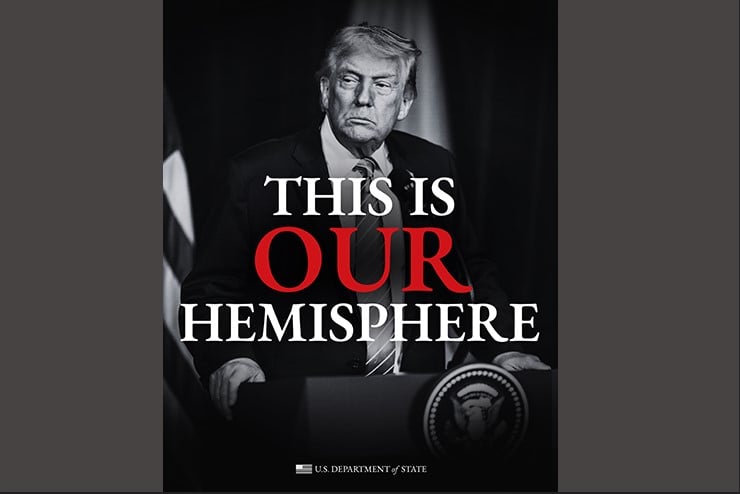
As for Trump’s variant of the Monroe Doctrine, again, there is nothing new under the sun. Understanding international relations requires a balanced appreciation of the variable factor of human will on the one hand, and the constant geographical reality on the other. Geography, in the case of the Western Hemisphere, determines—as if by law—the dominant power’s hegemonistic posture in the region, even if it had never been formally codified.
Although it is debatable whether there are “laws” in relations between states that apply to different eras and spaces, the desire to articulate them is natural and legitimate. Laws establish and maintain order—a prerequisite for our ability to make sense of history. There is no Logos in the chaos of chance and arbitrariness. Trump’s actions are not arbitrary, however. Seen through the realist prism and in their geopolitical context, they make sense. They certainly make more sense than the reckless expansion of NATO and baiting of Russia, as practiced by his predecessors.
As for Trump’s ostensibly eccentric focus on Greenland, it is a reminder that states have always sought to expand physical control over space. Territory, physical space, invariably steals the show in the drama of international politics. Due to its special status, Greenland’s border is not a fixed boundary that separates sovereignties and legal authorities for all time, but a political arrangement subject to change. The character of change will be contingent on the balance of power.
There is nothing sacred in Greenland’s current status as a territory of Denmark. Borders have been moving for centuries in favor of the stronger at the expense of the weaker. This happens regardless of law and justice, natural or otherwise. Legally binding treaties merely verify any given outcome. We do not know whether America really needs Greenland; we do know that its status will be the result of a dynamic process reflecting one state’s ability to take a territory and another’s inability to keep it.
For the believers in the progressive creed of Immanuel Kant or Woodrow Wilson, all of the above is heresy. History, to them, is a linear path of advancement in relation to which one takes a stand for good or evil. The allegedly pessimistic realist paradigm hinders “humanity” in its progress towards a conflict-free world. Since realists see conflict as inevitable, they stand accused of contributing to the prolongation of the tragedy of war. That accusation is incongruous. It is comparable to the claim that medicine, with its excessive focus on diseases, hinders human progress towards immortality.
One of the most commendable features of Donald Trump is his rejection of the progressivist view of history. Belief in that chimera, endlessly avowed by the Clintons, both Bush presidents, Obama, Biden, and nearly all their underlings, encourages megalomaniacal visions and leads to tragic outcomes. In this paradigm, history is not merely a benevolent but impersonal force; it is an active interlocutor, it prods its devotees to action, much as God called Moses in the Old Testament. Bolsheviks felt authorized to murder anyone they deemed on the “wrong” side, and killed millions of people. The trope that “history is on our side” is merely an atheistic variant of the Crusaders’ Deus vult or the Nazis’ Gott mit Uns.
Trump senses that international relations are geopolitically, not legally or ideologically, conditioned, and he acts accordingly. To his credit, as is evident from his National Security Strategy unveiled last December, Trump is loath to accept any supranational legal or political authority for the United States. In this, he takes the side of Hobbes against Hugo Grotius in an age-old debate over the primacy of state sovereignty against natural rights.
The question of who is right is determined by empirical evidence, and over the years, the evidence has always indicated that tangible self-preservation trumps putative sociability. In historically verified practice, it has never happened that appeals to reason and natural moral sense per se succeed in restraining, let alone eliminating, the primacy of power and raison d’etat in world affairs.
Whether that is good or bad is immaterial. That is how it is, today and until the end of time, when this fallen world will pass into eternity.
Leave a Reply