“What a divine surprise!” exclaimed Charles Maurras, upon learning of Marshal Pétain’s rise to power in France in July 1940. The veteran leader of L’Action française expected the new regime to overturn the legacy of the republican, secular, masonic “anti-France” he hated with a passion.
In this hope, Maurras was disappointed: Pétain was outwitted by outright Nazi collaborationists. His turn of phrase nevertheless describes President Donald Trump’s December 2025 National Security Strategy (NSS) for those who hope America can be once again a regular nation in its foreign affairs: powerful, secure, and focused on its pragmatic interests, in the realist tradition.
The president prefaced the 33-page document as “a roadmap to ensure America remains the greatest and most successful nation in human history and the home of freedom on earth.”
These lofty words smack of exceptionalist megalomania—they could have come from any standard neocon/neolib scribe—but what follows is a sound and coherent strategic platform based on flexible realism. The NSS opens with what amounts to a break with the decades-long quest for American global hegemony:
After the end of the Cold War, American foreign policy elites convinced themselves that permanent American domination of the entire world was in the best interests of our country. Yet the affairs of other countries are our concern only if their activities directly threaten our interests.
The Trump administration has finally developed the conceptual framework for strategies that provide a reasonable balance between America’s objectives and resources, between ends and means. Of course, the United States can and should maintain its strong, proactively defensive global position, but not as a hegemon. It should do so as a great power among powers.
In the same spirit, the NSS says the U.S. will refrain from promoting in foreign countries “democratic or other social change that differs widely from their traditions and histories.”
This is a breath of fresh air following Biden’s so-called rules-based international order, in which the U.S. force-fed radical woke ideas to foreign countries. American diplomats were compelled to become standard-bearers of ideological norms epitomized by the rainbow flag, which was raised over U.S. embassies.
“The days of the United States propping up the entire world order like Atlas are over,” the NSS says. This is a long-overdue recognition that today’s international relations are conditioned by geopolitical considerations, not ideology. The document accepts that there is no value system that can override the aspiration of major, or even regional, powers to increase their security by expanding control over spaces, resources, and access routes.
The NSS further states that “mass migration has strained domestic resources, increased violence and other crime, weakened social cohesion, distorted labor markets, and undermined national security. The era of mass migration must end.” This is another commonsense statement that is anathema to the enemy inside the walls. That “era” was not a spontaneous phenomenon. It was, and still is, a key element in the globalist strategy of eroding and ultimately eradicating national identities and state sovereignties through population replacement. Its pernicious consequences, six decades after the 1965 Immigration Act, are certain to permanently hinder America’s “social cohesion” and potential future recovery. Nevertheless, if Trump succeeds in stopping further mass inflows, he will be remembered as a great president.
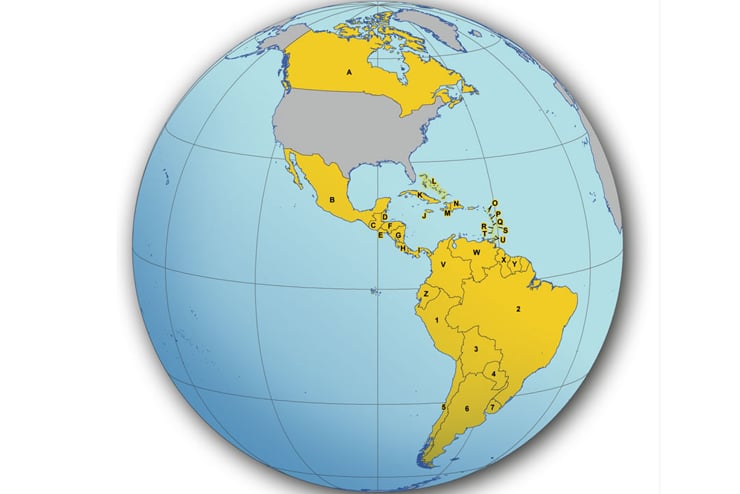
In its longest section, the NSS calls for the reassertion of American clout in the Western Hemisphere, where the U.S. must be the preeminent power to “control migration, stop drug flows, and strengthen stability and security on land and sea.” The document calls this the “Trump Corollary” to the Monroe Doctrine, and says it aims to reinforce our political, economic, and military preeminence in the hemisphere, and to keep non-hemispheric actors from positioning forces or controlling strategically vital assets in the area.
This Corollary has the primary objective of keeping China out of America’s hemisphere and stopping and reversing its economic penetration. Since China’s expanding hemispheric footprint is seen as a “structural threat,” a comprehensive U.S. effort should be expected in the years ahead to exclude China from Central and South American ports, maritime routes, telecommunications, energy, minerals, infrastructure, and associated political influence.
“Excluding China” is not limited to the Western Hemisphere, however. It is notable that the NSS was scheduled for release in September but was delayed, purportedly because Treasury Secretary Scott Bessent wanted to moderate its language on China to facilitate trade talks. The document accordingly eschews confrontational rhetoric. Unlike Biden’s 2022 NSS, it does not single out China as America’s greatest global challenge. It nevertheless reflects a cold, nonideological determination to limit China’s global influence in the name of America’s interests. To put it succinctly, the containment is not personal.
Framing the two powers’ interaction primarily in economic terms, the NSS seeks to “rebalance America’s economic relationship with China, prioritizing reciprocity and fairness to restore American economic independence.” Trade “should be balanced and focused on nonsensitive factors… maintaining a genuinely mutually advantageous economic relationship with Beijing.”
So far, so conventional—but then comes the geopolitical part. To prevent war in the Indo-Pacific, U.S. forces will be capable of “denying aggression anywhere in the First Island Chain.” This barrier to China’s power projection extends from the Kuril Islands at the northwestern end across the Japanese Archipelago, Okinawa, and Taiwan to the northern Philippines and Borneo.
Japan and South Korea will be asked to increase burden-sharing “necessary to deter adversaries.” Deterring a conflict over Taiwan, “ideally by preserving military overmatch, is a priority” and the U.S. “does not support any unilateral change to the status quo in the Taiwan Strait.” Control of the South China Sea by any competitor is a security challenge that will be resisted.
The South China Sea is the sole region where the Trump administration intends to maintain a strong, open-ended U.S. military presence outside the Western Hemisphere. The chokepoints along the island chain still present a formidable barrier to exiting or entering the South China Sea, the East China Sea, and the Yellow Sea. The U.S. is effectively extending a security guarantee to Taiwan by entrenching it firmly in the middle of its defense-deterrence architecture. This is as firm as any formal mutual defense treaty.
The NSS thus proves that the essence of spatial competition does not change; only the essential pressure points do. It is no longer Europe, nor is it the Middle East. It is “Asia’s Mediterranean.” Thankfully, this commitment is not made in the name of defending Taiwan’s democracy or promoting its people’s aspirations, real or desired. It is made in the name of American raison d’état. The calculus itself may be right or wrong, but the rationale is legitimate.
The demand for burden-sharing is especially welcome: American troops are no longer needed in either South Korea or Japan. Both are economic superpowers perfectly capable of defending themselves. They belong to the American island-chain containment perimeter as autonomous actors, and they should be treated as such. Japan, in particular, is able—and should be made willing—to discard its artificial and obsolete constitutional restraints (notably Article 9) against out-of-area deployment of its military forces.
Unlike previous NSS documents, the latest one does not mention North Korea. This aligns with the document’s realist approach to all potential crisis points, the Far East included. The Kim dynasty has always been a peripheral sideshow, however theatrical at times, and its possession of a few nuclear weapons and rickety delivery vehicles is irrelevant to the broader security calculus.
The NSS states that the U.S. no longer needs to prioritize the Middle East because it has diversified its energy supplies—the “historic reason” of America’s involvement. This is excellent news. The current Middle Eastern landscape offers the United States an opportunity to let go of a faraway burden that has never been essential to America’s security and well-being. It may imply the long overdue demythologization of the relationship with Israel, an old albatross around the neck of American foreign policymaking.
This commitment will be subjected to an onslaught by the Lobby that dares not speak its name, but also by the assorted Saudi and Gulf interests, which are loath not to be the focus of U.S. policymaking. Keeping America permanently stuck in the Middle East is the one interest that both Israelis and Arabs share. Wishing both sides all the best while staying away is both moral and rational.
It is remarkable that, unlike its predecessors, the 2025 NSS does not single out Russia as a potential threat to the United States. This is right and proper, since Russia is a regional rather than global power that struggles to achieve even limited military objectives in its immediate “near abroad.” The notion that Russian armies will sweep across Poland and the Baltic republics into central Europe once they have crushed Ukraine is ludicrous, in view of their lamentable performance since the war started almost four years ago.
While considered heretical by the chronically Russophobic bipartisan establishment in Washington and Europe’s warmongers, this omission is one of the most significant elements of the document. To a seasoned geopolitical operative, it implies the hope of Trump’s team that, in the fullness of time the Russian Federation may become a Western partner in containing China.
This is a tall order, in view of all that has come to pass over the last decade, but it makes geostrategic sense. In 1970–1971, Nixon and Kissinger successfully brought China back from the cold to triangulate the bipolar world of the Cold War. At that time, China was infinitely weaker than Russia in its Soviet guise. Today, however, Russia is far weaker than China. It is increasingly apprehensive of its economic and technological dependency on the cold-blooded dragon to the east. Trying to bring it back into the fold of European nations makes strategic sense.
In the same spirit, the NSS sees “an expeditious cessation of hostilities in Ukraine” as being in America’s core interests. It states that the U.S. “finds itself at odds with European officials who hold unrealistic expectations for the war perched in unstable minority governments, many of which trample on basic principles of democracy to suppress opposition.”
In plain English, this means the war is over, that Russia has won, and that the U.S. will not support European regimes that refuse to recognize reality, while at the same time demonizing and criminalizing domestic critics.
The NSS concludes that America should curb the sense in Europe that Russia is a threat and warns that NATO cannot be “a perpetually expanding alliance.” This is an important and welcome statement, considering the fact that the war in Ukraine was overwhelmingly due to the push for NATO’s eastward expansion. Outside of the U.S. neoconservative cabal, the proponents of “NATO forever” and its relentless eastward expansion are primarily Eastern European nationalists, whose Russophobic obsessions and neuroses must not be allowed to impact America’s grand strategy.
The antiquated North Atlantic alliance should be disbanded. While this is not imminent, the NSS rightly promises that NATO will be left to linger on in an ever-deeper irrelevance.
The old world, the NSS says, is undergoing a profound crisis, and this is not so much about economic decline or military weakness as it is about the loss of national identity, leading to the “stark prospect of civilizational erasure.” This especially applies to Europe, as the document states:
The larger issues facing Europe include activities of the European Union and other transnational bodies that undermine political liberty and sovereignty, migration policies that are transforming the continent and creating strife, censorship of free speech and suppression of political opposition, cratering birthrates, and loss of national identities and self-confidence.
Warning that “it is more than plausible that within a few decades at the latest, certain NATO members will become majority non-European,” the NSS warns that “it is an open question whether they will view their place in the world, or their alliance with the United States, in the same way as those who signed the NATO charter.” Meaning that mass immigration is corrupting the values of European nations.
European elites were aghast, as they should be. A prominent organ of the global liberal establishment, The Economist of London, called the NSS “a shocking assertion from a country that is itself built on immigration.” This is a mendacious claim. America was built on immigration from Europe—from the British Isles, the Low Countries, and Western Germany at first, and starting in the early 1880s from all parts of the Old Continent. That was light-years away from the present situation. Early immigrants to America came to work, and their offspring became fully “American” within two generations. Present-day Muslim immigrants to Europe treat the Old Continent as a candy store with a busted lock, a people to be robbed, raped, and stabbed at will, and nations to be transformed eventually into their own home countries’ dysfunctional image.
The ensuing NSS segment on Europe is short, but it is arguably the most important part of the document. It calls for “unapologetic celebration of European nations’ individual character and history” and advocates encouraging the revival promoted by “patriotic European parties.”
Those parties, specifically the National Rally in France, Reform UK in Britain, and the Alternative for Germany, have been subjected for years not only to police scrutiny but also to outright judicial intervention and insertion of regime-instructed agents provocateurs into their ranks to discredit, silence, and delegitimize them. This neo-Bolshevik ruse is an ongoing scandal and one of the best-kept secrets of Western media.
There is no contradiction between the document’s stated refusal to intervene in the domestic affairs of foreign countries where no American interest is at stake, and its implicit commitment to help patriotic, anti-globalist European parties and political forces reassert their nations’ identities. From now on, according to the NSS, the U.S. will help those parties and movements just as it had helped anti-Communist dissidents during the Cold War. Since the European Union interferes, brazenly, in the elections in Romania or Moldova, it should accept similar efforts from the United States.
The Alternative for Germany (AfD) in particular deserves American support. Far from being “neo-Nazi,” as it is wantonly misrepresented in the media, it advocates immigration policies that were considered eminently mainstream only two decades ago. Its ability to attract almost a third of the German electorate, in spite of the regime’s malicious demonization, proves that Europe still has not succumbed to the elite’s nihilism. Helping Germany return to its senses by abandoning the neurotic, guilt-ridden caricature of itself is an essential precondition of Europe’s moral and cultural recovery, without which there can be no continued American alliance with the Old Continent.
The 2025 National Security Strategy is a sound document based on solid assumptions. It is conceptually superior to all previous such documents. It is certain to be attacked from various quarters, all of them bad. Donald Trump’s ability to ignore them and to translate the NSS into actual policies will be the true test of his service to America. ◆
Leave a Reply