The recent Supreme Court decision overturning President Trump’s use of the International Emergency Economic Powers Act (IEEPA) is perhaps the most significant of the current term. Trump imposed tariffs using the IEEPA under the claim that it was a national security emergency related to both the influx of illegal drugs and persistent trade deficits. But in Learning Resources Inc. v. Trump, Chief Justice Roberts, speaking for the majority, held that the IEEPA does not authorize the president to impose those tariffs.
Predictably, the same voices within establishment conservatism who complained loudly about Trump’s apostasy in pursuing tariffs and their perception that he was destroying the “separation of powers” vigorously celebrated the decision. These establishment conservatives are now scolding Trump supporters and conservatives on the “new right” who have called for greater resistance to interference from the Court by saying that we are ignoring the purportedly simple case for judicial review and the supposed judicial supremacy that stems from it
David French rushed to publish a column at The New York Times under a fawning headline, “Is This the Most Important Supreme Court Case of the Century?” There, French argues that “the most important aspect of the court’s decision is how it may help restore faith in the way courts make decisions” because the “crisis in American democracy isn’t simply a product of the Trump administration’s overreach, it’s also a product of deep public cynicism about government institutions.” French, apparently, finds this cynicism to be unfounded.
More interestingly, French argues that Learning Resources will curb corruption because it rejected a “power grab” by President Trump. In other words, for French, the social implications of the decision and its consequences are what make it praiseworthy. French, it seems, is perfectly comfortable with a Supreme Court acting as policymaker.
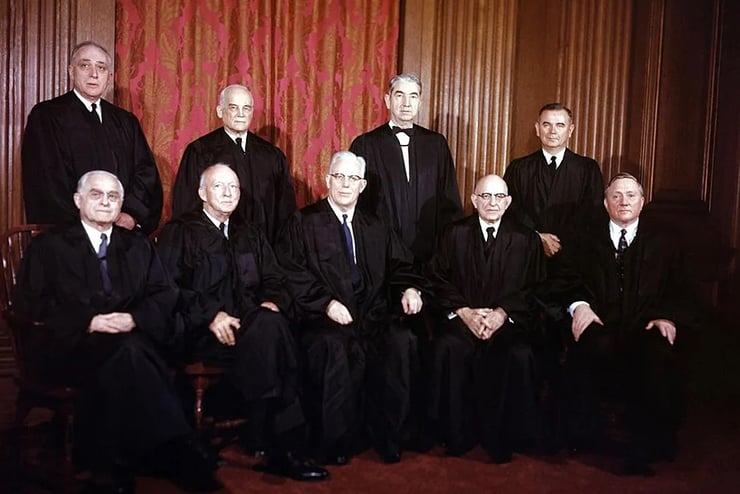
Anti-Trump conservatives like French are showing themselves to have short memories or demonstrable ignorance of their own movement’s history. Few, if any, seem to recall the main thrust of mid-century conservative critiques of the activist Warren Court. In the 1960s, scholars such as L. Brent Bozell Jr. and Charles Hyneman did not focus strictly on individual decisions and their constitutionally suspect bearings. Instead, these critics, especially when it came to the Warren Court’s rulings on voting, school prayer, freedom of speech, and criminal rights, were justly contemptuous of the Court’s obvious political maneuvering and the stunning absence in these decisions of any basis in the text or founding tradition. They were practicing not law but the reification of the normative political values and prejudices of the Court’s majority.
The most dangerous threat to the American constitutional system, they argued, was a notion of judicial supremacy that would inevitably politicize the Court and take politics away from the political process itself. Judicial review, as the Warren Court understood it, treated the Supreme Court’s rulings as the final, conclusive, and binding interpretation of the meaning of the Constitution, turning the Supreme Court from the weakest branch to a permanent constitutional convention and a lawmaking institution.
In Bozell’s 1966 magnum opus, The Warren Revolution, he bifurcated the Constitution between the fixed Constitution—that is, the written text of the Constitution itself—and the fluid or unwritten Constitution, based in custom and tradition which included questions that appeared “to be dealt with, and settled, by our written Constitution, but in point of fact are not settled by it.” Considering the ills of government by judiciary, Supreme Court decisions under the Warren Court had become “equivalent to a provision of the fixed Constitution.” The Court had, in effect, claimed sovereignty over areas of great social and political importance in which society had yet to reach consensus and in which its institutions associated with public policymaking were still operating towards consensus.
For decades, conservatives have been reluctant to consider Bozell’s logic—or, I might add, the thinking of either Robert Bork or Raoul Berger—because to do so would require them to admit the error of Brown v. Board of Education insofar as it greatly expanded the role of the Court in American political society. Brown was, in Bozell’s telling, the cornerstone in the Warren Revolution, which took the false doctrine of judicial supremacy and, in effect, made the Court the nation’s chief policymaker.
Judicial supremacy is false because the genius of the founding system was that it envisioned no chief or final arbiter of constitutional meaning, but presumed that all public authorities, state and federal, would compete with one another to guarantee American freedom. Too many have been ignorant of the history of their own movement and have inadvertently affirmed the normative values that were formerly considered the product of progressive thinking. The irony is that the same conservatives who reject Trump’s tariff policy on the principles of limited government and separation of powers are quick to embrace judicial supremacy so long as the judiciary imposes what they consider an originalist interpretation that produces conservative policy outcomes.
Other midcentury conservative thinkers understood that the rise of government by judiciary was a byproduct of Congress’s abdication of its constitutional duty to act as chief policymaker. As James Burnham put it in 1959’s Congress and the American Political Tradition, judicial review originally only arose as a necessary fiction to allow courts to declare what the law was or meant in a particular case. It was only after 1938, with Congress clashing frequently and for entire sessions with the executive, that the Court found itself acting as the executive’s political ally. Thus, according to Burnham, by the time of Brown, the Court, in active conjunction with the executive, had “scarcely troubled to hide the fact that it has been performing a legislative rather than judicial function.” The rise of judicial supremacy has, therefore, been a product of a deteriorating constitutional system. Too many conservatives have accepted this change and, rather than attempting to remedy it, have taken to viewing the Court as a potential savior of the American republic. But if politics is taken out of the political system and placed within the purview of the judiciary, only, it must be the opposite of republican government.
Today, the Court has escaped its act of mutual enhancement with the executive branch and now more fully embodies the roving convention that Bozell feared 60 years ago. Serious conservatives, wrestling with the profound questions of what is required to make our constitutional system function in a way that maintains a consensus-based society, should be reluctant to embrace either judicial or executive fiat. Per Bozell, we should remember that the founders’ system was predicated upon the interpretation and enforcement of the Constitution as a joint enterprise.
Leave a Reply