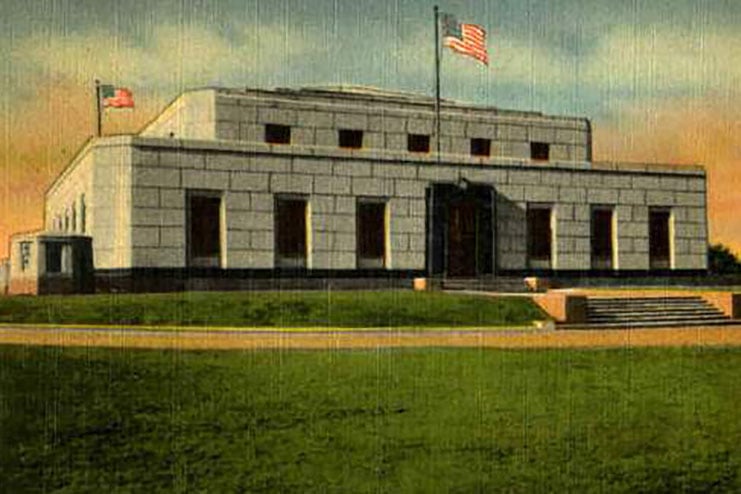
With all the recent attention on the remarkable price moves in gold and silver, it is surprising that the question of a comprehensive audit of the U.S. government’s gold reserves, a headline issue last year, has been conveniently memory-holed.
For a time in early 2025, both President Trump and Elon Musk, in his semi-official capacity as head of DOGE (the so-called Department of Government Efficiency), were vocal advocates of a comprehensive accounting of U.S. gold reserves. President Trump announced plans to audit Fort Knox. Musk offered to video it. But then something happened. Treasury Secretary Scott Bessent gave the public assurances that “all the gold is present and accounted for.” President Trump and Elon Musk suddenly stopped talking about it. The squirrel-like memory of the media grew tired of the subject. Soon they and the equally attention-deprived public forgot about it.
Yet the question remains important for the United States’ credibility among its creditors, both foreign and domestic, and for our country’s place in the international currency and monetary competition. Not to mention the right of Americans for government transparency.
In recent years, speculation has grown that perhaps the gold is not there, at least not all of it. It would seem, however, that this would be an easy concern to address.
Since the mid-1970s, the U.S. gold reserve has been reported stable at 8,133 tons. The gold currently held by the U.S. Treasury is fixed at the 1973 statutory price of $42.22. At the end of January 2026 with gold trading at around $5000/ounce, the accounting value of $11 billion had a market value of some $1.3 trillion, perhaps enough to give creditors some comfort. That is, if the gold is still there. This is not an unreasonable question about an asset that hasn’t been fully audited in over 70 years.
In 2025 Congressman Thomas Massie (R-Ky.) introduced the “Gold Reserve Transparency Act.” His bill called for an independent comprehensive audit that would require physical assay and inventory of all U.S. gold reserves every five years. A similar bill in the Senate proposed an accounting of any transactions in the government’s gold reserves from over the past 50 years.
An audit of U.S. gold reserves would not be easy. For Fort Knox alone, such an undertaking would require an estimated 18-24 months and 44,400 man-hours. A lot of work to be sure, but not a sufficient reason to forego the audit.
Other voices in the administration likely reminded President Trump of the need for continued security around Fort Knox, which would render a video production impractical and unwise.
Jim Rickards, a leading expert on gold and currency markets, offers another possible explanation. One of Rickards’ theories is that even if the gold is indeed there, some meaningful portion of it may be legally encumbered through contractual leases. Because these are paper agreements, the same physical gold may have been used as collateral for multiple contracts. This would mean that the gold is not “free and clear of liens,” and that a party other than the U.S. government may have a valid legal claim on it.
This is plausible, and so is an explanation centered around protecting national security. It is not like China would open up its vaults for inspection, either. But the sudden silence and unanswered questions from the administration may point to greater problems. There are times for secrecy, but, given the current widespread distrust in both government and financial institutions, this doesn’t feel like one of them. Even if there is a problem it should be disclosed and preemptively addressed.
Rep. Massie’s and a similar Senate proposal are still sitting in Congress, but no one is holding their breath. The administration has no interest in pursuing the question further. Just as with the so-called “Epstein files,” the lack of transparency provides little comfort but rather allows conspiracy theories, and in this case, investor doubts, to thrive.
The history of the U.S. government’s handling of its gold reserves is not reassuring.
In 1933, President Franklin D. Roosevelt made it illegal for Americans to hold more than a token amount (up to five ounces) of gold. The government acted with coercive force (including the threat of massive fines and up to 10-years’ imprisonment) to confiscate the estimated $1.5 billion in gold coins, bullion, and certificates held by ordinary Americans. This represented about five percent of the money supply, equivalent to about $1.1 trillion in liquidity terms today.
Then, in the midst of the Great Depression and the related banking crisis, the U.S. dollar was convertible into gold at an artificially low fixed rate of $20.67 per ounce. Anyone could walk into their bank and demand their paper currency be redeemed for gold. Because of the loss of confidence in the banking system, that is exactly what they were doing, as were foreign governments and banks that had a claim on gold held in the U.S. They were draining the U.S. government and banks of their gold reserves.
So, FDR declared a national emergency, confiscated citizens’ gold for $20, and the next year changed the official conversion rate upward by 67 percent to $35 per ounce. This mugging of the citizenry enabled money supply expansion, reduced the value of the dollar in foreign currency terms, and thus supported U.S. exports.
This was done in a context not unlike our own: rising geopolitical tensions, tariff wars, rearmament in Europe, competitive currency devaluations, and a scramble by governments around the world to shore up their gold reserves.
A generation (40 years) would pass before gold ownership became legal again for U.S. citizens.
But legalization of gold ownership in 1974 made the U.S. Treasury nervous. Officials were concerned that rising retail demand would fuel rising gold prices and lead to a further weakening of the U.S. dollar, already under pressure from President Nixon’s closing of the gold window in 1971 and the OPEC-led oil embargo in 1973. In order to keep gold prices down, the U.S. Treasury intervened in the market to the detriment of retail investors.
President Nixon’s move to close the gold window (which had allowed foreign governments and other holders to exchange their U.S. dollar paper claims for gold bullion) in 1971 came after several years of draining of U.S. gold reserves by foreign governments. After World War II, the U.S. held as much as 21,000 tons of gold. By 1971, the reserve had fallen to somewhere between 8,000 and 10,000 tons, depending on the source. The outflow had accelerated in the 1960s due to a coordinated effort by France, Britian, and other European nations. Seeking to shore up their own gold reserves, these countries were concerned about the U.S. fiscal position as a result of inflationary deficit spending on the Vietnam War and President Lyndon Johnson’s Great Society. By 1971, trade deficits were rising to unprecedented levels, and there were three times as many foreign claims as there were gold reserves to back them. Either the gold reserves would be completely depleted or convertibility suspended. Either course risked substantial U.S. dollar devaluation and economic chaos.
So, with the encouragement of the U.S. Treasury, President Nixon bit his thumb at the world and removed the gold backstop. The U.S. dollar would never again be supported by anything other than the “full faith and credit” of an increasingly indebted U.S. government.
After a period of currency instability and monetary disruption, all major currencies eventually floated against the U.S. dollar, which lost over one-third of its value in the 1970s. Rampant inflation ensued in the U.S.
We have never really recovered. Today’s dollar is worth about 12.5 cents in 1971’s purchasing power. In other words, the dollar has lost 87.5 percent of its value since losing its convertibility into gold. Today, we’re in the middle—not the end—of another monetary inflation cycle akin to the one we saw in the 1970s.
The rapidly rising prices in metals indicate another fundamental shift, and Americans should pay attention. The rising price of gold is a warning that, notwithstanding what the Consumer Price Index may say, inflation and dollar debasement are coming. Central banks around the world are stacking gold and silver, not U.S. dollars or other fiat currencies, as reserves. Currency exchange rates and monetary pressure will once again point to a Great Power conflict between the U.S. and China.
In the midst of this environment, it would be a modest comfort to receive verifiable confirmation that the U.S. indeed still holds what it reports on paper.
Leave a Reply