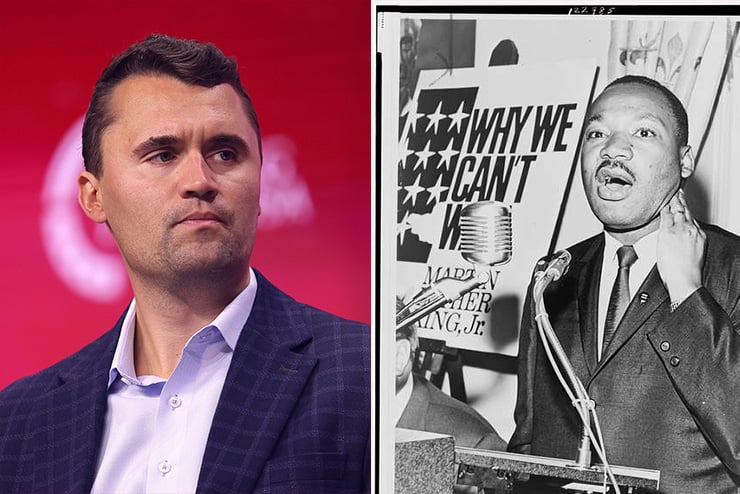
First Things Editor R. R. Reno’s elegy to the late Charlie Kirk rightly praises Kirk for his civil discourse, love of country, and Christian faith, but it centers on a wildly inept historical analogy. “Today, when I heard the terrible news that Charlie Kirk had been shot and killed,” writes Reno, “I thought again of Martin Luther King Jr.”
Those who are now attacking Kirk, according to Reno, resemble those who failed to recognize the achievement of Martin Luther King. “Both men represented movements that were upending the status quo.”
Kirk’s detractors, evidently, are like those earlier Americans who didn’t welcome long overdue reform. “The civil rights movement triggered a revolution in American public life,” writes Reno. “It overturned a longstanding consensus about race, and thankfully so. However, the movement’s success led to disbelief, anger, and bitterness among many whites.” In King’s case, as in Kirk’s, certain reactionary groups resisted the passing of an old—deeply flawed—order.
With due respect to Reno, Charlie Kirk differs from Martin Luther King in significant ways.
By the late 1960s, only a dwindling percentage of Americans were outright defenders of segregation, even if many still felt deep reservations about other issues that King and his movement were addressing. Unlike diehard segregationists, who had shrunk to a largely discredited minority even before King’s death in April 1968, the woke left today exercises considerable political and cultural control throughout the West. Those whom Reno views as the losing side in the cultural wars still set the cultural agenda across the West and regularly win elections. If only they were as irrelevant as Southern segregationists at the time of King’s assassination! Unfortunately, they’re not.
Reno also misrepresents Martin Luther King himself, who was far less worthy of veneration than Charlie Kirk. Although personally brave and often reacting to true injustice, King was, even according to his admiring biographer David Garrow, an outrageous womanizer, and one who depended on Communist advisors far more radical than his Republican panegyrists suggest. Kirk, by contrast, was a saintly Christian and a defender of open debate even with hateful foes.
Moreover, those who criticized King were not nihilistic cultural revolutionaries but were often justifiably troubled by King’s growing radicalization. This, of course, assumes that King moved toward the Black Power left late in his career, although there is evidence that he was going in that direction as early as his college days at Boston University.
The journalist Carl Horowitz, in the upcoming October issue of Chronicles, notes that many conservative establishmentarians cannot speak about American blacks without virtue signaling. They exaggerate how blacks are rushing into the GOP, as if this demographic finally sees the Democrats as “the party of slavery and Jim Crow.” The black underclass and black politicians, in this telling, are not accountable for the crime, debris, and unemployment in black cities. According to Republican celebrities and influencers, it is the Democratic Party—still apparently the party of John C. Calhoun and George Wallace—which has done and continues to do bad things to hapless black victims.
The view of King as a Christian conservative figure is part of this historical reconstruction. It therefore makes sense to present King as a precursor of Kirk and to compare King’s opponents to the radical left, which is celebrating Kirk’s assassination or pretending that Donald Trump caused it. This manipulation of facts for the sake of identifying blacks with the GOP exaggerates—to say the least—whatever rightward movements American blacks have made in recent years.
The conservative establishment should treat black political adversaries as they are, rather than as enthusiastic allies yearning to abandon the supposedly racist Democratic Party. Nor should they misrepresent King or his critics in the hope of scoring popularity points with those who are clearly not their friends.
What drives this misrepresentation, however, may be more than opportunism. Such behavior may also be motivated by what Rabbi Mayer Schiller once characterized as “the guilty conscience of a conservative.” The resulting narrative, whatever the motive, is far from convincing. The transfiguration of American blacks into Republican allies who have been wronged by the white racist Democratic Party is utterly laughable.
For those who haven’t noticed, members of the congressional black caucus have unanimously opposed a congressional proposal to pay tribute to Charlie Kirk. Only a Conservative Inc. commentator would be surprised.
Leave a Reply