Of course they had to make it about race. Race is their entire world—the prism through which everything must be viewed.
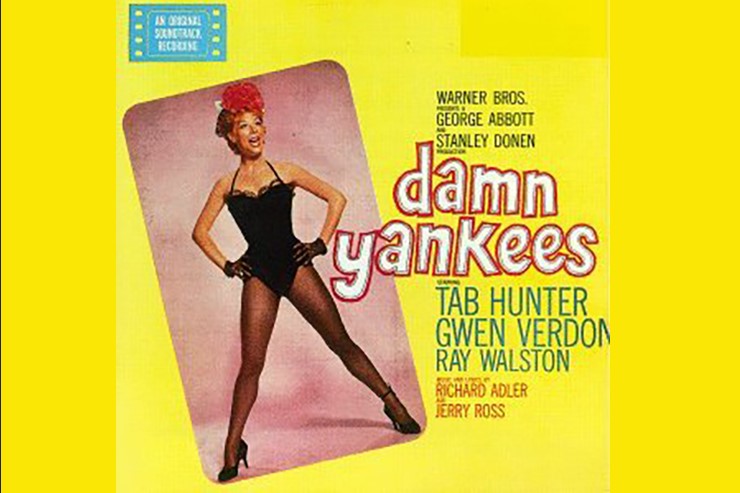
Arena Stage in Washington, D.C., has revived the classic musical Damn Yankees. The play tells the story of a man who trades his soul to the devil so that he might become a powerhouse young baseball player. His motivation is that he so desires his beloved team, the Washington Senators, to win the pennant that he feels driven to sacrifice himself.
However, this version is different. According to the Washington City Paper,director and choreographer Sergio Trujillo:
has called this production a “revisal,” rather than a revival, and the adapters have focused primarily on the book while dutifully leaving the highly underrated score intact (with some sensible lyric changes by Lynn Ahrens of Ragtime and more). Aside from pushing the timeline forward 45 years to 2000 and swapping in the Orioles for the then-defunct Washington Senators—a choice that avoids an anachronism but steals a little soul from this town’s devoted Nats fans—perhaps the most consequential change is the introduction of a new motivation for Joe’s ultimate deal with the devil: The desire to make his father, a minor league baseball player who was kept out of the major leagues because he was Black, proud of him.
Co-adaptors Will Power and Doug Wright have also attempted to give their women characters more agency. ‘The gender roles in the original piece were the gender roles in the 1950s,’ Wright explains. ‘But those gender roles happily don’t hold water today.’ Joe Boyd’s beloved wife, Meg, has her own busy work life in this production, and she confronts Joe over his disappearance instead of blithely accepting his return.
This woke “adaptation” of the musical particularly stings for me because I am convinced that Joe Hardy, the main character from the late Douglass Wallop’s novel The Year the Yankees Lost the Pennant, which was the inspiration for the original Damn Yankees, is based on my grandfather, Joe Judge, Sr. who was a star player on the Washington Senators during the years 1915-34. Wallop dated, and almost married, my Aunt Dorothy who was Joe Sr.’s youngest daughter in the 1940s. She once recalled to me that Wallop “loved baseball and was steeped in Senators’ history.”
There are some odd coincidences that lend further credence to the connection that has been part of my family’s lore for decades. Wallop’s character, Joe Hardy (Boyd in the musical), shares my grandfather’s first name, and in the 1958 film version, in which Wallop assisted, Joe mentions to the other players that he has just “rented a place in Chevy Chase,” which was where my grandfather lived.
Joe Judge played first base for the Washington Senators, and then for the Brooklyn Dodgers and Boston Red Sox during his last two years in the bigs. In his 18 years in major league baseball, he had a .298 batting average, 2,352 hits, 433 doubles, 1,037 RBIs, 1,500 double plays, and led the American League in fielding five times. After retiring, he coached at Georgetown for 20 years, sending several players to the majors. All in all, Joe Judge gave 40 years of his life to the game he loved.
There is a tremendous amount of talent behind the new version of Damn Yankees, but I really wish they had kept the original storyline. For one thing, it’s a timeless story with broad appeal about the love of baseball and the love of place and community. It is not supposed to be about bargaining with the devil based on racial resentments. Americans are tired of racial resentment.
My grandfather was not the kind of player, or the kind of man, who ever got into any scandals or drew a lot of attention to himself if it didn’t involve his play on the field. Family, friends, and sportswriters all described him the same way: polite, soft-spoken, and humble. A 1925 article in Baseball magazine described him as “the sheet anchor of the Washington infield.” Off the field, Judge was apparently the most sober and even-tempered man in any room. Relatives, players he coached, journalists—everyone with whom he came in contact—described him the same way: a gentleman.
My grandfather’s career took place partly during what is called the “dead ball era”—that is, before the 1920s. He learned to play a game that was about singles, bunts, fielding, and defense—not the home run derby that baseball became in the 1920s with the arrival of Babe Ruth. Ruth was a gigantic talent and an outsized personality, but he was also the forerunner of today’s spoiled brat athlete.
“The route to the common man’s heart is paved with ribaldry and excess,” baseball historian Harold Seymour wrote of Ruth’s hold on baseball fans. “What English king was more famous than Henry VIII?” One reporter noted that “Ruth is just a great, big, overgrown boy. He loves a good time, and… there are always scores of admirers on hand to see that it does not suffer any pangs of ennui.”
My grandfather once wrote about the Hall of Fame in the pages of Sports Illustrated. (It’s long been an open secret in the family that the article was, in fact, written by my father, who at the time was a writer for Life magazine.) Called “Verdict Against the Hall of Fame,” it was published in the June 6, 1959, issue of Sports Illustrated.
“The Hall has lost some of its meaning and much of its glory in recent years,” it read. My grandfather named players who were in the Hall for inappropriate reasons. Players like Joe Tinker, Johnny Evers, and Frank Chance were in simply because of the ring of their double-play combination, Tinker to Evers to Chance. Tinker’s lifetime average was .264, Evers’s was .270. The article pointed to catcher Ray Schacht, lifetime average .253, and shortstop Rabbit Maranville, who never once hit over .300. The essay then blasted the growing tendency to favor players with more personality than talent: “To be a credit to the game of baseball, a man need not have got off a record number of wise cracks or assembled a record number of feature-stories. There are a lot of colorful palookas.”
He went on:
BQIn my day, by the time the infield was finished spitting tobacco juice and licorice and rubbing the ball down with mud, especially on a dark afternoon, the ball would come at you looking like a clump of coal. A great hitter would lay the wood on it regardless of the side it was thrown from or the stuff on it. That same man could steal the base that made the difference. He was fast enough so that the hit-and-run and bunt-and-run were always possible. And when he got back to his position he would come up with a great catch, the great save, the great throw that meant winning instead of losing.
Today many so-called sluggers couldn’t steal a base if they were alone in the park. They are not expected to throw too well or run too fast as long as they can belt the ball out of the park when their one moment of usefulness arrives. The idea of being a team member sometimes is lost completely, and what we have is an association of specialist businessmen investing their specific talents and carefully watching their own special interests, upon which they hope to declare a dividend the following year.EBQ
On May 1, 1931, Joe Judge took himself out of a game in Boston. He had his appendix removed the following day. He was 36, and the operation ended his career in the majors. He bought a restaurant in D.C. that he called, simply, Joe Judge’s. Then he took a job coaching ball at Georgetown University, a job he loved. In 1959, he was forced to retire because he hit 65 years of age. By then, baseball was broadcast on television and Grandpa could watch from home.
My father used to say that Gramps was exactly like the crotchety old man watching the Nats losing in the beginning of Damn Yankees—razzing the players on his TV and trying to show the generation that pushed him out how to play the game.
My grandfather died after suffering a heart attack while shoveling snow on March 11, 1963. The papers reported the news, calling him “The greatest of all the Senators’ first basemen.” Columnist George Clifford of the Washington Daily News summed him up this way: “Joe Judge was not a character in the clownish, bittersweet fashion of sports. The stories about him become legends simply because of his ability.” Perhaps the best line to summarize my grandfather came from Sam Rice, the great Senators outfielder. Upon learning of Joe Judge’s death, Rice said, “There was no play he couldn’t make.”
Addendum: For most of my life, my family and I have been trying to get gramps into the Hall of Fame. I recently received an encouraging email full of interesting informaton from Craig Muder. Mr. Muder is the Director of Communications National Baseball Hall of Fame and Museum. He was responding to a note I sent him about about the prospect:
Dear Mark,
Thank you very much for your note.
Please understand that the Hall of Fame is not—and never has been—involved in electing candidates for enshrinement. The Baseball Writers’ Association of America (BBWAA) and the committees on managers, umpires, executives and long-retired players are the only bodies that elect eligible candidates to the Hall of Fame.
Election to the Baseball Hall of Fame is the greatest honor in all of sport. Only a little more than one percent of all the 23,000-plus men who have played Major League Baseball are enshrined at the Hall of Fame.
Joe Judge had a wonderful big league career and remains eligible for Hall of Fame election….Joe Judge would be considered in Classic Baseball Era election since he spent the entirety of his career in that era. To write a letter of support for Joe Judge to the Historical Overview Committee, you can use the following address:
Historical Overview Committee
Baseball Hall of Fame
25 Main Street
Cooperstown, NY 13326
All letters of support for any candidate are made available to the Historical Overview Committee should they ask to see them. Only letters sent by standard mail can be accepted.
Thank you again for your interest in the Baseball Hall of Fame. We hope to see you soon in Cooperstown!
Sincerely,
Craig Muder
Director of Communications
National Baseball Hall of Fame and MuseumEBQ
I was happy to read the encouraging news that there is still a taste for the Classic Baseball Era at the Hall of Fame. I think there is still an appetite for that way of playing ball, too—just as there is for a classic story about the game like Damn Yankees. It’s too bad that the producers felt the need to include so many nods to modern excess in this production.
Leave a Reply