M. E. Bradford was, above all, an evangelist for the conservative South. He could never give up on his home region or its people. In his 1985 collection, Remembering Who We Are, he is at his freewheeling best. Written over the preceding 20 years, these essays discuss a range of personalities, including Abraham Lincoln, William Faulkner, and Richard Weaver, and subjects such as the Southern Agrarian movement, America’s immigration history, and the literature of the American West.
Most of all, Bradford celebrates the achievements of the Southern Agrarian literati, including John Crowe Ransom, Allen Tate, Donald Davidson, Andrew Lytle, and Robert Penn Warren. These artists and intellectuals from Vanderbilt University contributed to the 1930 manifesto I’ll Take My Stand, which outlined the Southern Agrarian project for a more traditional way of life to counter the atomizing, deracinating effect of modern industrial culture. The Agrarians would attempt, through the teaching of literature and history, to influence not just American letters but the nascent conservative movement.
It’s hard to imagine now, but in Bradford’s day, it seemed possible that universities like Vanderbilt could become ground zero for conservative culture. He had studied under Davidson at Vanderbilt in the 1950s and had been converted to Agrarianism. From then on, he was a man on a mission. During his career, he would expand upon the theories of Davidson and Weaver, living out the classic tale of the pupil surpassing the masters.Based on his own experience, Bradford believed that 100 conservative men and women strategically placed at various universities could transform America’s culture and politics.
Bradford was a prolific scholar, in both scope and volume. His work included studies of the Founders and their beliefs. They were Christian men who were critical of mass democracy and egalitarianism, Bradford argued, contrary to modern attempts to portray them as atheistic leftists.
The essays in this collection also touch on his later plunge into electoral politics, particularly his 1976 support for Ronald Reagan’s insurgent campaign against President Gerald R. Ford in that year’s presidential primaries. His support for Reagan helped make voting Republican respectable, not just in Texas, but across the South. This Democrat-turned-Republican also had a tip on how the elephant can snap up George Wallace voters. “I have seen a county carried by two choruses of ‘Dixie’ played on loudspeakers on a moving flatbed truck,” Bradford observed. Republicans, don’t be shy.
—Joseph Scotchie
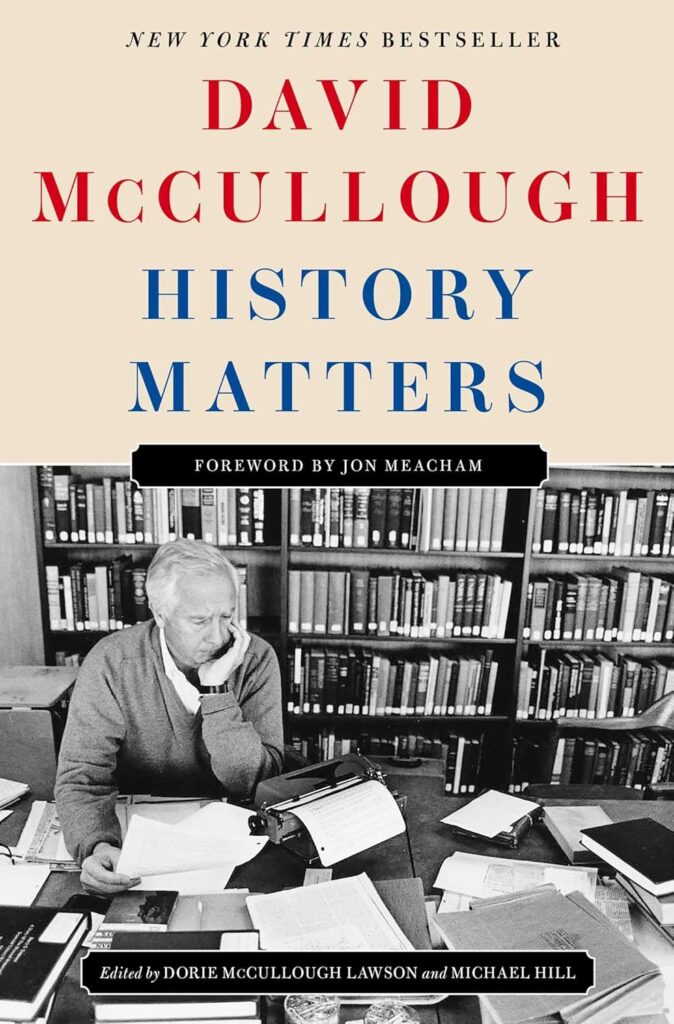
A gentleman I encountered at a party told me he had just picked up a new book about the American Revolution. He was struggling to recall the author, so I tried to help him: “Was it David McCullough?” He sneered, as if only a simpleton would be caught dead reading a historian with such mass appeal. But that was McCullough’s gift: He made history interesting. A woman had once remarked to McCullough after hearing about his book The Great Bridge, “Who in the world would ever want to read a book about the Brooklyn Bridge?” As he told The Paris Review: “I was determined to prove her wrong.”
McCullough, who died in 2022, authored such eminently readable books as Mornings on Horseback, 1776, Truman, and John Adams. His daughter Dorie, along with his longtime research assistant, have decided to offer his readers one final dispatch from the historian. Although perhaps little substitute for a final, immaculately researched book by McCullough himself, History Matters offers a more informal view of the man through a collection of essays, interviews, and remarks by the author, some previously unpublished.
We learn more about McCullough’s reverence for Washington and Truman, but also for less well known figures mostly lost to history, such as painter and photographer Thomas Eakins, and Manasseh Cutler, an 18th-century polymath.
We also discover the book that changed McCullough’s life, Writers at Work, a collection of Paris Review interviews with authors about their craft. In his own interview with the magazine, he offers tips: closely studying one’s subject to see what others might have missed; writing four pages every day, whether one feels like it or not; and aiming to write what you would enjoy reading—something that is a pleasure rather than a chore.
McCullough has emphasized the importance of not only reading the works of his subjects but also reading the authors they themselves read. As it turns out, one of the best parts of History Matters is McCullough’s reading lists. Among his favorites were Robert Penn Warren’s All the King’s Men, Winston Churchill’s Painting as a Pastime, and the journal of the painter Eugène Delacroix. (McCullough himself was a watercolorist, often painting for a month or two after finishing one book and before beginning the next.) Just as McCullough explored the lives of his subjects, History Matters allows one to better understand the great popular historian.
—Erich J. Prince
Leave a Reply