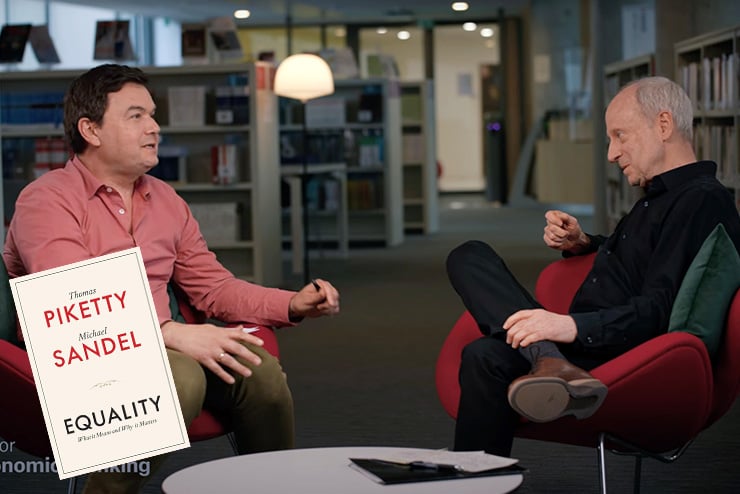
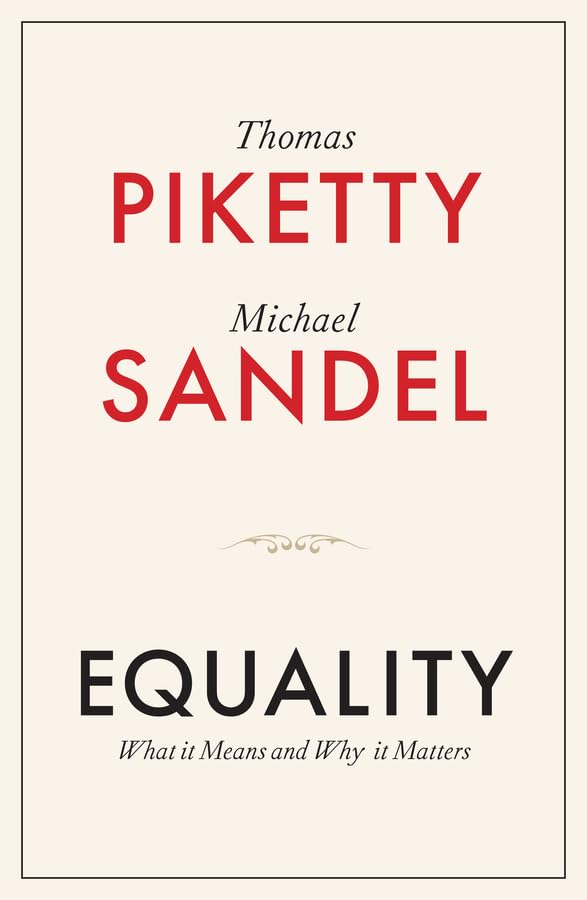
Equality: What It Means and
Why It Matters
by Thomas Piketty and Michael Sandel
Polity
128 pp., $15.00
Inequality is a universal feature of human societies. This is an indisputable claim, as the evidence supporting it is overwhelming. No society without inequality has ever existed, and it is difficult even to imagine what a society with no inequality would look like.
Given this fact, one might ask the authors of a book that expresses great concern about inequality to tell us why we should be as anxiously troubled as they are. Astonishingly, Thomas Piketty and Michael Sandel never get around to doing this.
The book’s first section bears the appropriate question as its title: “Why worry about inequality?” But no answer to the question is even suggested by the authors. There is no discussion of why and in what forms inequality is a bad or avoidable thing. The book simply posits “democracy” and “equality” as a priori, unquestionable goods—sacred idols, in fact. All proceeds from there. Not a word on the social good of freedom or its typically thorny and antagonistic relationship to equality. And nothing on the naturalness of inequality, including its presence everywhere in the biological world.
This is an inauspicious beginning. A serious argument cannot presume in advance the core principle from which it proceeds. Perhaps most of those who have been subjected to higher education today will agree with the unargued principle that equality is inherently good—perhaps those are the only readers Piketty and Sandel care to reach. But it is telling that these elite intellectuals on the left no longer think it’s necessary to lay out the case for the egalitarian regime they desire.
To get to true equality, access to “basic goods” must be made equal. The authors blithely note that “basic goods” have, in their view, no concrete referent in the material world. That is, there is no objective socioeconomic level we can point to as the border of the category “poverty.” “Basic goods” is a social construct, so we must constantly update the standard—which always means raising it—to accord with current social circumstances. If at a given time most nonpoor people have wide-screen television sets or smart phones or programmable central air, then those magically become basic goods, and our quest for equality must build those presuppositions into the project.
Piketty and Sandel say that meritocracy in the West is short of “perfect” because mobility from low to upper classes is “limited.” But they do not say what would make up an acceptable level of mobility. Should 50 percent of the poor become middle-class in their lifetimes? Seventy-five percent? To be clear, though, meritocracy, however perfect, is not even their goal, since that convinces people that those at the top deserve to be there. We absolutely cannot have that. We must instead imbue elites with a broad sense of responsibility for those below.
The authors advance the concept of “decommodification,” meaning the state subsidization of as many “basic needs” as possible. They cheer for the good old days, when the highest American tax rates were north of 80 percent. They are predictably enthusiastic about the efforts in Western Europe toward a decommodified society. “Look how well the social democracies have worked!” they cheer. They are silent on the ways in which those states are rethinking such policies and making sweeping cuts to public expenditures to cope with out-of-control mass immigration. They claim there were no negative effects on the American economy due to the tax rates in the mid-20th century. Somehow, they missed the huge federal budget deficits of the 1970s created by Great Society overspending that occurred simultaneously with high tax rates.
There can be no retreat from utopian egalitarianism programs, according to Piketty and Sandel. On the contrary, we must push even harder. We must transform mere “social democracies” into “participatory and democratic socialist” states. Piketty calls for a “federal internationalist socialism” together with a “United States of the World with progressive taxation.”
The dirty secret is that there is no logical limit to “decommodification” and there is no upper bracket tax rate high enough to pay for all the welfare programs that Piketty and Sandel desire. Take 100 percent from the top earners and you will still have deficits, because there is no limit to what the ruling class will spend.
Piketty and Sandel don’t consider what will happen when people come to realize that they cannot pass the benefits of their labor on to their children because those benefits will be expropriated by the “internationalist socialist” state. They admit the return to 80-percent upper tax rates will be hard to achieve politically because the upper and lower classes in America are so wholly separate in their social lives. As Charles Murray noted in Coming Apart, the elites despise those below them. Getting them to materially ante up in the way their forebears did in the 1950s will require broad cultural change. Piketty and Sandel’s only effort to suggest how this will be done is to channel vintage Obama in challenging the foolish idea that individuals have a right to their own money: “I’m sorry; this is not your money. This comes from the collective labor of millions of people.”
Often, the authors are hilariously unaware of the evidence that belies their claims about “successes.” Piketty cites India as an example of the benefits of a loading model for filling positions in government, in which certain positions are set aside, and all parties must present candidates for those positions from the lower castes. But how has that changed inequality in India? The top 1 percent of India’s wealthiest people still control 80 percent of the country’s wealth.
Equality will require more than the systematic expropriation of the wealthy. We will also need more people in college, though the evidence is vast that this is unsustainable. Piketty and Sandel are against legacy admissions in higher education. It is clear, though, that legacy admissions do not contribute to the drop in overall objective student academic accomplishment, but that affirmative action undeniably does. In fact, legacy students have higher test scores on average and typically have other characteristics that make them more qualified than the average student.
One need not even get into the financial benefit of legacy admissions—the potential for schools to reap increased donations from well-off families with multiple generations of graduates—to understand that what is driving the view of Piketty and Sandel here has nothing to do with concern for overall standards in admissions. They are posturing in the same way as people who know nothing about higher education trot out legacy admissions whenever it is pointed out how much damage is done to merit by affirmative action. “Egalitarian decommodification has been a great success” in higher education, they claim, and provide no evidence to counter the overwhelming data indicating the opposite.
Rather than by legacy or meritocracy, Piketty and Sandel want a lottery system for higher education admissions. In Sandel’s vision, schools would place all applicants who met minimal requirements into a hat and pick them at random. This, he believes, would eliminate the advantages that accrue to candidates from wealthier families. Piketty wants to go still further and make it mandatory that half of all acceptances come from the lower two-thirds of the socioeconomic ladder.
Of course, neither method will destroy the advantages of those from wealthy families. The decreased number of slots available to them may just make their efforts to advance the causes of their offspring even more vigorous. And what will happen when the elite families, who currently provide the lion’s share of college donations, begin to understand that the Sandel-Piketty admissions standards are designed to handicap their children? Don’t be surprised when they decide they no longer want to financially support institutions that discriminate against their families.
At this point, you will be unsurprised to learn that there is a section in the book on “borders and migration” that does not even hint at the impact of cultural or educational differences between migrants and native populations. This is like discussing the physical attributes of birds without mentioning wings.
Toward the book’s end, Sandel quotes Rousseau at length on private property as the root of all social conflict and inequality. “That… is pretty powerful,” he comments. Piketty agrees that inequality in property and disparities in talent are nothing more than problems to be overcome.
Sandel has two sons; Piketty has three daughters. It would be interesting to know what work they have done to help their own children advance, and whether any of those children have attended elite schools. Public figures who are zealous egalitarians should make such information known, as it is essential for evaluating their intellectual seriousness. If they themselves do not take their egalitarianism seriously, then why should we?
Leave a Reply