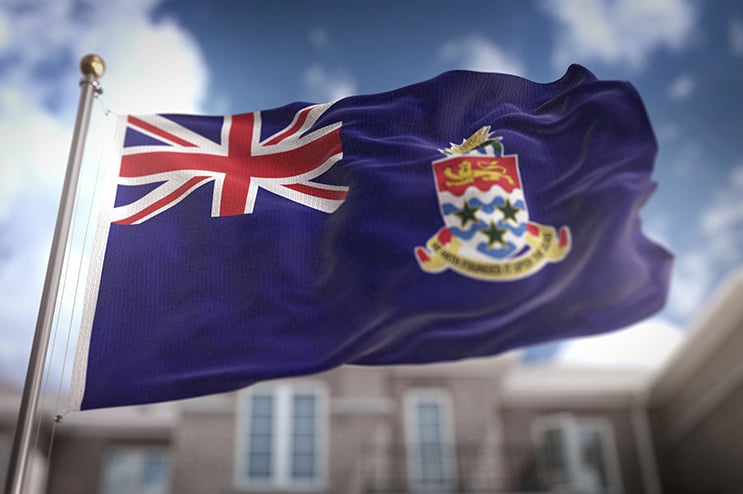
A small group of Federal Reserve economists raised alarm bells recently with the publication at the Fed’s website of an article showing that our current system depends on a group of shadowy hedge funds in the Cayman Islands lending huge sums of money to the United States government at low interest rates. We don’t know who is financing this lending operation or why they are doing it. But the entire federal government, apparently, depends on this money.
Once the largest purchaser of U.S. government debt, the Chinese, along with other countries, began dumping their holdings some time ago. At the same time, the Federal Reserve reversed its seemingly interminable program of buying treasuries under the guise of responding, first, to the 2008 financial crisis and then the 2020 COVID-related financial panic.
Slowly, but surely, both the Fed and the Chinese offloaded trillions in U.S. government debt at the same time the government ran record deficits—flooding the market with ever more IOUs. Basic laws of supply and demand dictate that when supply increases and demand craters, the price of the bond remains … unaffected and stable. Not what you’re expecting? Well, that’s what’s happening.
So these plucky economists from the Federal Reserve set to crunching the numbers and discovered that a group of hedge funds headquartered in the Cayman Islands have been buying eye-popping levels of treasuries. In fact, they’ve purchased so many treasuries that they have become the world’s leading holder—surpassing China, Japan, and the United Kingdom.
Like a lot of Americans I associate the Cayman Islands with John Grisham’s crime novel, The Firm, in which the Cayman Islands were exploited by lawyers seeking to perform money laundering operations without the scrutiny of federal regulators. As in the book, these bond purchases were largely undetected by the Federal Reserve’s official source of such data, the “U.S. Treasury International Capital (TIC).” Indeed, the Cayman Island treasury purchase operations were sufficiently secretive to cause the TIC data to “severely undercount Cayman-domiciled hedge funds’ holdings of U.S. Treasuries by around $1.4 trillion as of the end of 2024.”
The economists looked at secondary data to create an estimate of the true size of the Cayman Islands Hedge Funds and concluded the real number is closer to $1.8 trillion as of the end of 2024. What’s more, it’s not clear from the available data why these hedge funds are accumulating treasuries. The economists wrote, “Importantly, this $1.4 trillion gap is not solely attributable to the basis trade.”
What is “basis trade?” It’s hard to find a digestible explanation but my own understanding is that it’s comparable to pawn shop lending. If you take your grandmother’s wedding ring to a pawn shop, the dealer lends you money and gives you a ticket. When you come back with the ticket, the money, and a little extra in interest, you get the ring back. A “repo” agreement does something similar with treasuries. Clever bond traders have figured out that they can sometimes make a little money by selling the ticket on credit for more than they paid for the bonds. It’s a highly risky type of trade that requires huge amounts of borrowing to make small margins. Officially, that’s the explanation for why these hedge funds are buying so many bonds. But the economists who produced this paper aren’t so sure.
The timing of these huge purchases happens to coincide with collapse in demand for treasuries.
Our findings suggest that Cayman Islands hedge funds are, increasingly, the marginal foreign buyers of U.S. Treasury notes and bonds. As shown in Figure 5, between January 2022 and December 2024, a time when the Federal Reserve was reducing the size of its balance sheet by allowing maturing Treasuries to roll off from its portfolio, Cayman Islands hedge funds purchased, on net, $1.2 trillion of Treasury securities…they absorbed 37% of net issuance of notes and bonds, nearly the same amount as all other foreign investors combined.21 Furthermore, …the Cayman Islands is in fact the largest foreign holder of U.S. Treasury securities—holding significantly more than China, Japan, and the United Kingdom.
The economists noted,
The cross-border nature of the hedge fund basis trade implies that we should see this activity in the Treasury International Capital data on cross-border flows and positions of U.S. Treasury securities. However, TIC data on Cayman Islands holdings of Treasuries do not appear to be picking up the Treasury transactions associated with the basis trade activity that we observe from hedge fund filings in Form PF.
In other words, vast sums of money are backfilling the demand for U.S. debt preventing a collapse in demand for the treasuries. This is being done in a way that evades official data gathering. It’s not clear who is doing this or why—nor is it clear that anyone could make much money on such an enormous financial venture. Why is the data not showing up in official numbers? The economists say the reason, “is under active investigation.”
Without these massive purchases of treasuries, interest rates in the United States would spike to staggering levels. Outside of these mystery purchasers, traditional buyers of U.S. debt have switched to gold or other investments. Without these massive purchases in the Cayman Islands, the United States would be unable to sustain its current spending. We would be in an immediate and severe financial crisis.
To whom or what do we owe this support for our staggering debt? It’s hard to think of any explanation other than the buying comes from purchases backed by the Federal Reserve itself. Like the bubble leading up to the 2008 financial crisis, it’s difficult to imagine that investors would expose themselves without an implicit or explicit guarantee. Under this hypothesis, the Fed is the true counterparty in these offshore investments. It has engineered a way for bond dealers to get rich so long as they warehouse these bonds using borrowed money that’s guaranteed by the Fed through commercial banks. Only the Fed has both the money and the risk tolerance to accommodate this operation.
The situation is rapidly deteriorating and may come to a head in the coming months. The current path only works if the Fed incentivizes bond purchases faster than inflation and debt service balloons the budget. The minute people realize that the inflation numbers have been set to justify artificially low interest rates, the whole scam could come crashing down like a house of cards.
We’re closer to that moment than people might think. The official inflation number of 2.9 percent seems to contradict the lived experience of Americans and, as I wrote here, “if real inflation is around 8 percent, interest rates will need to exceed that by at least 2 percent if we are being honest about reality. That would quickly lead to interest payments that exceed all income tax.”
The fact that the net return on treasuries could be considered negative may explain why gold is becoming the reserve asset of choice as other countries flee the U.S. treasury. Our debt has become so large that even a tiny revision to inflation could set off a chain reaction that could balloon federal interest payments and starve the government of funding. Buckle up.
Leave a Reply