Satirist and Defender of Moral Order
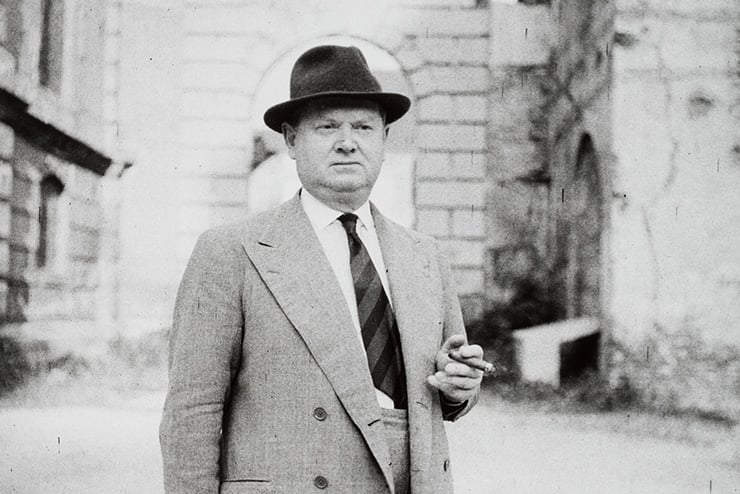
Evelyn Waugh was the 20th century’s finest satirist and perhaps the greatest in the English-speaking world after Jonathan Swift. Born in 1903 in London, Waugh was the second son of a prominent publisher whose firm, Chapman and Hall, published many of Waugh’s own books. He was educated at Oxford, where he read history for two years and lived a rather dissipated, rebellious life, leaving without a degree. Waugh turned seriously to writing only in the late 1920s. In 1930, he married his first wife, also named Evelyn. Within a year, she abandoned Waugh for another man—a sense of betrayal haunted Waugh for decades and may have contributed to his conversion to Roman Catholicism that same year. In 1937, after his first marriage was annulled, he married Laura Herbert, a Catholic. They produced seven children.
Waugh’s first novel, Decline and Fall (1928), announces his lifelong preoccupation with the theme explored by Oswald Spengler in The Decline of the West. Though Waugh never embraced Spengler’s ponderously Teutonic theorizing about the morphology of civilizations, he shared Spengler’s view that the sun had all but set upon the West. Everywhere he turned, Waugh saw the collapse of classical and Christian moral standards and the erosion, driven by egalitarian envy, of the hierarchies that had sustained the European social order for centuries.
In five early novels, Waugh explored the follies of the London set known as the Bright Young Things. Employing emotionally detached narrators, these novels expose—without any explicit moralizing—the utterly vacant lives of a generation of listless souls who parrot faux Cockney dialect and perpetually gad about in search of superficial distractions: champagne parties, car races, jazz clubs, scavenger hunts. Driven by ennui or apolitical nihilism, they are the disenchanted children of
the British aristocracy.
In the first of these novels, Vile Bodies (1930), Waugh sardonically explores the debasement of bodies devoted solely to amusement and the pleasures of the flesh. Yet, ironically, the Bright Young Things really seem to find the flesh abhorrent. They are disgusted by sexual encounters and can hardly even bear eating food. In one scene, the protagonist, Adam Fenwick-Symes, longs to live,
as Jehovah was said to have done, on the savor of burnt offerings…. He planned dinners of enchanting aromatic foods that should be carried under the nose, snuffed and thrown to the dogs.
While the early novels show little of Waugh’s Catholicism, A Handful of Dust (1934) reveals an undercurrent of tragic depth. The protagonist, Tony Last, is a passive young man devoid of moral purpose. Yet he does have one redeeming feature: He is devoted to the preservation of his family’s ancestral estate, Hetton Abbey, and is attached to the “ceremonious order” of his Sunday mornings just as his parents were, attending services at the local Anglican church in a dark suit and a “stiff white collar” that his young wife, Brenda, mocks. She loathes country life and is forever running off to London, where she becomes involved in an adulterous affair with a vapid young man known as John Beaver. Nonetheless, she manages almost absent-mindedly to produce an heir, whose death a few years later leaves her indifferent. Thereafter, she abandons Tony, just as Waugh’s first wife had abandoned him.
Tony, inconsolable, undertakes a journey into the jungle of British Guiana, where, after his guide is killed, his life is saved by the illiterate, mulatto son of an English missionary who drugs him and forces him daily to read aloud the novels of Charles Dickens. In the end, Tony is condemned to a sentimental Dickensian limbo of Little Dorrits and Martin Chuzzlewits, surrounded by savages and a demonic, if courteous, jailer. While the narrator never draws a direct parallel between the crude barbarism of Guiana and the more sophisticated barbarity of interwar London, the analogy is implicit.
As Waugh’s able biographer Martin Stannard argues, “What Waugh offers us in A Handful of Dust … is the humanist reductio ad absurdum, the life without (or at least in ignorance of) God.” Tony’s expedition into the wastelands of colonial Guiana is an encounter with “a civilization crumbling at its extremities.”
Waugh’s literary career in the 1930s was lucrative, allowing him to purchase a country estate, known as Piers Court, in Gloucestershire, a home situated on a site that at one time had been a Royalist stronghold, which Parliamentary troops under Cromwell had burned to the ground. This acquisition allowed him to construct a new identity. Surrounded by the trappings of aristocracy, Waugh enjoyed playing the role of elitist snob—thumbing his nose, in effect, at all those who sang the praises of the brave new socialist world that was emerging out of the rubble of merry old England.
Waugh was convinced that social hierarchy was not merely inevitable but a positive good for human society. Accordingly, he opposed egalitarian calls for social reform throughout the 1930s.
Waugh was never a cheerleader for capitalism, but he despised socialists of every stripe. This was evident not only in his novels but especially in his 1939 excursus on Mexico, Robbery Under Law, which was marketed as a travel book but was really an attack on the ongoing Mexican Revolution. Mexico’s President Lázaro Cárdenas (1934–1940) had nationalized foreign oil companies (primarily British ones) and implemented extensive educational and agrarian reform on a socialist model. In addition, he had secularized religious schools and in many cases confiscated their land. With his traveler’s eye for details, Waugh argued that under Cárdenas, Mexico was sliding toward a totalitarian nightmare that was at once tragic and absurd—the latter well illustrated by his visit to the National Museum in Mexico City. There, he discovered that when “the Cardenas regime introduced the classless era,” all museum workers were unionized within the Labour Front. The union declared the museum a closed shop and required all upper-tier specialists (catalogers, exhibit arrangers, etc.) to join. As a result, notes Waugh,
the janitor is the boss; he enjoys meetings and calls them frequently; he has the power to fire absentees, which he uses with relish…. Thus a floor cleaner may, and probably will, find himself in charge of the Mayan antiquities.
The problem with these socialist experiments, he argues, is that in order to achieve their utopian objectives, they first have to destroy “natural communities of historical commonality”—in short, social hierarchies that had evolved over centuries. What resulted was not so much a flattening of the social order as a reversal of the old relations, one in which workers became directors, in part because labor unions held the power of the strike and could bring whole sectors of the economy to a halt overnight.
From Waugh’s perspective, the British struggle against National Socialism had something in common with the mismanagement of the Mexican National Museum. World War II transformed British society by advancing many of the egalitarian goals Labour had pursued during the 1930s. The war required vast collective efforts and concentrated manpower, including evacuations, mobilizations, coordinated movements of troops around the globe, mutual defense during air raids, production of armaments, and much shared privation. Temporary confiscation of estates and agricultural lands became routine. More generally, the populace learned to look to the central government for a large number of services that had previously been privatized.
Ironically, then, much of what Waugh had looked upon with horror in Mexico was transpiring even as he did his part in the war effort—first as a Royal Marine and later as part of an independent commando unit in Crete and as an “observer” among the partisans in Yugoslavia. His Sword of Honour trilogy (1952–1961)brilliantly reflects his war service. While the trilogy is decidedly satirical, the work is also more overtly Catholic in its perspective than the earlier novels (excepting Brideshead Revisited, published in 1945).
Sword of Honour’s protagonist, Guy Crouchback, hails from an ancient Catholic family and shares something of the passivity of Waugh’s earlier protagonists. He is a deeply sympathetic figure who loathes both the Nazis and the Soviets for their godlessness and hopes to find a place in the struggle that will satisfy his sense of honor. He imagines himself a kind of medieval crusader, like one of his own ancestors, taking up arms against the infidel in the name of European Christianity. Thus, at the age of 36, he becomes an officer in the Royal Halberdiers, an ancient military order. Among the Halberdiers, he believes that he will be fighting alongside men who share his own notions of honor. With this and much else, he becomes deeply disillusioned.
Guy’s fellow officers prove, with one or two exceptions, to be time-serving bureaucrats, cowards, lunatics, or simply schemers for position and acclaim. When it becomes apparent that the Soviets will be celebrated as allies (while their genocidal crimes against Catholic Poland are ignored), Guy’s sense of betrayal is complete. This is powerfully symbolized in the final novel, Unconditional Surrender, when a sword forged in England to be presented to the Soviets in recognition of their victory at Stalingrad is displayed at Westminster Abbey. The British public flocks to see the sword as Fleet Street and state organs of propaganda insist that their erstwhile enemies are really their friends and potential liberators—a shift in opinion encouraged by Prime Minister Winston Churchill and a foreshadowing of the betrayal of Eastern Europe at Malta several years later.
One of Waugh’s later books, the novella Love Among the Ruins (1953), is charged with splenetic fury against the totalitarian society he saw emerging in postwar England. Like Orwell’s 1984, it is a dystopian vision, but it delves more deeply into the collapse of traditional moral order than that novel does. Incensed by Clement Attlee’s landslide Labour victory in 1945, Waugh commented in his diary, “The French called the occupying German army ‘the grey lice.’ That is precisely how I regard the occupying army of English socialist government.”
Waugh’s fictional protest against this occupation takes place in a futuristic England where most of the population dwells in domed cities. In this new order, state-sponsored euthanasia is routine, and radical reform of the penal code has resulted in prisons that are more like luxurious recreational centers, for in the socialist paradise “no man can be held responsible for his own acts.” Indeed, one spokesman states, “In the New Britain we are building, there are no criminals. There are only the victims of inadequate social services.” (It is worth noting that in a 1949 letter to the author Nancy Mitford, Waugh mentions that an actual prison “without bars” had been erected not far from his estate, where an in-house stage production of Hitchcock’s film Rope was performed by a cast of convicted murderers.)
The novella’s protagonist, Miles Plastic, is an arsonist who is expelled from his Edenesque prison grounds and given employment at the central euthanasia facility, Satellite City, administered by one Dr. Beamish, a serial killer whom the state has repurposed. Miles feels himself an “exile” from paradise and still carries his lethal lighter in his pocket. In his loneliness, he becomes attached to Clara, a former ballerina who, after a botched sterilization, has grown an impressive beard. It is precisely because her new bewhiskered face violates the “standard canons” of beauty that he falls in love with her. But the narcissistic Clara has different ideas. She hopes to return to the stage and leaps at the opportunity to undergo plastic surgery. The result is appalling. Her hirsute visage is replaced by a rubberized face that is modeled with perfect classical symmetry, allowing her to return to her old life. In his love for Clara, Miles felt that he had recovered the paradisial world from which he had been so rudely thrust. Now, in a passion for retribution, he resorts to his lighter and burns his former prison to the ground, killing most of its inmates.
In a perverse way, Miles is an admirable character—a hero, even—for he is the only character in the tale who refuses to accept rehabilitation. His final act of arson is an act of protest against a state in which romantic love has been reduced to an endless round of sexual pleasure. “Love,” we learn, “was a term seldom used except by politicians and by them only in moments of pure fatuity.”
Just a few years before his death, as the Second Vatican Council was deliberating over the great changes that would soon sweep through the Roman Catholic world, Waugh penned a piece for The Spectator’s November 1962 issue, in which he presents himself as an ordinary Catholic concerned about the changes contemplated by the council’s periti. Among other reservations, he has serious doubts about the advisability of making vernacular masses universal. Does the laity really desire “intelligibility” in the liturgy? he asks. And, in any event,
the vernacular used may either be precise and prosaic, in which case it has the stilted manner of a civil servant’s correspondence, or poetic and euphonious, in which case it will tend towards the archaic and less intelligible.
Mercifully for Waugh, he did not live long enough to learn that the “stilted manner of a civil servant” would, all too often, become the language of the sacred mysteries. On April 10, 1966, he died of heart failure, having attended a Latin mass that Easter morning.
Leave a Reply