The Godfather of American Law
Sir William Blackstone is the godfather of American law. His greatest contribution is the Commentaries on the Laws of England, a four-volume, comprehensive treatise on English common law—a body of judicial decisions based on customs, statutes, and reason stretching back centuries, and, according to Blackstone, based on a divinely inspired law of nature. Written between 1765 and 1769, the Commentaries were originally delivered as lectures and intended to serve as guides for his aristocratic students at England’s Oxford University in their role as justices of the peace and presiders over the courts.
The books were an instant hit in England, but, remarkably, they had an even greater influence in the United States. The best description of the American Revolution, as far as paleoconservatives are concerned, is that it was Englishmen fighting Englishmen over the rights of Englishmen. And it was to Blackstone that American Whig lawyers turned for definitions and elaboration of the protections to person and property they claimed against King George III.
More than that, Blackstone established the contours of America’s cherished concept of the rule of law. For Blackstone, there were valid and objective answers to legal questions, and the job of a judge was simply to follow the previously existing rules. Blackstone would have recoiled in horror at the contemporary American conception of a “living Constitution” with an evolving legal interpretation. He would have been confounded by the idea that judges should ameliorate legal rules to remedy purported historical discrimination, or to accommodate redistributionist or equitable aims.
Blackstone believed that the most important goals in law were stability and predictability—not flexibility. His greatest fear was that judges might apply their own idiosyncratic notions of fairness rather than follow established maxims and rules. He summed this up in his statement that it would be better to have “law without equity … than equity without law.”
There was much in common with Blackstone’s view of the English common law and the late United States Supreme Court Justice Antonin Scalia’s view of the American Constitution. Scalia famously rejected the “living Constitution” view, and declared that as far as he was concerned, the Constitution was “dead, dead, dead!” What this meant was the recognition shared by Blackstone’s contemporary, Montesquieu, and enshrined in the Federalist Papers, Nos. 47 and 78, that if the power of judging be not separated from legislating, there is tyranny.
Blackstone’s Commentaries nicely met the needs of a rising and conservative 19th-century American legal profession, which relied on Blackstone for the essentials of property, contract, and tort law. As the great American historian Daniel J. Boorstin remarked, “In the history of American Institutions, no other book—except the Bible—has played so great a role” as Blackstone’s Commentaries. Their status as bestsellers in late 18th- and early 19th-century America was also second only to that of the Holy Scriptures themselves.
The Bible and the Commentaries were not only connected in the top lists. Blackstone’s legal theories were based on the assumption that the word of God was the moral center of law, and that the English common law incorporated the morality of the Gospels and of Christianity itself. Blackstone’s writing convinced many Americans of the Christian religious grounding of the English (and hence American) common law, most notably Alexander Hamilton, the greatest treasury secretary and the most successful New York commercial lawyer of his time, and James Kent, the great chancellor of New York. There were those, however, such as Thomas Jefferson, who famously (or infamously) condemned Blackstone’s views as those of an unregenerate Tory, unfit for the education of democratic American law students. But the sage of Monticello was in a very small minority of American lawyers.
There were relatively few lawyers in late 18th- and early 19th-century America, and few lawbooks. The proliferation of Blackstone’s Commentaries meant that those few in the legal profession had immediate access to a systematic treatment of public and private law. The subject matter headings set forth in the Commentaries still resemble the key topics of first- and second-year law courses taught in American law schools today. The basic principles of property, contract, torts, family law, civil procedure, civil rights, and jurisprudence can all be found in Blackstone, in something not very far from their modern form.
This would not surprise Blackstone, since he believed that he was setting forth the “universal law of society,” reflected not only in the English common law, but also in the then-emerging “law of nations.” As one modern commentator on Blackstone, Horst Dippel, put it, “principles that are permanent, uniform, and universal; and always conformable to the dictates of truth and justice, the feelings of humanity, and the indelible rights of mankind.” Not for Blackstone the Thrasymachian notion that law is nothing but the will of the strong, or the modern positivist notion, identified with Justice Oliver Wendell Holmes Jr., that law is simply what is regarded as convenient at a particular time and place.
While Blackstone’s views were essentially conservative, he also set forth in the Commentaries a number of constitutional principles that reflect classical liberal notions of the Enlightenment. These were quite consistent with the Lockean thoughts that Jefferson would borrow for our Declaration of Independence, and those notions would shimmer through our Constitution of 1789 and the Federalist Papers. Among these ideas were the veneration of trial by jury, the preservation of the writ of habeas corpus, and the belief that government exists to secure the God-given rights and the private property of individuals. Blackstone clearly articulates the concept of government limited by law. If there was not yet a fully formed articulation of modern judicial review in the Commentaries, there was still the idea that the judiciary ought to be independent from the executive and the legislature.
Until Blackstone was elected in 1758 as the first Vinerian Professor of English Law chair at Oxford, training in the English common law was the domain of the London Inns of Court, the highly exclusive professional dining and debating societies that produced English barristers, from whose ranks judges were selected. Law was taught at Oxford and Cambridge before Blackstone, but it was Roman and civil law (civil law being the law of the European continent, derived essentially from Roman law)
Just as the Reformation democratized the reading of the Bible by making it available in the vernacular, so did Blackstone democratize the law by making it widely available for study in the universities. By the 19th century, chairs for law professors based on Blackstone’s model at Oxford had begun to appear in America, most notably the Dane Professorship of Law at Harvard, first occupied by Supreme Court Justice Joseph Story.
Blackstone’s democratizing influence extended beyond academe. Before the Commentaries, the esoteric rules of the English common law were virtually unknown among the laity. By the mid-19th century, the Commentaries had proliferated in America, leading that great observer of American society, Alexis de Tocqueville, to observe:
Scarcely any question arises in the United States which does not become, sooner or later, a subject of judicial debate… The language of the law thus becomes, in some measure, a vulgar tongue; the spirit of the law, which is produced in the schools and courts of justice, gradually penetrates beyond their walls into the bosom of society, where it descends to the lowest classes.
The “language of the law” that Americans first learned was that of Blackstone.
Blackstone was satisfied with the existence of a monarchy and an English hereditary aristocracy. He believed that England had, as a result of the triumph of Parliament in the “Glorious Revolution” of 1688, finally achieved a balanced government. Blackstone observed that the executive authority of the Crown was limited by the need to secure the consent of the aristocracy through the House of Lords and of the people through the House of Commons. In Aristotelian terms, then, England had achieved a government that successfully integrated the one (the King), the few (the aristocracy), and the many (the people). Thus, England’s “balanced Constitution” had providentially achieved a structure that would avoid both tyranny and anarchy.
Jefferson, of course, believed that this was nonsense, since he thought England’s monarchy and aristocracy were corrupt, and, further, that Parliament was hardly the model of fair representation. Nevertheless, Blackstone’s notion of balance informed the American Constitution’s separation-of-powers structure.
The great English utilitarian Jeremy Bentham was, if possible, even more critical of Blackstone than was Jefferson. Bentham was a student at Queen’s College, Oxford, at the age of 15, and listened to Blackstone’s lectures on law with what Bentham later described as “rebel ears.” He claimed Blackstone mystified the law and disguised its favoring the desires of the aristocracy and monarchy over the needs of the common man. The scholar Michael Meehan has conceded that “there are aspects of ‘everything is as it should be’ [in] Blackstone’s heady but complacent vision both of the steady workings through of the law through English history [and] of the ‘Glory’ of the present establishment,” which ignored the clear inequalities and injustices in the English class system. Bentham thought this indicated shortcomings in Blackstone the man, whom he accused of “logical confusion and moral complacency.”
This scathing indictment of Blackstone is now generally rejected by more dispassionate modern scholars, particularly Blackstone’s most gifted modern biographer, Wilfrid Prest, who does concede that Blackstone certainly was a defender of the established English Constitution and the common law. Still, Prest convincingly argues that by publishing his Commentaries, and thereby systematizing and regularizing the rules that had been laid down over centuries, and by giving his Oxford lectures (which, for the first time, made the common law a subject of university study), Blackstone was engaged in “reformist efforts.” His work dispelled much of the elitist obscurantism of 18th-century legal practice.
It is undeniable that some elements of Blackstone’s Commentaries are anathema to modern progressives. Putting aside his defense of monarchy and hereditary aristocracy, the English common law he explained would not please a feminist. In common law, after a marriage, a woman’s legal being was almost entirely subsumed by that of her husband. Wives had no power to enter into contracts without the consent of husbands, and, once married, the wife’s property became that of her spouse. The wife was presumed subject to the direction and even the mild physical chastisement of her husband. This didn’t bother Blackstone; after all, the common law was consistent with St. Paul’s notions expressed in Ephesians 5:22-33.
Comparatively speaking, it is probable that the legal status of women in late 18th-century England was no worse than that of their sisters elsewhere in the world, but it was certainly nothing even remotely resembling the equal legal status they achieved in Western countries during the 20th century, when Blackstone’s common law rules regarding women were obliterated by statute or constitutional amendment.
Blackstone was not only a law professor but also a trial judge. As a practitioner who wrote about, lectured on, and implemented English common law, he imparted to early American judges a sense that the old rules were best and that statutes were rarely improvements on the pre-existing legal system of case-law precedent. Unfortunately, the view that old case law is superior evaporated over time in America, as statutes, constitutional Amendments, and administrative and municipal regulations proliferated. If our modern legal system is now less discriminatory and more egalitarian, it is not at all clear that it maintains the certainty and predictability that Blackstone extolled.
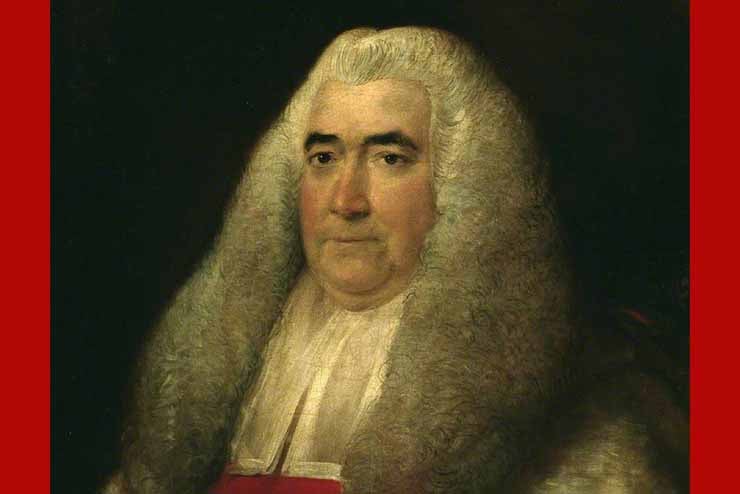
In an obscure collection of portraits and commentary published in 1939 (Some Old Portraits), the American author Booth Tarkington included Thomas Gainsborough’s 1774 painting of Blackstone in his judicial robes, a work copied in engravings and reprinted countless times. Tarkington remarks that, to some painters, Blackstone would have been “more monument than person.” After all, Tarkington notes, his Commentaries had at that time been published in 70 editions in English, 56 in French, 11 in German, nine in Italian, and at least one in Chinese. The great scholar had not only been the occupant of the Oxford chair, but also Solicitor-general to the Queen and a judge in the court of Common Pleas.
There were those who found Blackstone “cold, reserved and wary, exhibiting a frigid pride,” Tarkington writes. And yet, he was a friend of the most charming minds of his age, Samuel Johnson and James Boswell. Boswell reported that “Blackstone, a sober man, composed his Commentaries with a bottle of port before him; and found his mind invigorated and supported in the fatigue of his great work by a temperate use of it.” Gainsborough’s portrait managed to capture the essential humanity in Blackstone, which Tarkington describes as “a man laughing inwardly at something he knows he oughtn’t to laugh at,” and that indeed the great jurist was “a sly dog.”
Blackstone bestowed on America its notions of divinely dictated principles of property, authority, and deference. In recent decades, that inheritance has been warped to serve the dictates of the bureaucratic administrative state. It is not clear that this evolution has increased our freedom or maintained the Founding Fathers’ ideal that ours should be a government of laws, and not of men.
Leave a Reply