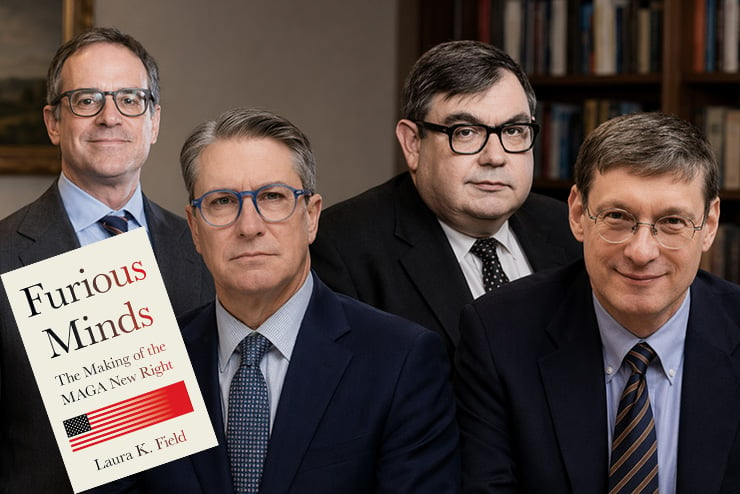
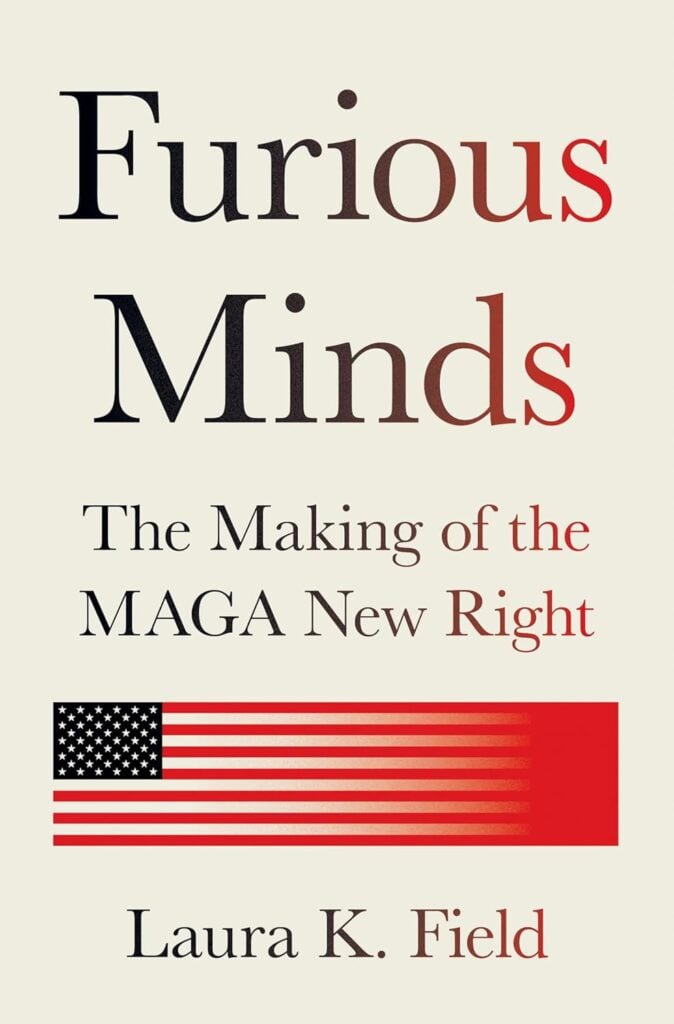
Furious Minds: The Making of the MAGA New Right
by Laura K. Field
Princeton University Press
432 pp., $35.00
The American right has evolved dramatically in recent years. Mainline conservatism went from shunning any express support of Donald Trump to fully embracing him and his Make America Great Again movement. Conservatives no longer feel obliged to confine their Trump praise to pseudonymous posts on the blogosphere, à la Michael Anton’s “The Flight 93 Election.”
This evolution warrants serious examination. Much time has been spent analyzing the post-World War II Right, but little effort has been expended on an objective analysis of what has been called the “New Right.” This need is unfortunately not met by Laura Field’s new book, Furious Minds: The Making of the MAGA New Right. Rather, Field offers some insight into why the Trump movement and the New Right so deeply unsettle liberal elites.
Broadly, the New Right consists of the Claremonters, the Postliberals, and the National Conservatives. These groups are united by shared opposition to immigration, free trade, globalism, and neoconservative foreign policy objectives.
Field provides a reasonably accurate overview of the New Right’s factions, tracing the Claremonters to Harry Jaffa and Leo Strauss, describing how the National Conservatives seek to unite various strands of the Right around a defense of the nation, and discussing postliberal figures such as Patrick Deneen and Adrian Vermeule. Yet she mars her descriptions with regular dismissals of their ideas with lazy labels such as “fascist” or “authoritarian.” In the end, an overriding commitment to egalitarianism impedes Field’s analysis and leads her to treat deviations from egalitarian premises as moral failures to be diagnosed and denounced.
Field’s assumption is that any argument recognizing ethnic or racial differences, and then drawing political judgments from those differences, is inherently illegitimate. Accordingly, she rejects descriptive claims about demographic change, debates about differences in assimilation between immigrant groups, and arguments for restrictive immigration policies based on the concept of national cohesion.
This pattern persists as Field examines the Claremonters. Although they adopt a Straussian philosophical framework emphasizing natural right and human equality, the Claremonters challenge fashionable contemporary egalitarian conclusions on race, immigration, nationalism, and civil rights. Due to their arguments against mass immigration as corrosive of civic cohesion, their extensive critiques of the Civil Rights Act, and their defenses of national particularity over abstract universalism, the Claremonters provoke Field’s rage, and she denounces them for their supposed drift toward conspiracism and racial essentialism. She makes this explicit in her assessment of Straussian-adjacent thinkers, whose inherited commitment to equality offers no insulation from sweeping accusations. The following passage is typical of Field’s approach:
Straussian adjacent ideas have devolved into rank conspiracism, from Great Replacement rhetoric to full-on election denialism. Sometimes, as we will see in the coming pages, Straussians end up squarely in the ‘just-asking questions’ corner of the far-right ‘race science’ club.
Field treats the National Conservatives likewise. By inviting Amy Wax to speak about what she terms “cultural-distance nationalism,” Yoram Hazony and the NatCon conference organizers violated a core egalitarian taboo: the acknowledgment that not all ethnic or cultural groups integrate into Anglo-Protestant American culture with identical ease. This breach frames Field’s broader indictment of the NatCon movement, which shocks and disgusts her for its “denial of the creedal character of America.”
The degree of ire Field displays, and the thinness of her engagement with New Right arguments, is directly proportional to how closely those arguments echo those advanced by paleoconservatives, some of whom have been welcomed into the New Right. The only faction of the Postwar Right to consistently “stand athwart” the creedal nationalist myth was the paleos. For this reason, Field approvingly quotes columnist and Democrat policy analyst Ed Kilgore when he described Patrick Buchanan as the “living link between the nativist, isolationist, and protectionist paleoconservative tradition in GOP politics… and the MAGA conservatism associated with Donald Trump.” She accuses Buchanan of “prefiguring contemporary Great Replacement ideology” and writes that the “intellectual source code for Trumpism” is the body of work produced by “paleoconservative white supremacist thinker” Sam Francis (who was a long-time Chronicles columnist until his death in 2005).
For example, Field sees the NatCon critique of the creedal nation as stemming directly from paleoconservative arguments made decades earlier. Yet when she turns to examining the relationship between nationalism and the New Right, she offers little beyond denunciation. In fact, the only time Field seriously examines what the New Right means by “nationalism” is when she quotes Sam Francis:
The nation is fundamentally a social and cultural unit, not the creation of the state and its policies, but a continuing, organic body that transcends individuals and gives identity to itself through a common way of life and a common people.
Rather than unpack this definition of the nation—or Francis’s other work, which the New Right often draws on—Field fixates on Francis’s racialist conclusions, treating them as malignant growths that metastasize across his oeuvre and justify dismissing his broader contributions to political thought, as well as the New Right’s reliance on them.
Field does the same sort of casual dismissal regarding a seminal 2016 essay in the now-defunct Journal of American Greatness by Julius Krein, “Notes on the Origins and Future of Trumpism,” which drew heavily on the work of Francis. Krein’s political project was to squash America’s managerial elite through Francis’s concept of a Middle American Revolution. Field dismisses Krein’s language and arguments as “conspiratorial” and “heady.” She then scolds him for being inspired by Francis, warning that “the legacy of white nationalism among paleoconservatives is hardly peripheral.”
But the points raised by paleoconservatives were not fringe eruptions of racial animus, as Field argues. They were sustained attempts to grapple with the cultural and institutional transformations of late-20th-century America. It was not “conspiratorial” to observe that a professional managerial class increasingly staffs the state and shapes its priorities through universities, bureaucracies, and cultural institutions. By reducing all of paleoconservatism to the preoccupation with white nationalism that Sam Francis admittedly developed late in his life, Field allows herself to avoid any thoughtful discussion of his ideas or those developed by his fellow travelers.
Of course, it would have only taken a few Google searches for Field to find essays or interviews in which Paul Gottfried, the oldest living paleoconservative and the editor of this magazine, rejects white nationalism. But because the paleoconservative emphasis on national particularity and rejection of the creedal nation already violates the egalitarian veto, such distinctions are beside the point, and engagement with any of Gottfried’s 13 books or the ideas they contain can be shut down with a single word: “racist.”
What Field spends more time on is postliberalism, and her gentler approach to that faction of the New Right is telling. Unlike those whose arguments against the anti-discrimination regime and multiculturalism more closely echo older paleoconservative critiques, Field gives the postliberals a noticeably more careful hearing. Field herself hints at this reason when describing the writers associated with the Front Porch Republic blog, founded by the postliberal Patrick Deneen, noting that they “are not thinkers who, like Paul Gottfried, are overtly reactionary or nativist in their sociological thinking.”
With that distinction made, Field proceeds to lay out the postliberal critique in greater detail. She summarizes one of its core contentions: “Liberalism failed by virtue of its own success.” According to postliberals, the neutrality and permissiveness of liberalism inevitably produce social decay. “Sohrab Ahmari was not wrong in this basic observation,” Field concedes, before ultimately concluding that the alternative world postliberals envision would be “violent and inhospitable.” Her concern centers on postliberal proposals such as common good constitutionalism and Christian nationalism, which seek to reassert a publicly binding moral and cultural order through law, institutions, and the state.
It is at this point that the egalitarian veto reemerges. Postliberals acknowledge that law inevitably shapes culture and that the state already privileges certain ways of life over others. Field, however, treats any proposal to use that authority to reassert traditional moral standards as categorically unacceptable. Her objection is not merely to the invocation of the common good, but to the postliberal refusal to treat all lifestyles, norms, and moral commitments as equally valid. To the liberal mind, this sort of judgment is verboten.
Glaringly absent in Field’s analysis is any examination of how the New Right responds to the failures of the Postwar Right, which alienated the right-leaning public and many intellectuals by casting aside or ignoring important issues. She omits this dimension of the story, though the omission is not incidental. The developments paleoconservatives first criticized as evidence of conservative failure are, from Field’s perspective, the natural and welcome successes of our liberal democratic and “pluralistic” society.
For much of the postwar period, the conservative movement conserved little of lasting substance. As Claremonter Christopher Caldwell observed in his 2020 book The Age of Entitlement, the Reagan presidency was not a revolution but a ratification of the leftward shift of the previous four decades. The New Deal, the Great Society, and the civil rights regime remained firmly in place, while permanent budget deficits were perceived by many Republicans as the price to be paid for social peace. Over the final decades of the 20th century and the beginning of the 21st, conservatives seldom contested the egalitarian premises underlying the welfare state and anti-discrimination apparatus.
This failure was not unnoticed at the time it occurred. Paleoconservatives like Gottfried, whom Field dismisses as “far right,” argued that the Postwar Right had been captured by a neoconservative elite that preferred accommodation rather than confrontation with the nation’s liberal managerial class. The result was a conservatism that governed defensively—invoking neutrality and liberty while acquiescing in what Gottfried called the emerging “therapeutic” state, increasingly coercive and self-righteous in its crusade to stigmatize socially conservative beliefs as a form of mental illness. In short, conservatism became the fulfillment of Francis’s concept of “beautiful losers,” principled but ineffectual.
For a brief period in the 1990s, the Postwar Right showed signs of willingness to halt the leftward march of American society. In the 1990s, National Review took up paleoconservative positions on immigration and national identity, a stark reversal from its and Commentary’s condemnatory responses to Chronicles’ “Nation of Immigrants” issue just a few years earlier. Soon after, NR’s editor-in-chief at the time and now one of the earliest NatCon signatories, John O’Sullivan, started articulating paleoconservative arguments about immigration, the failure of the conservative movement, and the evils of neoconservative foreign policy. In a long-forgotten NR essay, O’Sullivan bemoaned what he perceived as the inability of the right’s intellectuals and politicians to formulate an effective platform after the Reagan era, and accused neoconservatives of being “bricklayers” for the managerial elite’s Utopia.
Echoing paleoconservative warnings, O’Sullivan documented how the multicultural priorities of the managerial elite steadily permeated nearly every major institution of American life, including Hollywood, universities, bureaucracies, the courts, and corporations. At the same time, the bonds that once held the nation together were weakened by mass immigration, bilingualism, and the elevation of multiculturalism into national doctrine.
Yet, during that period, few voices within the conservative movement, aside from Chronicles and a handful of writers at NR and elsewhere, mounted sustained resistance to these developments. Instead, conservative leaders remained preoccupied with reinforcing the same market-oriented policies that, while successful in producing economic growth in the 1980s, offered no answer to the cultural and national disintegration unfolding around them.
For a brief moment, this convergence between paleoconservatives and NR suggested the possibility of a new fusionism that could replace a fractured and fraying conservative coalition. Yet the moment proved fleeting. O’Sullivan’s removal as editor-in-chief of NR closed the narrow opening through which such a reconciliation might have emerged, and the conservative movement quickly returned to the feeble posture that defined it until 2016.
The emergence of the New Right has reopened the possibility of this kind of synthesis, which is precisely why Laura Field, the New York Times, and the left react to it with so much disdain. Beneath each of the positions championed by New Right thinkers is a paleoconservative substratum, the same body of ideas that for decades was caricatured instead of addressed.
The New Right is a delayed response to the shortcomings of the mainstream right that paleoconservatives first identified. It arose from the recognition that the conservative movement had spent decades evading fundamental questions of national identity, culture, cohesion, and authority.
Field’s lackluster exploration of the New Right reflects liberal anxiety over the mainstreaming of paleoconservative arguments, and the reopening of questions that the postwar consensus thought were closed. What the New Right threatens is not just a particular policy regime, but a deeper moral and political arrangement that has allowed liberal elites to govern without justifying their authority.
Now, the New Right is forcing liberals to defend the political imbalance that characterized previous decades. Liberalism has long dismissed traditional norms as exclusionary while insisting that progressive strictures are inclusive. It has considered distinct national and ethnic cultures as interchangeable while simultaneously devising laws and building bureaucracies to manage the inevitable frictions that arise when different cultures compete within the same borders.
Furious Minds ultimately reveals more about the liberal order unsettled by the ideas of the New Right than about the New Right itself. The New Right may succeed or fail, cohere or fragment. But it has already accomplished something earlier conservatives barely attempted: it has rejected the egalitarian veto.
In doing so, it has revived arguments first advanced by this magazine decades earlier, arguments that were dismissed, marginalized, and driven from public discourse. This inheritance should not be obscured. Any attempt to nominally distance the New Right from the paleoconservatives, or to leave them undefended when accusations like those in Furious Minds are leveled, is trivial. So long as the positions of the New Right resemble or trace their origins to paleoconservatism, their proponents will face the same attacks previously directed at the paleos.
Leave a Reply