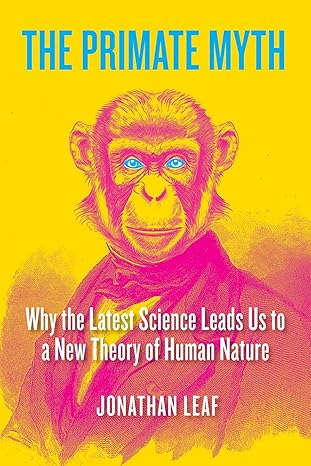
The Primate Myth: Why the Latest Science Leads Us to a New Theory of Human Nature
by Jonathan Leaf
Bombardier Books
320 pp., $21.00
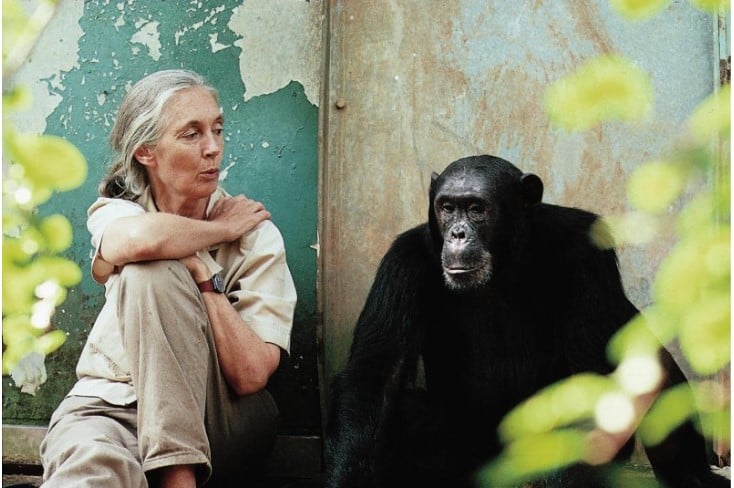
One day in the 1960s, in a forest in Tanzania, a 26-year-old British ethologist watched a chimpanzee she had nicknamed “David Greybeard” digging termites out of a mound with a stick. Birds had long been known to use “tools”—Egyptian vultures drop stones onto eggs to crack them open, and Darwin had seen finches on the Galapagos Islands using cactus spines to pry insects out of wood. But Jane Goodall was astounded to see a mammal doing something similar. It strengthened in her mind something that had often been surmised—that chimpanzees were proto-humans, us as we used to be millions of years before we diverged into Australopithecus, Neanderthal, and, finally, Sapiens.
Humans have always been fascinated by primates. African animists worshipped gorillas as gods, the Dayaks of Borneo saw orangutans as near-kin (“orangutan” means “people of the forest”), and Westerners encountering primates after the 16th century embraced them as pets and circus animals. We would later derive endless entertainment from the likes of King Kong, Tarzan, Planet of the Apes, and 2001: A Space Odyssey. Linnaean taxonomy and Darwinian evolution can even be seen as systematizations of an ancient obsession with the “wild men” of legends—hirsute forest-dwellers both disconcertingly familiar and dangerously fey.
Goodall had been a student of the paleoanthropologist Louis Leakey, originator of the “out of Africa” theory of human evolution, who was likewise fascinated by the great apes. Other 20th-century influencers famously interested in apes included Robert Yerkes, the once-celebrated psychologist who devised intelligence tests for the U.S. Army, and whose 1925 book Almost Human recounted his delight in the company of Prince Chim, an “intellectual genius” of a bonobo, with whom he shared his New Hampshire home.
Growing liberalization and secularization of thought over the 20th century would encourage new ways of viewing ourselves and animals. By 1965, Goodall was on the cover of National Geographic, celebrating the chimpanzee as an almost-person—no mere bundle of Brownian instincts, but a distant cousin, whose obvious skeletal similarities were mirrored by humanlike behavioral traits. (Goodall herself was careful never to read too much into chimpanzees’ apparent “emotions,” however.)
The Naked Ape by zoologist Desmond Morris (who died at age 98 in April) appeared in 1967, Dian Fossey (another Leakey protégé) published Gorillas in the Mist in 1983, and in 1991, along came Jared Diamond’s The Third Chimpanzee. Frans de Waal published Chimpanzee Politics in 1982 (which was recommended reading for U.S. legislators in the 1990s) and Bonobo: The Forgotten Ape in 1997, which portrayed the bonobo as a lovable proto-moralist (de Waal called them the “make love, not war” chimps). These were just some of the many influences on thinkers like Richard Dawkins and Peter Singer, who developed his theory of animal rights partly on the basis of excited descriptions of chimp existence. The development of genomics, which showed close similarities between chimp and human DNA, seemed to chime with these notions.
Human activities from dating and hunting to status-seeking and warfare were increasingly seen as prefigured in the activities of apes, particularly chimpanzees, providing “explanations” (or excuses) for what we do and why we do it. Human beings were effectively demoted from their erstwhile place of cosmological preeminence. When Goodall died in October last year, she was lionized by Prince William, Sir David Attenborough, and Leonardo DiCaprio, who said at her funeral in Washington, “Her groundbreaking work in Tanzania forever changed how we understand chimpanzees and, in many ways, how we understand ourselves.”
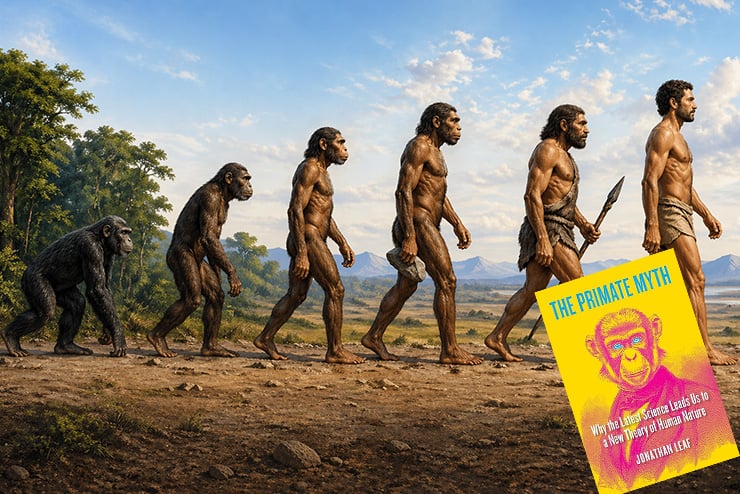
It is Jonathan Leaf’s firm belief that the many parallels that have been drawn between apes and us have been exaggerated. By seeing ourselves as transactional “naked apes” prone to unreasoning outbursts, he feels we are undermining civil society and making human behavior less rather than more intelligible. He wants to extricate Homo from the Hominidae and give us back a genus all our own.
The nature of “human nature” is perhaps the most fundamental of all questions, underpinning much philosophy and religion, and now the life and social sciences. Leaf anticipates academic resistance to his revisionist theories, so he has amassed 50 pages of endnotes and sources, many of them derived from the latest findings of neuroscience—a field rarely visited by primatologists. His account of neurological divergences between apes and humans seems inarguable, drawn not just from the latest studies of brain structure and function but also from insights in biochemistry, genetics, psychology, and even literature (Leaf is also a well-regarded novelist and playwright).
Mammals that bear little obvious resemblance to humans often display more “humanlike” behavior than do apes. Bottlenose dolphins and wolves are better comparators in many ways, with similar brain-to-body-size ratios, physical endurance, and carnivorous diets. They also share our capacities for altruism, co-feeding, cooperativeness, pair-bonding, “singing,” and tameness. We share none of these traits with apes. Nor are we covered with hair, or have prehensile feet, or walk on our knuckles. And we don’t spend much time in trees. We have different brains and hearts, larger eyes, fewer muscles, and higher metabolisms. Although we share most of our DNA with apes (though Leaf maintains this has been overstated), the minutest nucleotide discrepancies can lead to massive evolutionary differences.
Apes are not even especially intelligent, but are frequently outperformed by crows, dogs, elephants, parrots, and rats. A border collie can be trained to understand up to 1,000 words, and one parrot is said to have learned 950 and had some sense of tense, whereas apes rarely master more than 250. Apes cannot even recognize themselves in mirrors, unlike killer whales, manta rays, and even some species of ants. They can solve complex problems, but so can octopi, crows, and many other creatures, like the wolf in British Columbia recently filmed pulling on a rope to haul up an underwater crab trap to eat its contents.
Humans are herd animals, for better or worse. Herding provides us with protection, and cooperation enables us to achieve everything from securing our next meal to founding complex societies. Pair-bonding and alloparenting (shared parenting by unrelated adults)—neither of which is practiced by apes—also give human infants the surest start in life. Apes are not especially good at working together, or even copying each other, making the verb “to ape” oddly inapt. They can be trained in “cooperative pulling” experiments, where they need to work together to yank on a rope to obtain food—but so can many other animals, including hyenas and otters.
Chimpanzees—including the sainted bonobos—are also notorious among primatologists for biting and bursts of great violence—and of cannibalism, even of members of their own troop. They have no equivalent of the mass movements of other animals—like the spectacular starling murmurations, when hundreds of thousands of birds turn as one, or the “sheep tornadoes” known to oviculturists, when flocks of sheep suddenly group unaccountably and chase each other compulsively in circles, or the sad self-strandings (“suicides”) of whole pods of cetaceans. While chimpanzees’ pack hunting of colobus monkeys for food was sensationally reported (originally by Jane Goodall), close examination shows it to be relatively inefficient—much less efficient than any hunting by wild dogs or wolves.
There are, of course, drawbacks to being a herd animal; humans are more likely to follow cues, even bad cues. Leaf enjoys sideswiping at academics and journalists who are less independent-minded than they like to think, and whose statements “take on the colouration of fashionable ideas.” He perhaps belabors this point, devoting many pages to some of the ideas humans have followed against all experience and evidence, from lazily unchallenged scientific consensuses and the all-too-obvious inconsistencies of Marxism, to the exaggerated sense of solidarity that causes wars. (On this subject, it is surprising to learn that the most murderous mammal is the winsome meerkat.) Some of the author’s other ideas about some animals’ sociability can also seem overstated, such as his credulous belief in reports of dogs suiciding after the deaths of their owners.
This engaging and well-argued book is highly convincing and literally humane, emphasizing our better angels over our brutish reflexes, and calling us back to our natural place at the apex of the animal kingdom. Unlike many popular science authors, Leaf has respect for traditional morality and religious belief, which he sees not just as evolutionary mechanisms but as essential to our mental health. Human beings really are special, and Leaf’s project is to make us feel special again—not as arrogant, exploiting apes, but as benevolent stewards imaginatively connected to everything that exists.
Leave a Reply