Discussions of the future of apartheid generally assume that South Africa must remain a homogenous “unitary state.” This assumption not only presents a paralyzing dilemma (either democracy or apartheid), but also a prescription for continued social turmoil, if not outright civil war. A unitary state is a “winner take all” state—if there are indeed only...
Month: March 1989
Post
On ‘Our Stumbling Giant’
Having served as a pastor and naval chaplain under the authority of the United Methodist Church, I can truly appreciate Robert Nisbet’s comments concerning “Christian millennialism” (December 1988). Methodism and the National Council of Churches have stuffed that concept into the ears of their adherents at every opportunity. I wish Mr. Nisbet had commented on...
Post
On ‘Millions of Fathers’
The comments in your December issue about the anomaly of the laws, as now constituted, that affirm both the woman’s sole right to decide on abortion and the father’s duty to financially support the child once born were very well taken. The fact is that abortion is always justified on the basis of the tacit...
Post
On ‘Letter From the Heartland’
I would like to express how much I enjoy reading Chronicles, and particularly the “Letter From the Heartland” that Jane Greer writes. But “Eastern Montana: a gigantic plate of congealed gravy”? Harsh words from Greer (December 1988), one of the unfortunate residents of North Dakota—the state where the interstate curves so that a driver won’t...
Post
On ‘Caudillo and Generalissimo’
Professor Lee Congdon merits applause for a thoughtful review of two books on Francisco Franco (October 1988). I might raise the point of a number of significant omissions, but this would be unfair. I do, however, take exception to one commission, namely the assertion that Federico Garcia Lorca was shot by the Nationalists in 1936....
Post
Practical Items
School decentralization was one of the few practical items on the New Left’s agenda of the 1960’s. It was a genuinely radical idea, since the entire history of public education in the US has been the steady progress of consolidation and centralization. Small districts were merged, time after time, into larger consolidated units, and power...
Post
A Trick Question
“Globalization”—when did it become a central tenet of conservatism? According to Deputy Secretary of State John C. Whitehead, it was in the New Deal era that the US “rejected isolationism and economic nationalism” in favor of the “globalization of our daily lives.” The text of Whitehead’s address to the September meeting of the Economic Policy...
Post
A More Perfect Union
In Pursuit is a philosophical exegesis on what is wrong with contemporary social policy analysis. In some ways it is a sequel to Murray’s Losing Ground, having much in common with Part IV (Rethinking Social Policy) of that influential book. Though this is a more enterprising work, it is also a less successful one, leaving...
Post
The Real American Dilemma
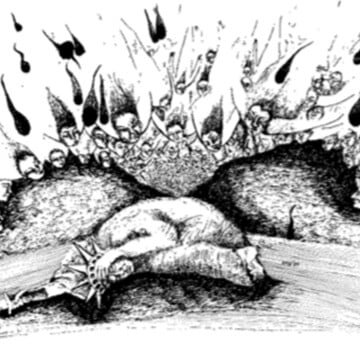
This remarkable editorial by Chronicles’ longest-serving editor offered one of the first and best analyses of America’s immigration problem.
Post
Blood Relations
In 1840, when Edgar Allan Poe wrote the first modern detective story, “The Murders in the Rue Morgue,” an unsuspecting public scarcely realized it was witnessing the birth of a new genre that would actually become the most ecumenical of all literary forms. Since Poe’s time, the detective story has flourished among readers of every...
Post
Tabula Rasa
If George Bush accomplishes nothing else in his lifetime, he has at least earned a secure niche in future editions of Trivial Pursuit. Not since Martin Van Buren trounced the Whigs in 1836 has an incumbent Vice President been elected to the White House. The lackluster record of Andrew Jackson’s successor perhaps does not inspire...
Post
Burned but Never Consumed
The first writer known to have made the outrageous accusation of ritual cannibalism against the Jews was a pagan Greek named Apion. But it was the Christians who established prejudice against and hatred for Jews as a fixture of Western civilization. The Christians’ animus against the Jews derived from the idea that “the Jews” had...
Post
The Deconstructive Lyric
“Poetry is certainly something more than good sense, but it must be good sense . . . just as a palace is more than a house, but it must be a house.” —Samuel Taylor Coleridge Margaret Atwood writes in her poem “Mushrooms”: Here is the handful of shadow I have brought back to you, this...
Post
Reading, Writing, ‘Rithmetic and War
Twenty-five years ago when I was a schoolteacher in an Afghan mountain valley I came across a book by an English pedagogue called Teaching English Under Difficult Circumstances. I was reminded of that title as I read this informative monograph by Middle East commentator Antony Sullivan. His short book might have been subtitled, “Teaching the...
Post
Passage to India
Though he never came here, Walt Whitman knew India was more than a country: a subcontinent, madhouse of religions, seedbed of civilizations, primordial and immemorial. “Passage to more than India.” How to cope with this vital mess, this messy multiplicity? These hundreds of millions of people in hundreds of thousands of villages? I have learned...
Post
Under the (Smoking) Gun
In The Wall Street Journal on June 16 last, Mr. Alexander Cockburn—whose regular presence in the premier organ of capitalist opinion, by the way, nicely illustrates Lenin’s maxim about rope—argued that the current antismoking hysteria is a capitalist plot. The loathsome Cockburn adduced an article in an obscure publication of the Spartacist League that maintained...
Post
Prodigal Son
“Children begin by loving their parents. After a time they judge them. Rarely, if ever, do they forgive them.” —Oscar Wilde Louis Simpson stands as an easy example of the poet divided, whose best talents and strongest predilections are at odds with one another. He takes Walt Whitman as spiritual father and his relationship with...
Post
Bam! Thwap! Prole!
Fans of George Bush pulled an unusual weapon from their political arsenals in the 1988 campaign—comic books. Delegates and hangers-on at the Democratic Party National Convention in Atlanta reportedly were upset when handed copies of a cartoon magazine ridiculing the public record of Massachusetts Governor Michael Dukakis. The appearance of the “attack” comic book, entitled...
Post
But Why the “Red Flag” of Revolution?
I have never been a flag-waver, nor felt much sympathy for howling mobs, particularly when bent on destruction. But since this year, 1989, marks the bicentennial of the world’s first and most influential revolution (there is hardly a revolutionary notion or motif that cannot be traced back to Danton, Robespierre, Marat, Babeuf, and their spiritual...
Post
Bad Georgie
The facts of George Garrett’s literary career are laid out in the bibliography here: his 24 books include novels, plays, and collections of poems and short stories. In addition he has served as editor of 17 other books—interviews with contemporary writers, literary criticism, books on film scripts. He has also written a biography of the...
Post
Gnawing Away at Vidal
We do not live in a golden age for homegrown and corn-fed radical critics. Legal restrictions on political speech remain few, but informal strictures and the passage of time have muted those who remember—and like—the free, landed republic that this country used to be, before World War II and the monolithic Cold War state that...