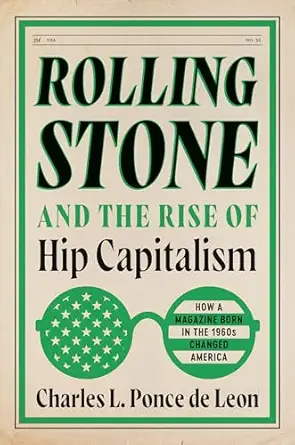
Rolling Stone and the Rise of Hip Capitalism: How a Magazine Born in the 1960s Changed America
by Charles L. Ponce de Leon
The University of North Carolina Press
304 pps./$30.00
Every journalist should read Rolling Stone and the Rise of Hip Capitalism: How a Magazine Born in the 1960s Changed America. For the first 20 years of its existence Rolling Stone produced some of the greatest journalism in American history.
The names of its fearless contributors are familiar—Hunter S. Thompson, Greil Marcus, Jon Landau, Annie Leibovitz, Tom Wolfe. Under Rolling Stone founder Jann Wenner, the magazine achieved great things.
Today, of course, Rolling Stone is widely considered a joke. This is owing largely—although not solely—to “A Rape on Campus,” the 9,000-word story published in 2014 about a group of frat boys who supposedly gang-raped a woman on the campus of University of Virginia. The story turned out to be false. It was retracted about a month after publication, and Rolling Stone and the article’s author Sabrina Rubin Erdely were successfully sued for libel and defamation in a $7.5 million lawsuit.
Having learned nothing from that experience, Rolling Stone today is hysterical, woke, and even communist in its bent.
It wasn’t always this way. Jann Wenner who, along with Ralph J. Gleason, co-founded Rolling Stone in 1967, may have been an egomaniac, control freak, and a bit of a jerk. But, as author Charles L. Ponce de Leon shows, Wenner was also ambitious and wise in his stewardship of the magazine. His vision and even humility allowed him to hire the best people and let them flourish, even if they disagreed with him. This produced a magazine of surpassing excellence that was always engaging. Hiring people who were allowed to criticize its founder, willing to take on sacred cows (even if they were rock stars), and demanding high standards while taking on challenging subjects in new ways—these are all things that today’s version of the magazine has lost the courage to do.
Wenner was born in 1946 and raised in the San Francisco Bay Area. A smart kid who was interested in newspapers and media from a young age, Wenner got into music and drugs in the 1960s, but as Ponce de Leon notes, he was always too ambitious to fully embrace the left. One hippie observer said that Wenner “looked on the counterculture lovingly and from a distance.” Ponce de Leon puts it this way:
Wenner quickly recognized that this wasn’t his scene. Despite his love of marijuana, LSD, and rock music, he wasn’t entirely comfortable with the blossoming counterculture…. Like many other young Americans, Wenner was, at best, a fellow traveler, never a full participant. But he understood the counterculture’s appeal, and he yearned for a lifestyle and career that could accommodate his new interests.
Wenner and Gleason found the first year of publication to be a difficult one, but the biweekly soon found its audience. Ponce de Leon repeatedly demonstrates that Rolling Stone succeeded because Wenner had the courage to hire people with real talent—even when those people would criticize Wenner himself. John Burks was a former editor of the San Francisco State student paper and had served as a West Coast correspondent for Newsweek. Burks had “little interest in rock … but his professional bona fides were impressive.” Hired in 1968, Burks changed the magazine:
He turned Rolling Stone’s offices into a real newsroom, teaching writers how to produce accurate, well-reported stories. Aside from [writer Ben] Fong-Torres, ‘nobody knew anything about journalism,’ Burks recalled. The process took time, but the results were impressive, boosting the magazine’s reputation and inspiring new writers to contribute or apply to join the staff. By the middle of 1969, Rolling Stone had become more consistent and professional—and more successful than ever, demonstrating the virtue of Wenner’s plan to occupy the middle ground between the mainstream and the countercultural fringes. Wenner appreciated the help and supported Burks’s innovations. He knew they were making Rolling Stone a better publication.
Then there was Greil Marcus, who was hired to be the editor of the record review section. Marcus took the job on the condition that Wenner not interfere with his decisions. Wenner agreed. Rolling Stone was clear that it regarded the “Holy Trinity” of rock as the Rolling Stones, the Beatles, and Bob Dylan. Beyond that, however, things were pretty freewheeling. “Given the diversity of taste among the magazine’s reviewers and the wide range of music they wrote about,” Ponce de Leon writes,
there wasn’t a single standard for determining the quality of a record or the virtues of an artist. And no artist was uniformly praised. Even the magazine’s favorites released records that elicited mixed reviews and occasionally worse, and the features of their music that sparked praise varied. This was one of Rolling Stone’s strengths. Within its pages, readers could find a variety of perspectives, and the magazine’s eclecticism generated a liveliness that made it stimulating to read.
Marcus said he “felt debate and conflict within the section was good—that it was a version of how people actually argued about albums.” He made it clear to writers that they could be critical. “I said to people over and over again, ‘Be as mean, as tough, as angry as you want to be. If something insults your intelligence or is a betrayal of somebody’s talent, say so. Don’t hold back.’”
Several Rolling Stone writers were present at Altamont, the violent and calamitous free concert put on by the Rolling Stones in 1969, which resulted in a death and heralded the end of the 1960s. This, as Ponce de Leon notes, was “an important crossroads” because “as journalists, they had to report on the tragedy and assign blame.”
Magazine co-founder Ralph J. Gleason was adamant that they cover the story as if it were “World War III.” Still, the staff knew about Wenner’s friendship with Mick Jagger and were worried that he would pull punches. He didn’t, covering Altamont as the disaster it truly was. “I had a choice, and I didn’t have a choice,” Wenner wrote in his memoir. “Mick meant a lot to me, the pleasure of his company, the bragging rights of knowing him. He would expect me to be protective. But perhaps, with time, it would be less painful, and he would understand what I had to do.” Wenner added, “We wrote responsibly and drew conclusions from the facts,” The magazine’s coverage of Altamont reflected badly on the Stones, and Wenner knew that “Mick wasn’t going to like it.” He was right. Jagger informed Wenner that he no longer trusted him “to quote us fully or in context,” and concluded, “I hope our friendship can flourish again one day.”
In the 1980s, Wenner and Rolling Stone were accused of “selling out” and becoming more conservative, but Ponce de Leon sees a continuum in the magazine’s ethos. They hired P. J. O’Rourke, a former liberal turned libertarian. “The magazine had always been receptive to libertarian-influenced critiques,” Ponce de Leon observes,
and in its early years, the policies of the Nixon administration had made the federal government—and the broader ‘establishment’ it represented—an inviting target for left-wing radicals and counterculturalists, often bringing them into common cause with young libertarians, including Republican ‘longhairs’ eager to reverse the influence of social conservatives and Cold Warriors in the GOP.
There was “a strong libertarian dimension” to the “new culture” that Hunter S. Thompson and Rolling Stone had promoted in the early ’70s, and some of the political figures and movements the magazine had championed over the years “were decidedly ‘antistatist,’ committed to decentralization and participatory demography and deeply suspicious of state power.” O’Rourke and Thompson, both of whom admitted to drug use, had a different sensibility than Rolling Stone’s 1980s political writer William Greider, who was an unapologetic leftist.
Rolling Stone’s kind of guts are in short supply in today’s media environment. If an influencer claims to dislike a new song by Beyonce or Taylor Swift, he is likely to be subjected to a vicious torrent of abuse from angry fans and sychophantic journalists. Rolling Stone in the 1980s famously blasted Journey, Bon Jovi, Billy Joel, Led Zeppelin, and Pat Benatar. In a memorable review, music critic Deborah Frost described the music of Billy Squier as sounding like “a construction site under your window that’s on permanent overtime . . . or the throbbing little blood vessel in the general vicinity of your forehead that tells you the very next stage of your really terrible hangover will be throwing up.”
Most of the problems with media today stem from left-wing platforms protecting and promoting their own, but the problem also exists on the right. While Wenner’s hiring was meritocratic, too many conservative media outlets hire through nepotism or networking. Talent and creativity are rejected in favor of familiarity and friendship. We don’t demand excellence of our reporters. It often makes for lazy and poor journalism. While Rolling Stone even went after one of its own sacred cows, its namesake and a member of its “Holy Trinity,” we on the right tend to overprotect our own.
In December 2024, for example, the Washington Post ran a takedown of Jordan Peterson by book reviewer Becca Rothfeld. The piece was inspired and hilarious, the kind of thing Rolling Stone would have published in its glory years. It was, frankly, something a conservative platform should have had the guts to run. Here’s a sample:
Peterson cut his teeth in an era when conservatives styled themselves as rationalists. (Recall all those liberal snowflakes whom they were always DESTROYING with the sheer force of reason on YouTube.) But then something changed: Peterson started crying. He cried when he whispered, “Is there anything more fundamental than pain?” and concluded, haltingly, “Love …”; he cried when he lamented “loss of faith in the ideal of the individual.” Sometimes, he cried for no immediate reason, as if the poignancy of the world were simply too much to bear. Peterson was not just a lapsed rationalist: He was a full-fledged weepy sentimentalist, and his transformation heralded a broader stylistic shift. Now the predominant conservative sensibility is that of mystical grandiosity—of JD Vance’s nostalgic invocations of the good old days, of calls to heroism and spirit. The Democrats have been caricatured as soulless technocrats, concerned with the trifling details of governance and the minutiae of bureaucracy, and the GOP has become the party of capital-M Meaning.
Rolling Stone is no longer relevant, having destroyed itself with a false rape charge and then gone fully woke. It is now in a defensive crouch—upholding the woke orthodoxy and rejecting all criticism as illegitimate. It has become what it once claimed to abhor. Yet for its first two decades, whatever one may have opined about the sensibilities and priorities of the magazine, it was a model of real journalism and courage. There is a lesson in its downward spiral that today’s journalists should take the time to understand and consider.
Leave a Reply