Inevitable Differences: An Inquiry into Human Variation
by J.E.R. Staddon
Academica Press
200 pp., $99.95
“Diversity is our strength.” Turns out the left is right about this.
But not in the way they think they are. In fact, they are right in a way that they cannot tolerate and that they constantly deny.
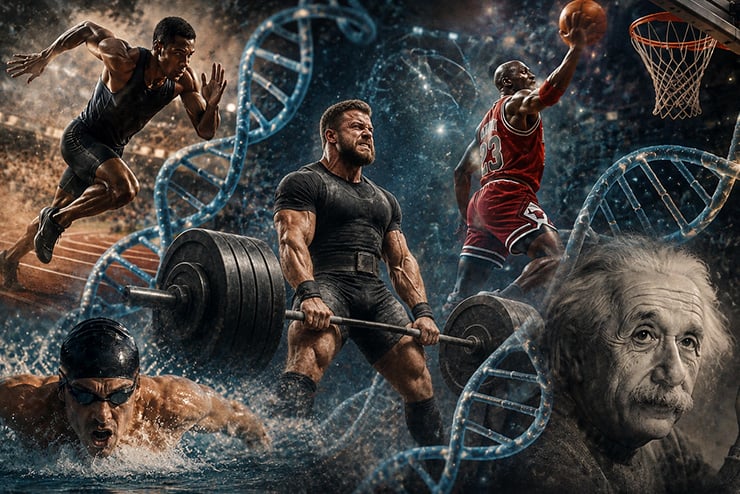
The most fundamental fact of life is variation and diversity. Even single-celled bacteria of the same species are not perfectly identical. In the case of human beings—massively more complicated organisms—the level of variation is tremendously higher. We now know that even so-called identical twins are not entirely identical, biologically speaking.
Human variation has many important consequences. It manifests everywhere, not just in our external physical appearance but also in our brains, which are the material cause of our personalities and behaviors. If we cared to look closely at the genetic structure of every single human, we would find that every single one of us is, in some ways, biologically unique and different from all others.
The “You be you!” progressive mantra seems consistent with this. But then things get icky.
The variation means, inevitably, that some individuals will be stronger than others, some will be more beautiful than others, some will be more tenacious in pursuing goals than others, some will be more adept at solving intellectual puzzles than others, and some will be more prone to depression and other crippling psychopathologies than others.
Humans are not the same, and that means that, at a fundamental level, they are unequal. Assign a number of individuals to a particular task, and they will not respond identically. Some of the variation is due to environmental differences, mostly in the social and experiential histories of different individuals. But research convincingly demonstrates that a significant portion of the difference in human performance stems from genetics. Genetic variation and differences inevitably cause unequal outcomes among individuals.
Rather than being appalled by the unfairness of the genetic lottery, John Staddon recommends embracing genetic diversity. Humanity could greatly benefit from a division of labor that properly exploits its natural genetic diversity, he argues in his new book. Those innately well-suited to particular tasks should be set to those tasks, rather than to those for which they are poorly suited. This may seem like an obvious point, but remember that Western countries today are dominated by the policies of egalitarian social engineers, who see any demographic imbalance within a profession as a sign of bias, inequity, racism, or sexism.
Staddon makes solid points against the anti-inequality crowd simply by posing questions that are seldom asked for fear of cancellation. What exactly is so bad about inequality, per se? Some differences might be shown to produce negative effects, but that is not true of all inequality—some forms are actually positive. No one on the anti-inequality left ever bothers to seriously grapple with this.
Staddon points out that the notion of social justice, invoked constantly by anti-inequality ideologues, is poorly defined and murky in all of its applications. When defined distributively, social justice is effectively Marxist. Questionable, typically unargued moral principles lie at the root of this ill-defined concept. In the popular articulation of the philosopher John Rawls, the highly intelligent must be prohibited from benefiting from their luck (their intelligence), and we must correct for the “unfairness” inherent in this human variation. But why we should feel compelled to do so is never fully articulated.
For Rawls, a clue can be found in his past: He had two siblings who died young from infections that he had passed along to them. Rawls never managed to psychologically adjust to the randomness of those tragedies and the happy chance that protected him from a similar fate. Instead of consulting religion for an answer (a common response), Rawls developed a morally corrosive secular philosophy to ensure that no one could enjoy the benefits of unearned goods.
Of course, in real practice, the Rawlsian model is utterly impracticable. These inequalities and “injustices” are so thoroughly baked into reality that no amount of social engineering and redistribution could eliminate all of them. But such ideologues insist that we must never cease trying to do so, however much demolition of the natural order is required.
Staddon notes that contemporary writers like Kathryn Harden extend this perverse perspective even to cultivated behaviors such as a strong work ethic, classifying them, too, as undeserved. It reminds one of the arguments against human free will made by some public intellectuals, like Sam Harris, and more traditional scholars, including Robert Sapolsky. We can’t completely ascribe our acts, beliefs, or existence to our own agency. The material universe shapes, limits, and determines them in large part. Indeed, we are nothing more than another material machine inside that larger machine, for these thinkers.
The ideology of the social justice radicals is perfectly consonant with that position. Indeed, Harris, Sapolsky, and others in the anti-free will movement typically argue that no inequalities can be morally justified precisely because no one ever really earns anything. This is a distressingly anti-human worldview.
“Systemic racism” is another conceptual fabrication of the anti-inequality crowd. Staddon argues it is used not in any rigorous or scientific manner but always as a polemical device, to assert the one cause for racial disparities that is permissible: discrimination. The reality is that discrimination is only one among many factors, such as differences in cultural values and behaviors, socialization, parental and family structures, and innate biological variations. If one even expresses interest in studying the full gamut of possible causal factors in race disparities, one is in danger of being targeted for moral reeducation.
It is curious that racial disparities are utterly disallowed by left-wing intellectuals, but few are troubled by the fact that men commit more violent crimes and receive longer sentences than women. By their logic, we should investigate systemic misandry—the only morally sound explanation for such differences.
Staddon’s book contains useful contributions to the now-voluminous body of literature demonstrating the mendacity of the “antiracism” writers Ibram Kendi, Robin DiAngelo, and Ta-Nehisi Coates. The latter endeavored, in his widely praised essay on reparations, to get John Locke on his side of the issue. Staddon shows how Coates willfully misquoted Locke to make it seem as though Locke endorsed the concept of reparations extracted from uninvolved parties. Furthermore, Coates asserts that black Americans have to be “twice as good” as whites; he cites Barack and Michelle Obama as exemplars. Staddon wonders if Coates would be interested in empirically testing his thesis by requesting the release of the academic transcripts and standardized test scores of these two intellectual pretenders, who hold four Ivy League degrees between them.
Staddon recommends a properly broad view of IQ’s contribution to inequality. Even if some significant portion of IQ is heritable, and differences are thus in some measure impervious to social engineering, it should be understood that IQ is a limited good. A perfectly meaningful life, worthy of respect, can be had even by those with very low IQs. The academic left is obsessed with discounting the possibility that IQ differences might have real consequences, yet at the same time, they are dismissive of those they see as having insufficient quantities of it—it is inconsequential, but also the one true human value. They must, at some point, understand that diversity of IQ is an unalterable fact of our species.
How this can be done, though, is something of a puzzle. The anti-inequality mob rejects the idea that human intelligence might vary naturally, and their anti-science progressive prejudice on this and other aspects of inequality is being built into our fast-growing body of artificial intelligence. Ask an AI program the question “Are there IQ differences between racial groups?” and you will inevitably receive a careful, politically correct framing that overemphasizes environmental factors and downplays or wholly ignores genetic ones. Anyone interested in an honest answer will be systematically led away by AI-generated search engines from all facts that are inconvenient to the moralizing and radically egalitarian narrative that now utterly dominates our elite intellectual culture.
The insidiousness of this is depressing to contemplate. We are instilling an anti-empirical and biophobic prejudice within the machine intelligences that are fast taking over all our cognitive tasks. This will ensure that a destructive victim-worshipping politics infects everything in our culture.
Staddon’s book is a careful analysis of a complex set of issues that will be useful to truth-interested readers. Regrettably, as is usually the case with serious books on this topic, those who most need to read and understand it will not do so, but will instead call the author and anyone who says anything positive about the book the predictable tornado of names.
Leave a Reply