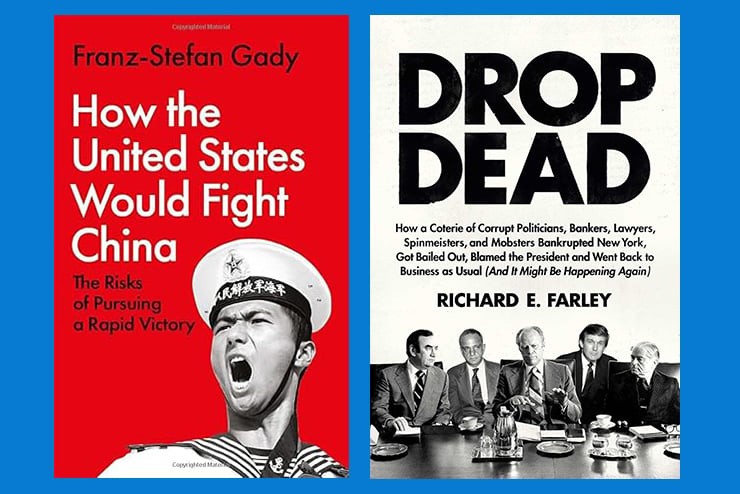
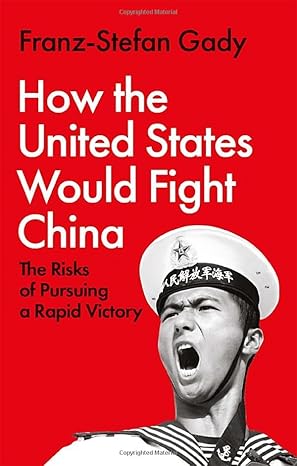
How the United States Would Fight China: The Risks of Pursuing a Rapid Victory, by Franz-Stefan Gady (Oxford University Press; 256 pp., $34.99). Much of U.S. military strategy is about striking fast and hard, and there have been times when it has stunned adversaries into early submission. But should a confrontation with China arise, a shock-and-awe game plan is not going to work against well-equipped and disciplined Chinese troops, especially when the generals in Beijing have spent decades preparing for American tactics.
This is the warning to the U.S. issued by Franz-Stefan Gady, a military advisor at the Center for a New American Security, a D.C. think tank with strong ties to the Democratic Party. The most likely flashpoint, says Gady, is a Chinese invasion of Taiwan, in which the U.S. would rush to the island’s aid. He unpacks the layered aspects of such a conflict, including cyberattacks, air and maritime operations, drones, and ground firefights. The threat of nuclear weapons would always hover in the background.
Instead of a quick finish, the conflict could drag on for months or years, Gady says, and the American military would struggle with the logistics of a long supply line. Gady notes that the American public might not have the stomach for a protracted war that seems to be far from home.
He acknowledges that the U.S. has valuable cards to play: superior training, precision strike capability, and technology designed to counter superior troop numbers. The Pentagon has also invested heavily in “decision dominance,” which means more effective use of battlespace information. However, this concept has never really been put to the test, and it might not survive an encounter with reality.
Gady is by no means sure that the U.S. would win such a conflict, but suggests increasing its chances by pre-positioning critical supplies in the region and air defenses in Taiwan. Perhaps the biggest improvement would come from a shift in the U.S. military’s culture of warfighting, with greater emphasis on fighting wars of attrition.
This is all interesting food for thought, but there are problems. Gady does not discuss Taiwan’s military capacity or the role of allies in the region. Nor does he consider the effect of simultaneous regional conflicts on the Korean peninsula or in the South China Sea. Nevertheless, Gady addresses many worrying issues. Let us hope that we do not have to find out if he is right.
(Derek Parker)
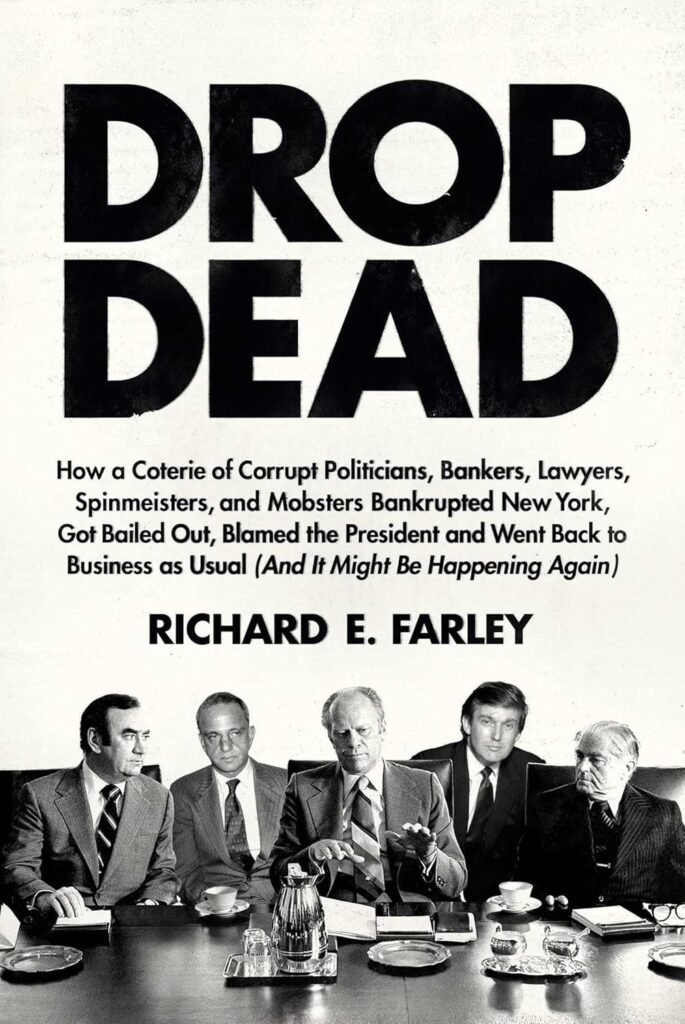
Drop Dead: How a Coterie of Corrupt Politicians …Bankrupted New York [etc.], by Richard E. Farley (Regan Arts; 296 pp., $32.00). “Ford to City: Drop Dead” blared the New York Daily News’s iconic Oct. 30, 1975, headline reporting President Gerald Ford’s definitive statement about a possible U.S. federal government bailout of New York City’s worst fiscal crisis. Richard E. Farley, a Manhattan leveraged finance attorney who has written two previous books on the modern American financial system, adopted Ford’s apparently fatal admonition to title his recent book on the crisis’s origins and resolution.
The Daily News headline is arguably the best remembered detail of New York’s fiscal crisis, now half a century in the past. But as Farley points out, Ford neither said those words nor did he foreclose the possibility of federal aid, which he proceeded to provide to the tune of $2.3 billion. Running for election as an unpopular incumbent who arrived in office only because Richard Nixon had resigned the previous year, Ford, in fact, said he would bail out the city, provided it entered bankruptcy and got its financial house in order after decades of chicanery and neglect.
Under Mayor Abe Beame, the city ran an annual deficit of more than $5 billion and had been cut off from capital markets. Appeals to Congress and the Federal Reserve fell on deaf ears. Austerity measures and spending cuts were politically impossible in the face of public service union opposition and catastrophic threats to urban quality of life. The city police union even published tourist guides calling New York “Fear City,” advising visitors to stay away.
The final deal, worked out in just 15 days after the “Drop Dead” headline, avoided a bankruptcy declaration that nobody wanted and drew on investment in municipal debt from the city unions’ pension funds. If anyone “saved the city,” it was Ford, who got New York’s incompetent and self-dealing administrators to cooperate enough to get the city back on its feet. But in a classic act of political and journalistic spin, the plain fact that Ford bailed out New York was obscured and tarnished.
Farley’s at times wonky analysis reveals the true story, which a 1977 Securities and Exchange Commission report conclusively proved. It was New York’s elites—politicians of both parties and various backgrounds—who literally passed the buck for too long before finally compromising and essentially conniving their way into federal largesse. Farley cynically concludes that New York’s elites learned nothing and will bring the city back to the fiscal brink again. He published his book before Zohran Mamdani became mayor, but the recent news of New York’s impending financial precipice may well prove him right.
(Paul du Quenoy)
Leave a Reply