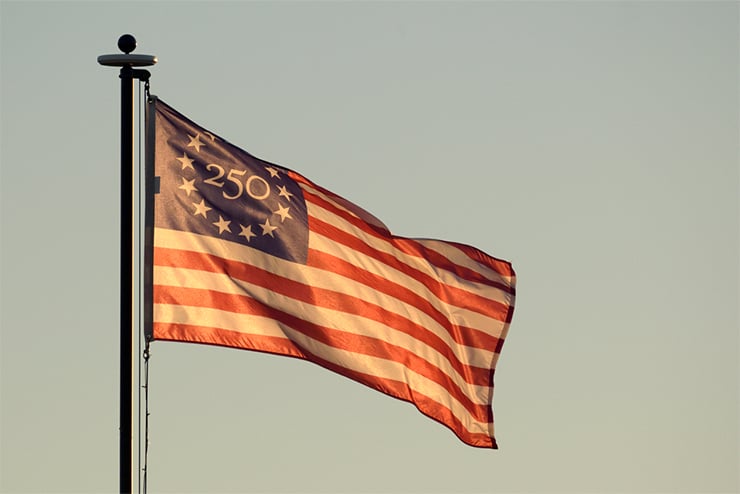
As the United States celebrates its semiquincentennial, the national temper is characterized by a contradictory mix of faith and pessimism. A recent National Public Radio (NPR) survey of 1,340 respondents found that a slim majority of Americans still believes that the country’s best days are yet to come. On the other hand, in June a PRRI national survey found that far fewer Americans reported being either “extremely” or “very proud” of their identity than they did in 2013 (51 percent vs. 81 percent).
Formally framed as a celebration of national unity, the jubilee comes at a time of stark domestic divisions and growing angst about the future. While the country is arguably wealthier than ever and consistently safe from external threats, several polls conducted over the past six weeks reveal that a significant majority of citizens feel the republic is in decline.
According to a major Gallup survey conducted in late May, fewer than one in five Americans (19 percent) think the signers of the Declaration of Independence would be pleased with how the country has turned out. More than three-quarters (77 percent) say the founders would be disappointed, compared with 71 percent in 2013 and 42 percent in 2001.
There is a deep generational gap. The PRRI poll indicates that just 34 percent of adults aged 18 to 29 say they are proud to be American, as opposed to 66 percent of those 65 and older. According to the results of the NPR poll released on July 1, more than nine-tenths of Republicans (93 percent) say they are proud to be American, as opposed to 45 percent of Democrats and 61 percent of independents. In that poll, most Americans opined that the nation has drifted from its founding ideals.
All this is in stark contrast to the wave of nonpartisan patriotic pride that swept the country during the 1976 Bicentennial. That spirit was largely unaffected by the fresh memory of the fall of Saigon (April 1975), Richard Nixon’s resignation under the cloud of Watergate (August 1974), or the fact that 30-year fixed mortgage rates reached 9 percent that year. Polls indicated that optimistic Americans outnumbered pessimistic ones by a 3-to-1 ratio. A clear majority felt the country’s best days were yet to come, and over three-quarters believed the nation had achieved its founding ideals.
Whatever conclusions we may draw about the cultural and party-political implications of recent surveys, they should not be treated as conclusive or permanent. History provides significant examples when what appeared to be the spirit of decadence and fatalist resignation swiftly gave way to the temper of patriotic and spiritual renewal.
The 1933 King and Country debate at the Oxford Union is a case in point. It famously declared that students would “in no circumstances fight for King and Country.” Taking place just days after Hitler became German Chancellor, the outcome epitomized the lasting trauma of the Great War in Britain. It also sparked pacifist movements, mostly in the English-speaking world.
This “abject, squalid, shameless avowal,” as Winston Churchill called it at the time, was blamed by him and others for emboldening dictators. The debate captured the visceral anti-war sentiment of an age group deeply affected by the mass slaughter of the previous generation. Students viewed the motion as a moral stand against wars as such, but it created the impression that British youth lacked the moral fiber and will to fight. It was subsequently claimed that this may have encouraged aggressive, revisionist powers of Europe.
Only seven years later, those same upper-crust Oxford graduates fought gallantly in their Hurricanes and Spitfires against the Luftwaffe in the Battle of Britain. Churchill, by that time the beleaguered Kingdom’s prime minister, told the House of Commons in August 1940 that “never in the field of human conflict was so much owed by so many to so few.” Many others Oxonians fought, mostly as reserve officers, in North Africa, Burma, Sicily and Normandy. At Trinity College, 133 members died in 1939-1945. At Worcester College 92 were killed…
In the years before 1914 France was a deeply divided society, arguably even more so than today’s America. The Dreyfus Affair tore French society apart, dividing it into the pro-republican, anti-clerical Dreyfusards and the pro-army, conservative anti-Dreyfusards. It triggered violent riots and polarized families over the case of Capt. Alfred Dreyfus, a Jewish-French artillery officer falsely convicted of treason in 1894. The intense polarization deeply affected the nation. The schism was not fully healed even in the aftermath of the vindication of Dreyfus in 1906.
Nevertheless, when Germany attacked in August 1914, the fierce polarization of the preceding two decades was suspended in favor of national unity and determined defense against les Boches. France mobilized over 8 million soldiers during the war; 1.4 million were killed and 4.2 million wounded. Nearly 25 percent of all French men aged 18 to 30 died during the Great War. La Patrie took precedence over everything else. It was worth fighting and dying for.
These examples indicate that it is possible for the spirit of national unity and solidarity to overcome political and cultural divisions, no matter how deep, in time of external peril.
There is a problem, however. In order for such sentiments to be (re)asserted, a nation is needed. Not some vile multitude of the late imperial Rome, or of today’s urban America, but a nation based on common ancestors, on myths and tales and songs, and a sense of shared destiny.
A “creedal nation,” a polity composed of some 350 million fully autonomous individuals, each pursuing his own model of life, liberty, et cetera, is no such thing. The collective striving embodied 250 years ago in the Declaration’s “one people” makes no sense unless there is a clearly definable “people” to support it. Liberalism (in the American, rather than European, sense of the word, of course) is fundamentally incompatible with meaningful democracy, which presupposes the proximity – if not complete identity – of the values and objectives of the governed and the governing.
Institutionalized democratic process in America at 250 is largely a façade which masks the loss of true national will emerging from an authentic nation. The conditions for its emergence and growth arguably did exist for about a century between 1865 and 1965, from the Reconstruction to the Immigration and Nationality Act. It has been systematically eroded over the past six decades, and is largely absent today.
The result is “Our Democracy,” which rejects the political – the life-and-death distinction between friend and foe. The claim that each and every denizen of our planet is a potential bona fide American, entitled to come over at any time and as he deems fit, renders the entire political process meaningless. It becomes grotesque and absurd in equal measure. At the same time, millions of Americans – especially the young ones, in state schools and the janissary-producing institutions of higher education – are being indoctrinated into the dogma that the trend is inevitable, that unceasing immigration on a vast scale is unstoppable, and that in any event it is all for the best.
This is not true. Free citizens must not submit their destiny, and that of their progeny, to a historicist fallacy. Immigration can, and should, be subject to the democratic will of the American people. They have every right to defend themselves and their way of life. The obstinate insistence of the functionally nihilistic self-hating liberals on treating each and every newcomer as equally meltable in the post-postmodern pot can and must be defeated. The alternative is to open the gates and turn the Remnant into a putrid Camp of the Saints.
Depoliticized governance celebrates diversity but in reality it suppresses legitimate public will. A functioning democracy requires cultural and social homogeneity to reach legitimate, morally sustainable collective decisions. Obligatory multiculturalism and imposed globalist mindset wreak havoc on the shared identity and values necessary for a sovereign people to govern itself. The rituals of public debate simply serve as a front for special interest groups. Orwellian exercises in NPR-approved “national conversation” can never be a true reflection of public will in search of public good.
On balance, “our democracy” needs an urgent and ruthless overhaul. A more authentically democratic form of governance may be salvaged from its ruins if there is an open-ended moratorium on immigration (legal as well as illegal) and a determined, decades-long push to expel millions of aliens who have demonstrated – by their actions and statements – that they do not belong here.
This is the existential task for America as she turns 250. It is the one issue by which the presidency of Donald J. Trump will be judged in 2076.
Leave a Reply