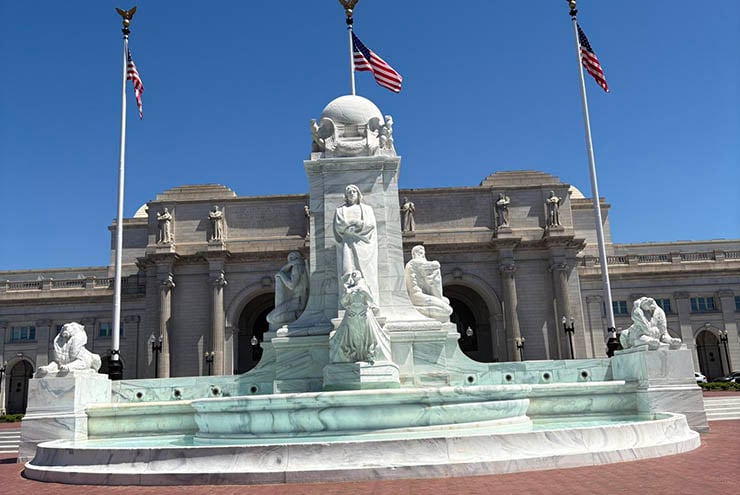
For 19 years, the Christopher Columbus Memorial Fountain outside Washington, D.C.’s Union Station did not run. It sat there, dry, in one of the most important entrances to the nation’s capital, a dead fountain in front of the train station that greets members of Congress, tourists, commuters, foreign visitors, and schoolchildren coming to see the seat of their government. It stopped working in 2007 and remained broken through four presidencies. Then, this May, the water returned.
A civilization that can no longer make its fountains run has already accepted decay. A civilization that restores them has not yet surrendered.
The history of that fountain makes the point sharper. The Columbus Fountain stands before Union Station, designed by Daniel Burnham and sculpted by Lorado Taft, at a place America once understood to be the ceremonial gateway to the capital. Presidents, congressmen, students, tourists, and even Mr. Smith when he went to Washington, were greeted into the city by that splendid water and stone effigy of the Italian navigator.
The juxtaposition of the classical fountain’s placement opposite one of the grandest train halls of its day honored the spirit of Columbus with the meeting of the Old World and the New. Its inscription speaks of “high faith” and “indomitable courage.” When it was dedicated in 1912, Washington did not mark the occasion with a sterile ribbon-cutting or an ordinary press release. The city celebrated for three days. There were parades, concerts, prayers, wreaths, fireworks, the Marine Band, a 21-gun salute, and floats depicting the life and voyage of Columbus. Soldiers, sailors, Marines, Knights of Columbus, Italian societies, public officials, families, and ordinary citizens gathered in the capital. President Taft reviewed the parade at Union Station.
That was how Americans once opened something as simple as a fountain. They did not do it because every citizen agreed on every footnote of history’s pages. They did it because the country still knew how to honor its inheritance in public. America was beautiful not only because it had mountains, rivers, farms, churches, towns, cities, capitols, and monuments. It was beautiful because Americans could still celebrate these things together. They could bring clergy, soldiers, immigrants, families, civic associations, and the president into one ceremony without hatred, discord, or protest.
Where did that spirit go?
It did not disappear all at once. It was first scolded by the established and woke elite, then neglected by the comfortable, and finally drained by the bureaucratic habit of treating national symbols as maintenance problems. Patriotism became something to be apologized for. Monuments became liabilities. Beauty became suspect. Then the water stopped, and everyone got used to the decay. This is how we tossed civic spirit out of the public square.
America marks its 250th birthday this weekend. Of course, the most important question is not what America will say about itself in 2026. It is what will America build, restore, and hand down for the next 250 years.
“America the Beautiful” should not be treated as a song title but should be taken as a command, a civic duty.
Washington, D.C., is the only city that belongs, in some sense, to every American. Most citizens will never live there. Many will never visit. But it is still theirs. It is the physical seat of their republic. Its monuments, avenues, parks, courts, fountains, memorials, and public buildings are not local amenities. They are national symbols. When they are clean, ordered, and beautiful, they tell the citizens that the country has not forgotten itself. When they are dirty, broken, and neglected, they teach the opposite lesson.
Neglect is never neutral. It conveys that inheritance is a burden, that maintenance is impossible, that public beauty is expendable, that the past is embarrassing, and that decline is normal. A dry fountain in Washington is not just a plumbing problem. It is a sign of a governing class that has lost the duty of care.
Decline is a choice. That is true. But the opposite is also true. Human flourishing is a choice. Beauty is a choice. Order is a choice. Renewal is a choice. Decay presents itself as fate because no one wants to take responsibility for it. But much of what we call decline is simply the accumulated result of choices no one wants to defend.
That is why President Trump’s campaign to beautify the capital matters. His critics may describe these projects as futile vanity projects. But a president who notices broken fountains, ruined parks, dirty memorials, bad pavement, lifeless public spaces, and ugly federal buildings is noticing things that many supposedly sophisticated people have trained themselves not to see. This president is a builder. He says so often, and it is true in a literal sense. He came out of a New York world of cranes, lobbies, marble, brass, deals, concrete, and glamour. He understands, instinctively, that buildings are statements. So are parks. So are fountains. So are reflecting pools. A capital city says something about the nation it represents. If the capital looks beaten, unsafe, and unloved, no amount of official language about democratic norms will conceal the truth.
Hamilton understood the constitutional side of this problem. In Federalist 70, he wrote that “Energy in the executive is a leading character in the definition of good government.” Hamilton himself tied executive energy to protection, steady law, property, liberty, and resistance to faction and anarchy. But there is more to it.
Government also has to act. It must execute. It needs to repair what is broken, clean what is filthy, protect what is threatened, and finish what has been started. The fountain was appropriated by an Act of Congress signed by President Theodore Roosevelt in 1907. For today, energy in the executive is exactly what President Trump is accomplishing by carrying out the spirit of his constitutional duty to execute the law with fervor for the American people.
The Columbus Fountain, like many pieces of urban landscape across the country, stood dry and neglected for years. Now the fountain runs again. Washington’s Meridian Hill Park tells the same story. Its great cascading fountain, one of the most beautiful public water features in the capital, was dry for seven years. Locals walked past it. Children grew up nearby without seeing it work. Visitors saw a monument to what the city used to be able to do. Then the water returned there, too. The same has been true, and is being made true, at Lafayette Square, where the ornamental fountains across from the White House had been inoperative for nearly a decade. And, of course, there is the recent cleaning and painting of the Lincoln Memorial reflecting pool. These are not small things. For all the left’s artificial drama and manufactured controversy, these efforts are the visible difference between a government that manages decline and one that reverses it.
This is the proper spirit for the semiquincentennial. Not an apology for stewarded decline but a commitment to restoration. Renewal means accepting the burden of repair. It means being a good steward and upholding the duty of care for the next generation.
There is something shameful in the fact that, in America’s 250th year, part of the national task is simply to make things that were already built great, great again. Fountains that should never have gone dry must be repaired. Parks that should never have been allowed to decay must be restored. Monuments that should never have needed rescue must be protected. Public buildings that should never have been made ugly must be replaced, renovated, or no longer imitated. This is a burden. But it is also a responsibility.
The current president has accepted that task. So should the country. Not with swagger, nor with resentment, nor with decorative revenge. Instead we should approach our task with humility, because we are repairing what we allowed to decay. But we should also approach with wisdom, because beauty without discipline becomes a short-lived spectacle. Also with grace, because renewal should invite the living into gratitude, not merely accuse them of neglect. And, finally, with peace, because a nation that can honor its inheritance without hysteria is already stronger than one that can only fight over the ruins.
America does not need another year of elite lectures about how complicated its history is. Serious people already know that history is complicated. They also know that complexity is often used as an excuse for ingratitude. The country does not need to be told again that its heroes were flawed, its wars were mixed, its politics were compromised, and its promises were unevenly fulfilled. All of that is true, but none of it is exhaustive and it certainly is not enough to sustain a people. A nation cannot live on indictments. It needs gratitude, memory, order, courage, and beauty.
Architecture is central to this because architecture is public memory made visible. The founders knew this. Washington, Jefferson, and L’Enfant did not model the capital on the forms of Greece and Rome because they lacked imagination. They did it because classical architecture gave the new republic a language. It spoke of law, restraint, proportion, self-government, sacrifice, and civic seriousness. It connected the American experiment to an older, republican inheritance of the West. In America, that inheritance arrived through Christian civilization with churches, courts, universities, town halls, capitols, and public squares shaped by a belief that order in the built world should reflect order in the soul.
A column bears weight. A dome or spire draws the eye upward. A portico marks an entrance as important. A courthouse that looks like a courthouse tells the judge he is not a biased opinion giver. A capitol building that looks like a capitol building tells the legislator he is not lobbying for self-interests. A memorial that is kept clean tells the living that these dead should not be forgotten.
These things matter because man is not a machine. He is moved by what he sees. That is the purpose of art. Man is formed by the spaces he inhabits. A people surrounded by ugliness will eventually start to think ugliness is normal. A people surrounded by buildings that sneer at scale, memory, and human dignity will eventually get used to the indignity of insults.
That is the great failure of so much modern public architecture. The problem is not that it is new. America is not afraid of the new. The Golden Gate Bridge or even the United States Capitol dome was once new. The problem is that too much modernist and brutalist public architecture seems hostile to ordinary human beings and their purposes. They offend because they often seem to hate the past, the citizen, and the cities around them.
Brutalism is not ugly because concrete exists. It is ugly for making the citizen feel small before the state and unwelcome in his own city. A courthouse that looks like a bunker teaches one lesson. A courthouse with columns, steps, light, stone, and proportion teaches another. A school that looks temporary teaches the disposability of its project. A federal building that could just as easily be a claims-processing center, a prison intake facility, or a data warehouse does not inspire republican virtue. It inspires the desire to leave.
America does not need every post office to pretend to be the Parthenon. But it would not be a terrible thing if Americans were proud of their local post offices in the same way Greeks once were of the Parthenon. Public buildings should be beautiful and durable. They should be good enough to outlast the officials who commission them. They should respect the people who pay for them. They should not require a commentary from “experts” to explain to the common people why they are not ugly.
The president’s executive order on federal architecture is important for that reason. It restores a simple principle that never should have been controversial: public buildings should uplift the public and have continuity. In Washington, classical architecture should be the default because Washington is a classical city. That does not mean architects going forward should have no freedom. It means freedom should be disciplined by place, history, and purpose. The capital is the beating heart and symbolic center of the republic.
The proposed White House ballroom belongs in this conversation. A great country needs rooms for ceremony. It needs places large enough to receive foreign leaders, honor soldiers, host national celebrations, and gather the institutions of government without resorting to temporary tents. A ballroom attached to the White House should be beautiful, restrained, secure, and permanent.
The National Garden of American Heroes points us toward another necessary recovery: public gratitude. The recent war on statues was never really about statues alone. It was about whether our past has any claim on the living. Of course, no public monument can tell the whole truth about a person. Of course, some names will be debated. Of course, no nation’s heroes are without sin. But a people that can only accuse its ancestors will not become wise from this exercise. It will become bitter and empty.
On this, our 250th Fourth of July, we should be focused on recovering the physical and moral landscape of the republic. Make the fountains run. Clean the memorials. Repair the reflecting pools. Restore the parks. Build the ballroom well. Raise the statues. Put beauty back into federal architecture. Protect the capital. Punish vandalism. Remove graffiti. Make public buildings look like public buildings again. Stop pretending ugliness is acceptable. Stop treating order as oppression. Stop accepting decay.
A self-governing people must be able to govern what is in front of its face. If it cannot maintain a fountain, it will not maintain a border. If it cannot protect a statue, it will not protect a constitution. If it cannot keep its capital clean, it will not respect its laws. The small failures and the large failures come from the same spiritual condition: the loss of soul and will.
The good news is that soul and will can return.
A dry fountain can run again. A neglected park can be filled with families again. A vandalized monument can be cleaned. A dead public space can be revived. A bad architectural regime can be replaced. A country that has accepted too much ugliness can remember that beauty is not elitist, oppressive, or optional. It is one of the ways a civilization tells the truth about what it loves and respects the people who populate it.
Monuments outlast bad ideas. They preserve truths that living elites forget. They remind us that our ancestors were not always fools, that beauty is not oppression, that order is not cruelty, that ambition is not greed, and that civilization must be maintained by people who believe in it.
America the Beautiful will not be restored by itself. It will be restored by leadership, faith, memory, law, craft, and executive energy. It will be restored by men and women who do not consider decline acceptable.
Decline is a choice. So is human flourishing and American renewal.
A great republic ought to look like one.
Leave a Reply