There aren’t all that many magazines still standing that publish quality original short stories of science fiction and fantasy, so I’ve made it a point to patronize a few. I’m increasingly convinced that the stories we tell are going to be the only thing that matters in the end.
Maybe that is also why so many philosophical works from antiquity have endured, despite their distance from contemporary science and political theory. Unlike much of modern philosophy, these works take the form of dialogues, allegories, and speculative flights of fancy—in other words, they are stories. In The Prince, Machiavelli, the Florentine godfather of modern political science, encouraged those interested in gaining political power to “read the life of Cyrus written by Xenophon.” The Cyropaedia, as that work is called, is really just an early form of the novel.
As I was browsing through Clarkesworld recently, one of those few magazines of science fiction and fantasy, I came across a few writers who had asked for their stories to be removed from the online website, indicated by notes such as, “The author has requested that this story be removed in response to LLM developers using online works for training without authorization.”
Large language models, LLMs, which is the technology that powers artificial intelligence, pose a threat to creators because they comb all available online data and use it to train their AI programs. Essentially, they steal the work of real creators without regard to copyright, and use it to train the machines that will attempt to replace them. Artists and writers have their creations turned into the raw material of AI without receiving so much as a pittance of compensation for the privilege of being dispossessed of the fruits of their labor.
Unfortunately for creators, there is little they can do about it. Tech executives like Twitter co-founder Jack Dorsey and X.com Chief Executive Elon Musk have both endorsed abolishing all intellectual property (IP) laws, which are the only tattered restraints remaining that prevent them from gobbling up all human creativity in the known universe. They’d like to see the product of every mind as merely a brick in the foundation of their competing Babelian towers.
It is hard to think of a more evil, inhuman scheme than reducing all life on the planet to food for the algorithms encasing us in a veil of unreality, our stories becoming not more than fodder for their hallucinations. The Musk-Dorsey position is abominable because it is so hypocritical and indifferent to history, which I suppose futurists do not have much use for anyway. To understand the significance of IP law and how it harnessed the spark of human creativity rather than simply exploiting it, you have to revisit the hometown of Machiavelli, Florence.
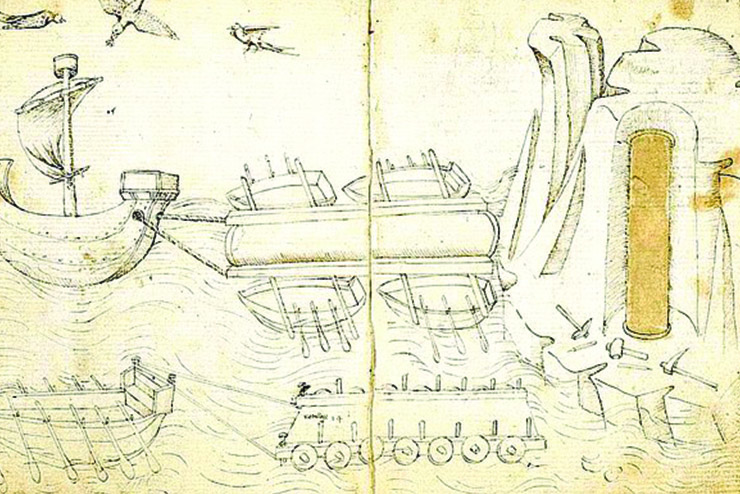
The earliest issuance of a patent was granted in 1421 to Florentine architect and engineer Filippo Brunelleschi. Pippo, as he was called, was a central figure in Renaissance architecture, having designed the dome of the Cathedral of Saint Mary of the Flower and invented a number of technical innovations. By 1398, he had established himself as a master goldsmith and sculptor; by 1415, he was experimenting with linear perspective, which would revolutionize art by systematizing the illusion of depth on a flat medium. As he began work on the Basilica of San Lorenzo, the rulers of Florence granted him a three-year monopoly on his most enigmatic invention: a ship called Il Badalone, or “The Monster.”
There are no detailed written descriptions of the vessel in official documents. A critic of Brunelleschi described it as an acqua vola or “water bird,” and surviving sketches show a low-sitting barge equipped with what appear to be paddle wheels and windmill vanes, adding to its mystique, even though its purpose was more mundane. The strange vessel was specifically designed as a cost-effective solution for transporting marble up the river Arno from Pisa to Florence. The patent is significant in that it was a prelude to the coming Industrial Revolution, which incentivized innovation by giving inventors ownership of their ideas. It contains an amusing amount of gushing praise for Brunelleschi’s genius:
Considering that the admirable Filippo Brunelleschi, a man of the most perspicacious intellect, industry, and invention, citizen of Florence, has invented some machine or kind of ship, by means of which he thinks he can easily, at any time, bring in any merchandise and load on the river Arno and on any other river or water, for less money than usual, and with several other benefits to merchants and others, and that he refuses to make such machine available to the public, in order that the fruit of his genius and skill may not be reaped by another without his will and consent; and that, if he enjoyed some prerogative concerning this, he would open up what he is hiding and would disclose it to all.
That penultimate sentence, “in order that the fruit of his genius and skill may not be reaped by another without his will and consent,” was revolutionary in its implications. Unfortunately for Brunelleschi, his creation sank to the bottom of the Arno, taking with it all its precious cargo of virgin marble on its first voyage.
The first phase of the Industrial Revolution may have started in Great Britain, but its roots were in Italy, with Brunelleschi in 1421 and then in 1474, with the passage in Venice of Europe’s first patent law. Creators could reap the benefits of their genius like never before. Technological advancement was fueled by a system that incentivized innovation and protected those responsible for funding it. In a recent podcast about the history of patents, Professor Arthur Daemmrich pointed out how protecting the IP of individual inventors, like the gun maker Samuel Colt, spurred innovation across the United States.
So Colt brings in lots of skilled machinists who learn [his] approach, who then go to other companies. They either start their own companies or other companies hire them away, and you get bicycles, you get sewing machines. These aren’t violating the Colt patent. They’re building on a manufacturing approach that then has these very positive spillovers, you get this massive economic cycle going first in Hartford and then elsewhere across the U.S.
Opponents of IP law, like Musk, argue that it is an obstacle to innovation. Yet Musk has repeatedly sued individuals in order to protect his own “trade secrets.” Indeed, just last year, Tesla helped federal prosecutors convict a German-Canadian man of stealing trade secrets. The man, who launched his own battery business built on proprietary information gleaned from Musk’s company, was sentenced to two years in prison. In December, Tesla settled a lawsuit against the automaker Rivian, which Tesla claimed stole its IP by hiring ex-employees.
People like Musk only oppose IP law to the extent that they see it as a means of giving themselves a leg up over the competition. It gives them a chance to engage in cutthroat, dishonest behavior while adopting a façade of magnanimity and altruism.
The calls for removing all protections on the kind of content needed to train AI amount to the extraordinarily wealthy demanding that they be allowed to strip mine at no cost the psychic content of the human race. Their purpose in enhancing their products in this manner is not to improve our society but to replace every last human aspect of it. Musk and other Silicon Valley tech leaders who have only recently adopted conservative politics like to cast themselves as the saviors of humanity, standing opposed to progressive villains like the former chairman of the World Economic Forum, Klaus Schwab. But what really is the difference between “You’ll own nothing and be happy,” and “Delete all IP law”?
What’s needed instead is something like a digital bill of rights to protect creators and consumers from being both pilfered and surveilled. There’s already a potential model in the United States: the Florida Digital Bill of Rights, which upholds the right to freedom from unfair censorship, control over personal data, transparency concerning search engines, and limitations on data collecting. The bill isn’t perfect, but it is a first step toward keeping the AI genie in the bottle a little longer, and could be a framework for broader federal legislation.
You may be wondering why we should go through all this trouble just so that I can read quality science fiction online. I think the question people ought to ask themselves is whether they want to live in a world where humans write their own stories, or one in which our stories will be written by AI algorithms. Worse, AI controlled by megalomaniacs who see no value in human culture beyond its utility as an input. Just ones and zeros stacked in towers of technobabble. ◆
Leave a Reply