Assassinations and attempted assassinations of U.S. presidents are almost as old as the office itself. Abraham Lincoln, James A. Garfield, William McKinley, and John F. Kennedy were assassinated—events well remembered by high school history books. Mostly forgotten, however, are the failed assassination attempts on presidents, even though several came within a hair’s breadth of succeeding, including the first attempt on Donald Trump.
Andrew Jackson has the dubious distinction of being the first president attacked by an assassin. Like Trump, Jackson was bold, decisive, disruptive, outspoken, and hated by his political enemies. Kentucky Senator Henry Clay and his Whig Party colleagues called Jackson “King Andrew.” “When the President acts by himself, without consulting either the Congress or the Court, we are no longer in a republic, but under a crown,” Clay said. South Carolina Senator John C. Calhoun, who had been vice president during Jackson’s first term, said Jackson was “a Caesar who ought to have a Brutus.” Supporters of John Quincy Adams called Jackson a tyrant. Newspapers labeled him an adulterer, a Jacobin, a slave trader, and a murderer.
On Jan. 30, 1835, Jackson attended a funeral service in the House chambers for Congressman Warren Davis of South Carolina. At the conclusion of the service, representatives and senators, and the president and his cabinet, made their way to the rotunda of the East Portico. As Jackson approached the rotunda, a man stepped out from behind a column and, from only eight feet away, leveled a pistol at Jackson and squeezed the trigger. The firing cap exploded, a sound heard by all, but the powder in the chamber failed to ignite. Jackson reacted immediately, raising his cane and charging at the assailant. The man fired a second pistol at Jackson, but again, although the cap made a loud report, the powder charge didn’t ignite.
By then, the nearly 68-year-old Jackson was on the man, raining down blows with his cane. At the same time, Navy Lieutenant Thomas Gedney and Congressman Davy Crockett tackled and subdued the attacker, whose name was Richard Lawrence, a 30-year-old English immigrant and house painter who had quit his last job.
When interrogated, Lawrence said he had read in newspapers that Jackson was a tyrant and an evil man. Lawrence said killing Jackson would put things right for the nation and for himself. As the questioning of Lawrence proceeded, it became clear he was delusional. He said he was a lost heir to the English throne and that Jackson had murdered his father.
Having been in formal duels—Jackson carried a bullet that lodged near his heart from one of them—numerous fights, and battles with British soldiers and Indian warriors, Old Hickory seemed unfazed by Lawrence’s attack, and probably only upset that others had interrupted his caning the would-be assassin to death.
Jackson was immediately taken by carriage to the White House. Arriving there shortly after Jackson, Vice President Martin Van Buren later wrote in his autobiography that he found the president “sitting with one of Major Donelson’s children on his lap and conversing with General Scott, himself apparently the least disturbed person in the room.”
Richard Lawrence was brought to trial in April, found not guilty by reason of insanity, and committed to an asylum. In 1855, he was among the first patients admitted to the newly opened St. Elizabeth’s Hospital in Washington, D.C. He died there in 1861.
Another close call occurred on Feb. 17, 1933, when Italian immigrant Giuseppe Zangara tried to assassinate President-elect Franklin Roosevelt. Born on a farm in southern Italy in 1900, Zangara’s early life was marked by hard labor and brutal punishments. When he was two years old, his mother died. His father remarried, but his stepmother did nothing to protect him from the beatings his father administered. At six years old, his father pulled him out of school and hired him out to work.
Despite being only five feet tall and weighing just 100 pounds, Zangara enlisted in the Italian army at age 17 and served for five years. Upon his discharge, he grew convinced that the various kings of Europe were responsible for wars and poverty. He’d remedy that by killing the monarchs, starting with Victor Emmanuel III of Italy during his ceremonial tour of Naples. Zangara might have killed the Italian king but for an uncle, who had immigrated to America and was back home for a visit. The uncle persuaded Zangara to accompany him to his new home in New Jersey, where opportunity beckoned.
Zangara went to work as a bricklayer in New Jersey but was troubled by abdominal pain, evidently from damage to internal organs, probably from the childhood beatings he suffered. Nonetheless, he worked fairly steadily until the Crash of 1929. Work became scarce, and he moved frequently about the country, picking up only an occasional odd job.
On the night of Feb. 17, 1933, Franklin Roosevelt was giving a speech from the back of an open car in Miami, Florida. Zangara was standing in the crowd, and in his pocket was a .32 caliber revolver. He was only some 20 feet from the President-elect, but at five-foot nothing, Zangara had trouble getting a clear line of sight. He stepped back a few feet and climbed onto a small bench that a woman, Lillian Cross, was already standing on.
The elevated position gave Zangara a line of sight. He raised his revolver and aimed. Cross responded quickly, grabbing his arm. He fired again and again as she tugged on his arm. Three spectators were hit. So, too, were a bodyguard, a Secret Service agent, and Chicago Mayor Anton Cermak. One of the spectators and Cermak suffered serious damage, but the others had only superficial wounds. The spectator recovered. Cermak did not, hanging on for 19 days before dying of sepsis.
When interrogated, Zangara said, “I have the gun in my hand. I kill kings and presidents first and next all capitalists.” He was indicted on four counts of attempted murder, and then, when Cermak died, on one count of first-degree murder. Zangara pleaded guilty to all charges and was sentenced to death. He didn’t blink an eye and said to the judge, “You give me electric chair. I no afraid of that chair! You one of capitalists. You is crook man too. Put me in electric chair. I no care.” The judge and the State of Florida didn’t care, either. Zangara was electrocuted on March 20, a little more than a month after his attempted assassination of President-elect Roosevelt.
Even a follower of Charlie Manson attempted a presidential assassination, although there is some uncertainty whether Lynette “Squeaky” Fromme was earnest in her attempt.
Born in Santa Monica in 1948, Fromme spent most of her childhood in Westchester. Her father was an aerospace engineer, and she enjoyed a typical middle-class existence for the era. Redhaired, pretty, and energetic, she was a member of the Westchester Lariats, a youth dance troupe that performed throughout Southern California, made television appearances, and, during the summers, toured the United States. The Lariats even performed at the White House.
After graduating from Orville Wright Junior High School, the Fromme family moved to Redondo Beach, and Lynette enrolled at Redondo Union High School. The favored drugs of the era—marijuana and LSD—were readily available, and Fromme became a user. She had been an A and B student at Wright, but her grades fell at Redondo Union. She graduated in 1966, and her father told her she could continue living at home if she attended nearby El Camino Junior College.
As Lynette’s drug use persisted, tension with her father increased. She managed to finish her first year at El Camino, but after an explosive argument with her father, he showed her the door. With her belongings in a bag, she made her way to Venice Beach. Alone, depressed, and sober, she was sitting on the side of a street when a bus pulled up. A short, wiry guy stepped off the bus and began to walk by her. He gave her a penetrating look and said, “Your parents threw you out, didn’t they?”
Fromme was floored. She told the guy she felt trapped at home and wanted more from life. “Don’t want out and you’re free,” he said. “The want ties you up. Be where you are. You got to start somewhere.”
Lynette Fromme had found her guru. He would prove to be more of a Svengali. His name was Charles Manson, and he had just gotten out of the pen after seven years of incarceration.
Fromme watched Manson walk to a small group of people who had been waiting for him. As they walked off, she grabbed her bag and hurried to join them. They eventually settled at the Spahn Ranch in the Santa Susana Mountains above the west San Fernando Valley community of Chatsworth. George Spahn had a stable of horses that he rented. He also rented the ranch itself for Western movies and television episodes.
By the time the Manson Family arrived at the ranch, Spahn was 80 years old and nearly blind. Spahn allowed Charlie and his followers to live at the ranch rent-free in return for labor. Charlie assigned everyone daily chores. Fromme’s job was to guide and read for Spahn. Fromme described him as still mentally sharp and physically hardy. He nicknamed her Squeaky.
Fromme was never connected to any of the murders. Her only conviction was for contempt of court when she refused to testify against other family members. Through everything, she remained pathologically devoted to Manson.
Wearing a red robe with a matching hood, Fromme stood on the grounds of the Capitol Park Building in Sacramento on Sept. 5, 1975. President Gerald Ford was walking to the park building after giving a speech at the nearby convention center. He waved, greeted people, and shook hands as he moved along. Fromme was within a few feet of him when she pulled out a Colt 1911 .45 caliber semi-auto. At point-blank range, she squeezed the trigger. Nothing happened. There was no round in the chamber, although there were four rounds in the magazine.
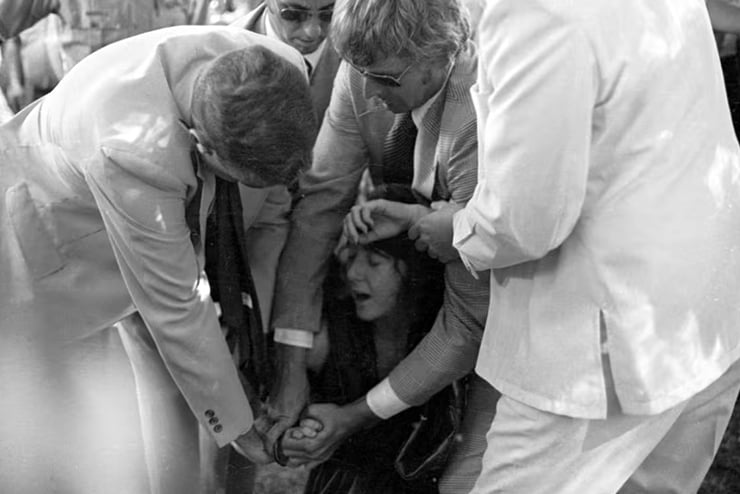
Secret Service agents immediately grabbed Fromme. She said she was there merely to protest President Ford’s environmental policies and didn’t intend to kill him. She declared that’s why she had earlier ejected a chambered round from the Colt. A .45 round was found on the bathroom floor of her apartment. She thought she would be found not guilty. No such luck for Squeaky. She was convicted and sentenced to life. After serving 34 years, she was paroled in 2009. Since then, she has lived quietly with a boyfriend, an ex-con himself, in a small town in upstate New York. ◆
Leave a Reply