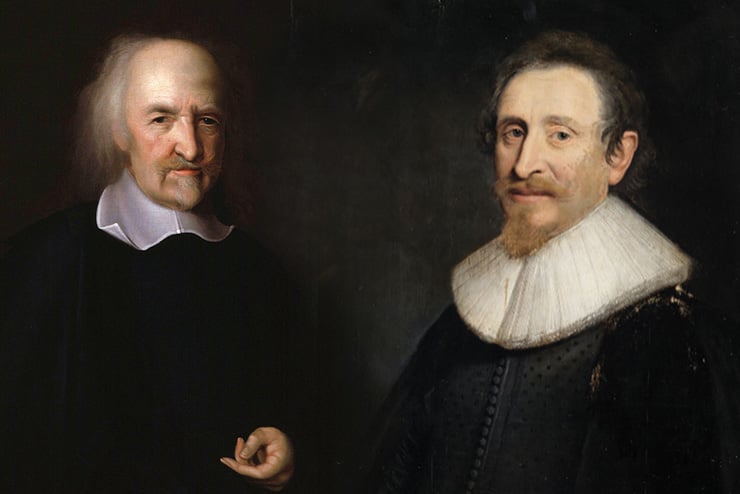
States define their goals through the acquisition, maintenance, or expansion of power—the ability to impose their will on others. U.S. military action in Venezuela on Jan. 3, President Donald Trump’s claim to Greenland, and the smouldering conflict with Iran provide three recent examples that confirm the basic postulate of realism: that international politics is defined by “national interest as power.” This is the primary and rational goal of foreign policy.
In a Hobbesian system of sovereign states, devoid of a supranational authority endowed with the monopoly of force, international legal norms carry little weight. Bellum omnium contra omnes (“the war of all against all”) concerned the genesis of the state as such, but Thomas Hobbes’ anthropology elaborated in a “domestic” context also serves as the operating principle of world politics. That was the case for centuries before Donald Trump began his second term. That was notably the case during the dominance of the so-called rules-based international order, which lasted a little over three decades following the end of the Cold War.
The list of transgressions of this rules-based order is long: the NATO attack on Serbia in 1999, wars in Afghanistan and Iraq, and completed or attempted regime changes throughout the Middle East (Tunisia, Syria, Libya) and Eastern Europe (Ukraine, Belarus, Georgia, Moldova). The claim that Trump has capriciously ruined a well-ordered world based on respect for international legal and moral norms is patently untrue.
That much was admitted in Davos in January, when Canadian Prime Minister Mark Carney—a certified globalist—called that order a useful “fiction,” sustained not by universal and permanent principles but by U.S. power and selective enforcement of rules invented ad hoc. When successive administrations (most notably Biden’s handlers) invoked the rules-based international order, they were merely asserting the primacy of a set of transient rules made in Washington and tweaked as needed at any given moment. That order, Carney acknowledged, was a convenient illusion, which Western elites gladly treated as real for as long as American hegemony delivered favorable setups to make the lie profitable for them.
Trump doesn’t pretend to follow any lofty rules when he bombs Iran, demands Greenland, or arrests a foreign head of state in his capital. He is unperturbed that all of the above is in violation of Article 2(4) of the UN Charter—a cornerstone of modern international law that prohibits the threat or use of force against the territorial integrity or political independence of any state.
There is nothing new in Trump’s behavior. A famous passage from Thucydides’ History of the Peloponnesian War, known as the “Melian Dialogue,” describes an episode in 416 B.C. when Athens demanded the surrender of the neutral island of Melos. Athens promised mercy for submission but threatened destruction for disobedience. The Athenians declared that justice existed only between equals; otherwise, “the strong do what they can, and the weak suffer what they must.” Invoking natural law in the form of divine justice, the Melians refused to surrender. Athens attacked them, killed all adult males, and sold their women and children into slavery.
Whether Trump is familiar with Thucydides’ opus or not, he understands its key message. It is relevant not only to Venezuela, Greenland, and Iran today, but also to conflicts between states, tribes, and clans throughout history, across civilizations, and in all places. International relations find their most tangible expression in the propensity of stronger actors in the system to impose their will on weaker ones.
Violence is immanent to both man and state. It reflects the relative immutability of human nature, regardless of political context or technological development. No communities—or intercommunity relations—exist that are free of conflict and coercion. To understand what happened in Melos two-and-a-half millennia ago, or in Versailles in 1919, or in Munich in 1938, we need to follow realism as a concept and analytical framework. A realist is free from the Kantian vision of the world as it should be, or the parallel illusion that human nature is amenable to didactic improvement. The realist is grounded in the historical experience of the world and man. He accepts as a given that the Melian dialogue reflects the reality of its time as faithfully as the reality of our own, or any other time.
Three decades of post-Cold War neoconservative-neoliberal discourse is finally over. The rhetorical posturing over promoting democracy, defending human rights, protecting victims, and preventing genocide as justifications for foreign interventions is at an end.
Three decades of post-Cold War neoconservative-neoliberal discourse is finally over. The rhetorical posturing over promoting democracy, defending human rights, protecting victims, and preventing genocide as justifications for foreign interventions is at an end. Trump’s vision of international order is based on a single “rule”—the American interest, as he understands and pursues it. This may seem disconcerting, but it has the potential to make relations with other actors, and especially relations between the great powers, more predictable. Coherently defined interests—devoid of ideological phraseology—and geographic zones of interest can be defined and negotiated. The resulting system is likely to be more rational, more calculable, and ultimately more morally sustainable.

As for Trump’s version of the Monroe Doctrine, again, there is nothing new under the sun. The geography of the Western Hemisphere naturally determines the hegemonic role of the principal power. This would be the case even if the doctrine had not been codified in 1823.
Trump’s actions, seen through the prism of realism and in their geopolitical context, make more sense than the relentless eastward expansion of NATO and the baiting of Russia that his predecessors had practiced for years. Trump’s creation of the “Peace Council”degrades the authority of the UN, but the self-serving bureaucratic machine on the East River has not enjoyed much of it for decades. His seemingly bizarre focus on Greenland, which has further strained relations between the U.S. and the Eurocratic establishment, reminds us that states naturally tend to expand control over space: territory has always had primacy in the drama of international politics.
In any event, the coast of Greenland is not a fixed border that forever separates sovereignties and legal orders; it is a political arrangement. General Karl Haushofer, the doyen of German geopolitics, correctly pointed out more than a century ago that borders are not determined by law but by the state’s ability to conquer, delineate, and retain them. All over the world, but especially in Europe, borders have shifted over the centuries in favor of the stronger and at the expense of the weaker, regardless of ethnic and historical rights. The border is a reflection of the state’s ability to conquer certain territories—or its inability to preserve them—while legal and political arrangements are only retroactively made to verify any given outcome. All along, the factors of space and power remain inexorably permanent, and human nature stubbornly unchangeable.
For all present-day devotees of Immanuel Kant’s and Woodrow Wilson’s liberal creed, this is pure heresy. For them, history is a linear path of progress. They claim that the realists’ allegedly pessimistic paradigm hinders “humanity” in its progress toward a conflict-free world. Since realists see conflict as inevitable, they are accused of effectively prolonging the tragedy of war. The accusation is absurd, however. It can be compared to the claim that medicine, with its excessive focus on disease, hinders human progress toward immortality.
It is unlikely that Trump is familiar with the realist theory of international relations, as outlined by George F. Kennan and Hans Morgenthau in the 1940s or John Mearsheimer today. The president’s actions over the past year suggest that he is nevertheless aware that world affairs are conditioned by relations of space and power, not by legal norms or ideologies. As we enter the second quarter of the 21st century, the three main global powers—the United States, China, and Russia—all share a historically conditioned sense of national identity. In today’s world, only the European Union apparat and the leaders of its key member states (notably Germany) still reject any notion of group coherence based on common historical experience and cultural heritage.
Trump’s rejection of the progressivist view of history is particularly encouraging. In this, he differs from his seven immediate predecessors, starting with Jimmy Carter. All of them have invoked the need to be on “the right side of history” to justify their actions. Belief in this fantasy fuels megalomaniacal visions and often leads to tragic outcomes. It makes a reasonable compromise with “evil” adversaries inherently unlikely. The danger of violent global conflict is, somewhat paradoxically, lower now than it was under past presidencies, because Trump is averse to the Manichean ideologizing of every conflict. Departing from the typical neoliberal modus operandi, Trump does not make a Hitler out of every enemy, as his predecessors did with Milošević, Saddam, Putin, and many others. By discarding platitudes about “common values,” Trump implicitly returns geopolitics to the center stage.
This is welcome news. Only the spatial vision of power provides us with the tools needed to develop a reliable vision of world affairs. It is no coincidence that the Middle East, Ukraine, the Caucasus, the South China Sea, Korea, and the Balkans all belong to the “Rimland,” the disputed zone which surrounds the core of Eurasia, the vast pan-region that the famous Scottish geographer Sir Halford Mackinder called the Heartland. The essence of competition along the Rimland does not change; the pressure points and attendant ideological discourses do.
There is no spontaneously emerging or consciously created legal system, and there is no supranational structure capable of restraining the aspiration of great powers to establish or strengthen their control over spaces, resources, and access routes. The laws of survival for that elusive, self-justified virtual person, the State, have never been subject to normative variables. They rest on the lasting coordinates of space, power, and human nature, resulting in the visible debacle of liberal theories grounded in natural law, universal moral norms, and utopian visions.
Hugo Grotius, the 17th-century Dutch jurist commonly recognized as the father of public international law, postulated that the pursuit of advantage by sovereign states is subject to common standards that oblige, rather than merely counsel, moderation and restraint. Yet Grotius himself was not averse to the notion that might can be right if it brings benefits to one’s own side. His theorizing on international law, as that term has been understood since the Peace of Westphalia, began with his unfairly neglected 1606 treatise, On Loot (De iure praedae). Grotius presented a legal justification for the Dutch seizing a Portuguese ship carrying silk, porcelain, and silver worth 3 million guilders, equal to the annual income of the English crown at that time. In chapter 15 of Mare Liberum, Grotius argues that the high seas should be considered a free zone in which the law of the stronger prevails for both states and armed private companies.
Two decades later, in his famous book On the Law of War and Peace, Grotius argued that Europeans can wage war against any people whose customs they consider barbaric, in accordance with the ius gladii, the law of the sword. Rulers, Grotius wrote,
have the right to demand punishment not only for injuries inflicted on themselves or their subjects, but also for those that do not concern them specifically, but which constitute grave violations of the Law of Nature or of the people.
Grotius thus offered justification for conquering and killing anyone resisting Holland’s colonial expansion.
The Dutchman thus appears in two guises, like Dr. Jekyll and Mr. Hyde. Grotius, the upholder of moral obligation and human sociality, coexists with Grotius, the defender of piracy and the upholder of the right of the sword—effectively an apologist for the Athenians’ behavior in Melos. This duality smacks of hypocrisy. It looks like a precursor of the rules-based international order decreed by the neoconservative-neoliberal duopoly four centuries later, in which the so-called rules were selectively applied by the strongest nation, the U.S., against weaker ones.
The Trump phenomenon shows that grounding state reason in the coordinates of power and space refutes Grotius’s famous contention that natural rights operate under all circumstances and on any assumptions. The issue of alleged primacy of rights over state sovereignty remains the key point of contention between Grotius’s disciples and realists like Trump, Vladimir Putin, Xi Jinping, Narendra Modi, Recep Tayyip Erdoğan, and most other national leaders outside the EU and Canada.
In the end, the imperative of self-preservation trumps Grotius’s hypothetical “sociality.” International law will survive as an auxiliary tool of real politics, not as a neutral arbiter of “justice.” The vision of a global order based on the willing universal acceptance and respect for universal norms remains a fantasy. The geopolitical trinity ofspace, power, and raison d’état—unholy as it may be—remains inviolable.
Carl Schmitt would approve. His realist, anti-liberal critique of universalist legal norms is as valid today as it was in his time. The ongoing multipolarization of the world accords with his plea for a spatial ordering of global politics rather than a universal, liberal, discriminatory legal system. That utopian lie has finally run its course, just over four decades after Schmitt’s death.
International law is, in the final analysis, a belief system, and all belief systems rely on experiential credibility for their authority. International legislation will continue to be made, cases will continue to be heard and decided at The Hague, and analyzed in professional journals and dissertations. In the meantime, reality will increasingly move away from the fictitious rules-based international order that some devotees of liberalism still claim can be regulated.
This is neither “good” nor “bad.” It is how it is, and how it will be until the end of history, when this fallen world passes from time to eternity. In the short term, Trump may make missteps, especially in the Middle East. In devising his long-term grand strategy, however, he will serve the American interest well by continuing to accept the supremacy of Hobbesian existential realism and acting accordingly. ◆
Leave a Reply