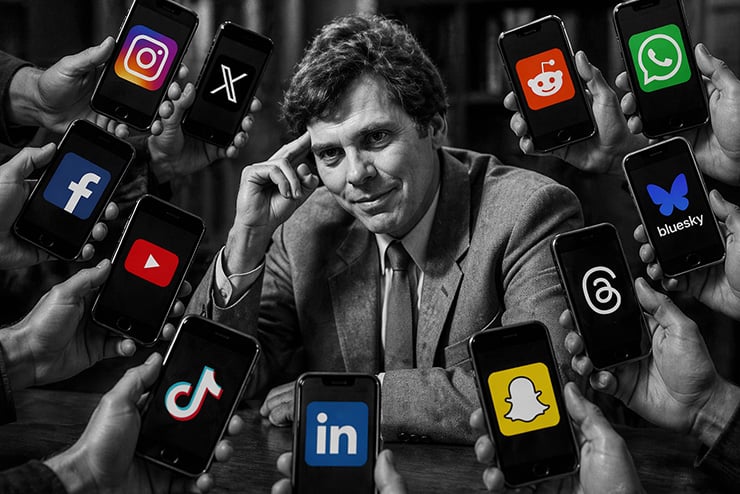
The media’s obvious political biases are as subtle as a purple-haired, rainbow flag-waving Mamdani voter screaming “Death to Israel!” Conservatives have labored for decades to combat the liberal slant of the television networks, national newspapers, and Hollywood studios. Their tactics must deal with rapid technological change. So they target Facebook, Twitter, and TikTok. The right accuses these social media cesspools of pushing the electorate leftward, most notably in 2020.
But rhetoric won’t vanquish our enemies. Normal Americans abhor the media’s repulsive political, cultural, and social revolutions. However, the media’s mere existence is even worse than its destructive biases.
Neil Postman’s Amusing Ourselves to Death: Public Discourse in the Age of Show Business warned of the media’s existential threat to the common good more than 40 years ago, long before we surgically attached our iPhones to our faces. An incisive media theorist and cultural critic, Postman joined New York University’s faculty in 1959. He served as the chairman of its Department of Culture and Communication until his untimely death in 2003 at the age of 72. His 20 books and more than 200 articles presciently warned of digital technology’s impending horrors back when landlines mattered, and cell towers didn’t. Postman’s philosophical critiques transcended the partisan squabbles playing out across the media wasteland, from the propagandizing editorialists at The New York Times and The Wall Street Journal to the featherbrained sock puppets on MS NOW and Fox News.
Postman’s main metaphor in Amusing Ourselves revolved around two dystopian literary classics whose Monarch Notes many of us skimmed in high school. Unlike self-conscious teenagers too preoccupied with acne to bother with literature, Postman actually read the texts closely. His caustic assessment resonates even more today than when he wrote it in 1985.
Postman contrasted George Orwell’s 1984, where “people are controlled by inflicting pain,” with Aldous Huxley’s Brave New World, where “they are controlled by inflicting pleasure.” Whereas Orwell feared the tyrants “who would ban books,” Huxley declared book bans obsolete “for there would be no one who wanted to read one.” Orwell despaired that the concealment of truth would deaden our minds; Huxley imagined that truth “would be drowned in a sea of irrelevance.” Ironically, Orwell’s “captive culture,” unable to even access the truth, stood a better chance of survival than Huxley’s “trivial culture,” the narcotized members of which had no idea “what they were laughing about and why they had stopped thinking.” If you’re more upset that your child’s school banned Born Ready: The True Story of a Boy Named Penelope while he squanders all his free time posting selfies on Instagram, then you need to either dig up those Monarch Notes or, better yet, immerse yourself in Postman.
Everyone can recite Marshall McLuhan’s famous adage, “The medium is the message.” Postman freely acknowledged McLuhan’s influence on his own work. But he expanded McLuhan’s theory: the form by which we convey our ideas matters just as much as the ideas themselves. Trouble awaits societies as they move from the written word to the spoken word. “The written word endures, the spoken word disappears.” Written words go through a rigorous vetting process. Writers reflect on them and revise them. Editors review them and rearrange them. Journals assess them and publish them. Then the reading public casts its judgment. As Postman concludes, “Writing is closer to truth than speaking.”
Out of this process, something approaching the truth boils to the surface, unlike the chaos and confusion hot-take tweets and television talking points stir up. As proof, Postman noted that his doctoral students demanded written proof that their theses had passed muster, rather than mere verbal approval, which, in reality, would amount to “only a rumor.” The written word requires more investment from both the reader and the writer. And it doesn’t just vanish like a neocon dodging his draft notice. Postman identified America’s shift from its written-word “Age of Typography” to its ephemeral “Age of Television” as the “most significant cultural fact of the second half of the twentieth century.” This transformation has further accelerated in the twenty-first century as social media has supplanted television.
Our understanding of the truth also changes as we shift from one medium to another. Witness the changes as humans moved from “orality to writing to printing to televising.” Reading requires that we sit still and immerse ourselves in deep thought. In order to evaluate a written argument, we must employ what Bertrand Russell called an “immunity to eloquence.” We must be able to distinguish grounded fact from eloquent fiction. We need to sift through rhetorical flourishes. Ultimately, we must know “the difference between a joke and an argument.”
These abilities represent the “primary definition of intelligence” for print-centric cultures. For Postman, 18th- and 19th-century America ranked as “perhaps the most print-oriented culture ever to have existed.” Thomas Paine’s book sales support his assessment. Common Sense’s estimated 1776 print run of 400,000 copies in a population of 3 million is proportional per capita to roughly 47 million copies today. While Postman’s ranking is up for debate, 21st-century book sales pose no threat to it.
Print’s “insistent and powerful” monopoly arose naturally between the 17th and the 19th centuries, as no other form of media existed. Americans did not read merely for leisure; reading was a necessary life skill. States didn’t set their voting ages at 21 to disenfranchise the youth. Rather, they knew “mature citizenship” could not be reached “without sophisticated literacy.” Although states back then repealed property qualifications for voting in their frequent, misguided, egalitarian fits, they never abolished literacy requirements.
Print’s monopoly gave rise to what Postman labeled the “Age of Exposition,” or what weepy nostalgists refer to as America’s Intellectual Peak. Print’s benefits were manifold. Their recitation, which Postman provides in his book, will resound with discerning Luddites who live by the printed word today:
A sophisticated ability to think conceptually, deductively, and sequentially; a high valuation of reason and order; an abhorrence of contradiction; a large capacity for detachment and objectivity; and a tolerance for delayed response.
Rapacious social media companies program their algorithms to encourage the exact opposite tendencies.
Long before Zuckerberg and Musk set out to pollute public discourse, the telegraph had already instantiated the “irrelevance, incoherence, and impotence” of “context-free information.” Fed by the telegraph, newspapers began to print “news from nowhere, addressed to no one in particular.” Not surprisingly, news became worthless. Nineteenth-century Americans in Maine had nothing relevant to share with their compatriots in Texas, but that didn’t stop them from sharing.
News remains worthless today. Postman proved how with a simple thought experiment:
How often does it occur that information provided to you on morning radio or television, or in the morning newspaper, causes you to alter your plans for the day… or provides insight to some problem you are required to solve?
Aside from the weather forecast, probably never. Case in point. I took a coffee break while writing this piece and reflexively turned on my TV to keep me company. The Fox News anchors breathlessly reported Eric Swalwell’s breaking sexual misconduct allegations, former New York City Mayor Eric Adams’ acquisition of Albanian citizenship, and a segment on “Faith and Fatherhood at the Masters.” This useless reportage only served to remind me that I’m not sure who Eric Swalwell is, I can’t imagine why anyone would even visit Albania, and, most importantly, I have no idea where my golf clubs are. I chugged my coffee, yelled at my dogs for barking, and went back to writing.
Postman reserved a special place in Hell for television, but only because he didn’t live long enough to witness the toxicity of social media. “Television’s conversations promote incoherence and triviality,” both of which have proven themselves “uncompromisingly hostile to typography’s way of knowing,” per Postman. In a word, television “attacks” literate culture, as Postman concluded. TV journalist Bill Moyers agreed. Moyers accused television of fostering “an anxious age of agitated amnesiacs.” Blithely ignoring his personal role in our cultural barbarization, Moyers added, “We Americans seem to know everything about the last twenty-four hours but very little about the last sixty centuries or last sixty years.” Is it even possible to scroll sixty years backward on X?
Unfortunately for me, Neil Postman left both NYU and this mortal, media-addled coil before I started teaching there in 2011. But this past week, I had an interesting watercooler conversation with my colleague Jonathan Haidt, NYU’s modern-day Postman. Haidt and I inevitably blackpill, so our joint mental health tends to be inversely proportional to the frequency of our casual encounters. However, Haidt has started cheering up, with good reason. Several countries passed legislation to prevent minors from accessing social media. A recent suit in California, where I think Eric Swalwell lives, found social media companies—just like Socrates—liable for corrupting the youth. And schools nationwide have begun banning electronic devices from classrooms, a policy I enacted in my classroom back in 2011.
But I couldn’t help myself from dark thoughts during my last conversation with Haidt, mentioning how annoying I found speakerphones at airports, just to be a tad specific. Haidt then went dark himself. He predicted that cellphones would go down as the greatest industrial disaster in human history. The recent surge of teenage depression and suicides, especially among girls, will seem trivial compared to the next generation’s inability to focus, all thanks to social media and electronic devices.
Hate the left-wing media’s confiscatory tax policies, incessant war mongering, and unnatural transgender fixation all you want. But hate the medium itself even more. Huxley’s dystopia of mindless amusement has lulled us into a state of unwitting
complacency. ◆
Leave a Reply