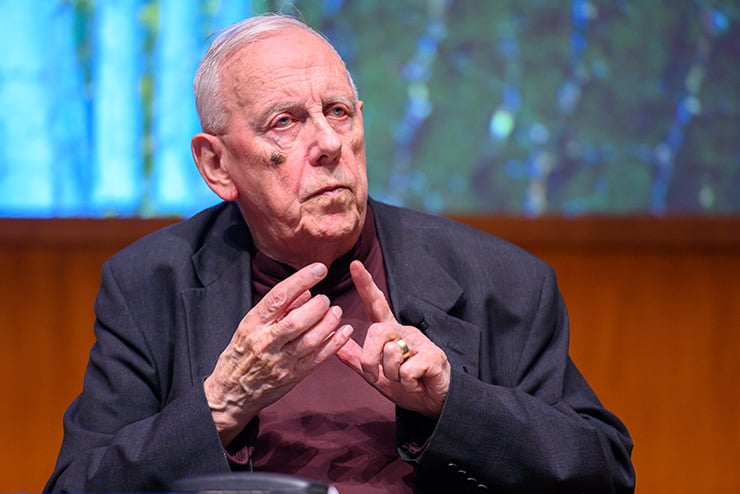
Defender of Virtue
Shortly after Alasdair Chalmers MacIntyre left this vale of tears on May 21 of this year, he received effusive praise from both the left and the right. The American socialist magazine Jacobin celebrated the renowned philosopher for leaving “us a substantial, fascinating, and provocative body of work.” The Catholic journal First Things mournfully observed that, “The republic of letters is diminished by his death, not because of what he might yet have done (though he lived to write), but because of what he had already achieved.” Even The New York Times published a respectful obituary.
MacIntyre probably would have explained this impressive degree of recognition by pointing to what he believed was the true task of a philosopher:
to enable plain persons to articulate the hitherto unrecognized presuppositions of their actions, so that they become able to criticize those presuppositions and to engage in critical and self-critical deliberation with others in their household, workplace, school, clinic, local political society.
MacIntyre always defended the self-governing communities cherished by these “plain persons.”
MacIntyre was born in Glasgow on Jan. 12, 1929, to parents who were both practicing physicians. Describing his formative years in a 1991 interview, he claimed to have “the philosophical good fortune to be educated in two antagonistic systems of belief and attitude.” He said that some of the “older people” who influenced his early upbringing urged him to ignore his Gaelic ancestry and to focus on an education “designed to enable him to pass those examinations that are the threshold of bourgeois life in the modern world.” Yet the imagination of the young MacIntyre remained “engrossed by a Gaelic oral culture of farmers and fishermen, poets and storytellers,” a culture that equated justice with playing “one’s assigned role in the life of one’s community.” This tension between modern conformity and traditional community inspired some of the most famous ideas that he later articulated in his major works.
In the first half of his life, the forces of modernity seemed to win over the soul of MacIntyre. Although he studied the philosophy of ancient Greece at various English universities in the late 1940s, MacIntyre was initially more receptive to analytic philosophy, which still enjoys hegemonic influence in most philosophy departments in the United Kingdom. Analytic philosophy’s focus on logical rigor, adherence to the scientific method, and striving for clarity in language all deeply impressed him. The atheistic implications of analytic philosophy, however, also forced MacIntyre to “fence off the area of religious belief and practice from the rest of my life, by treating it as a sui generis form of life, with its own standards internal to it.”
By the 1950s, he was also briefly drawn to Marxism and even joined the Communist Party of Great Britain. Although MacIntyre left the party in protest over the Soviet invasion of Hungary in 1956, his study Marxism: An Interpretation (1953) revealed his sympathy with Marx’s analysis of the destructive effects of capitalism, including its eradication of “natural communities” based on the agrarian way of life. But while Marx defended the death of traditional community as the price of economic progress, MacIntyre lamented it.
Despite his early qualified support of leftist ideology, MacIntyre ultimately repudiated leftism in practice. In the mid-1960s, the Labour Party’s embrace of statist control of the British economy and education led him to conclude, in an essay about the Christian socialist historian R. H. Tawney, that “Labour is increasingly the political expression not of workers, but of managers and technocrats. It is the party of the other half of our ruling class.” In short, Labour was no longer the party of plain persons, a reality that is abundantly evident in leftist political parties today.
Modern moral philosophy has no answer to the challenge of Nietzsche, who astutely concluded that an ethics based on subjective value preferences could just as easily justify a tyrannical will to power.
MacIntyre’s turning away from the left occurred several years before he abandoned his philosophical atheism. In Secularization and Moral Change (1967), he confidently claimed that “Christianity confronted with the secular life of the post-Industrial Revolution society has in fact found it impossible to lend meaning to that life or to enable people to understand and find justification for living out its characteristic forms.”
MacIntyre’s departure for America in 1970 did not initially coincide with any notable philosophical change in his thinking. As he took up various teaching positions at Brandeis, Boston University, Vanderbilt, and Duke, his publications reflected the biases of analytic philosophy. By the late 1970s, however, MacIntyre was veering away from his modern predispositions. In his 1979 essay “Why Is the Search for the Foundations of Ethics So Frustrating?”, he targeted liberal democracy’s failure to reconcile “incommensurable” moral beliefs, leading to conflicts that are never settled in any decisive way.
The fact that both sides in the abortion debate invoke the language of “rights” was a classic example of this impasse. This failure to resolve ethical conflicts, MacIntyre added, was typical of the “institutions of the American polity, with their appeal to abstract universality and consensus, [which] are in fact a place of encounter for rival and incompatible outlooks.” In short, he wondered whether there was a common good that united Americans as a people, living amidst polarizing conflicts over the meaning of right and wrong.
This absence of moral consensus in late modernity was not unique to America. As MacIntyre started to realize, the crisis was rooted in the defective nature of modern philosophy. Although he had originally intended to write a book on ethics that reflected modernist biases, he tore up this manuscript and decided to write a work that demanded a radical rethinking of the history of moral philosophy.
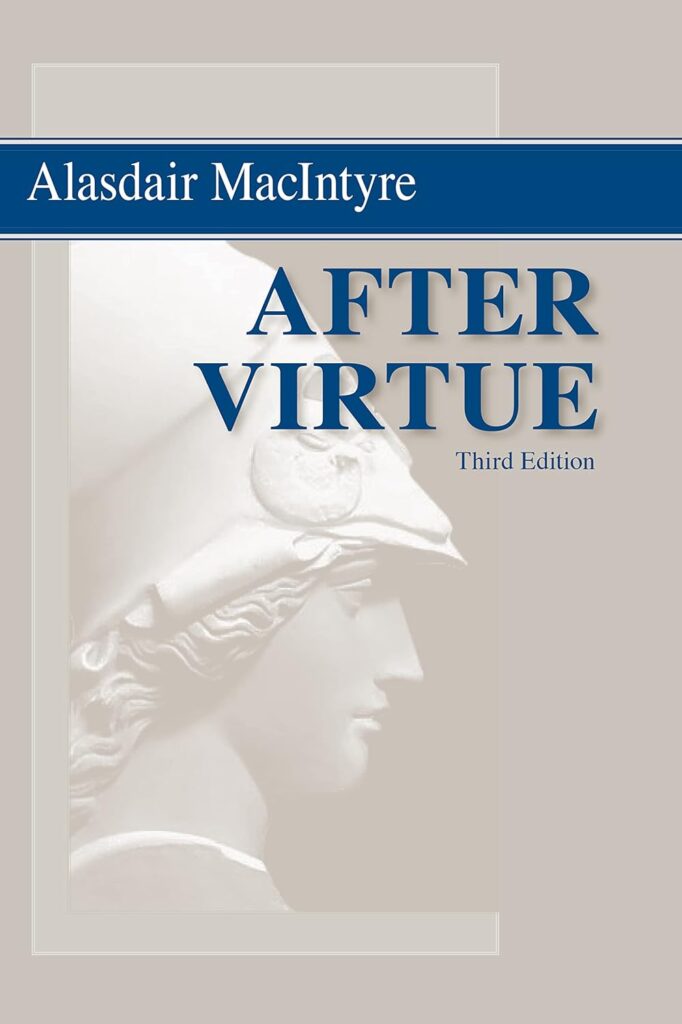
The result of this paradigm shift was his most famous work, After Virtue: A Study in Moral Theory (1981). In it, MacIntyre compared the moral crisis of modernity to a hypothetical scenario in which enlightened citizens were trying to make sense of the natural sciences, long after a catastrophe had destroyed scientific culture, by piecing together fragments of scientific language and knowledge that had barely survived the destructive event. In MacIntyre’s judgment, moral philosophy and even morality have already suffered a similar fate. “We possess indeed simulacra of morality, we continue to use many of the key expressions,” he wrote. “But we have—very largely, if not entirely—lost our comprehension, both theoretical and practical, of morality.”
According to MacIntyre, the greatest thinkers since the Enlightenment made a grave error in repudiating the premodern philosophical tradition that had emphasized the importance of virtue as the most reliable basis for morality and politics. Indeed, the title After Virtue has a double meaning, one that points to the disastrous aftermath of this modern revolt, as well as the pressing necessity to recover (to chase after) this lost tradition of virtue ethics.
Why was a focus on virtue superior to modern accounts of moral philosophy? MacIntyre contends that these modern theories, including rights-based, utilitarian, and Kantian philosophies, too narrowly focus on articulating principles of conduct that should guide the various choices of self-interested individuals. Absent in this array of theories is any attention to the goal or purpose of human existence as well as any account of what it means to live a good (that is, a virtuous) life.
Instead of relying on ethics that promote individual autonomy and self-interest, MacIntyre urged his readers to rediscover the teleological ethics of Aristotle and St. Thomas Aquinas, specifically their “concept of man understood as having an essential nature and an essential purpose or function,” one that is fulfilled through the practice of such virtues as honesty, courage, justice, and moderation. Although plain and pious persons in search of meaning or purpose were quite capable of practicing these virtues, the overall societal failure to understand this objective morality imprisons modernity within “new dark ages” in which “the barbarians are not waiting upon the frontiers; they have already been governing us for some time.”
The “barbarians” to whom MacIntyre referred included the managerial class that has controlled big government and big business since the 1930s. This elite arrogantly believes in their own expertise or competence, which allegedly allows them to predict and control social change. Their related desire to wield efficient control of human nature trumped the need to cultivate good character among plain persons, whose intelligence these bureaucrats despised. While the managerial class confidently dismissed the premodern metaphysics of a God-given teleology, they embraced the illusion that their own expertise was based on scientific objectivity, when in fact it was an expression “of arbitrary, but disguised, will and preference.” Their failure to predict change further reflected their unjustified confidence in their rationality, even as they sought to control the destinies of the citizenry in the name of greater “freedom” and “equality.”
With the removal of a divinely sanctioned purposive design in the universe, modern philosophy also displaced any notion of objective morality. Belief in the precepts of natural law, which taught that human beings could discover the objective truths of morality using their God-given reason, has been dismissed as unscientific. This rejection led to ideas such as emotivism, a creature of analytic philosophy, which taught that moral judgments are merely expressions of emotion, feeling, and taste.
The idea of an objectively good life for all human beings ceased to exist, along with the idea of an essential human nature in search of a final end. At most, reason in its modern incarnation simply functioned as the “slave of the passions” (to use David Hume’s famous phrase), calculating the consequences of acting on one feeling or another without being able to objectively decide which one is best for the person in question. Subjective value preferences have replaced objective virtue-based imperatives. The “good” became identifiable with what pleases people and the “bad” with what pains them.
The practical result of emotivism is to foster the rise of a “democratized self,” who lacks any social identity or essential nature “because it is in and for itself nothing.” As a result, modern moral philosophy has no answer to the challenge of Nietzsche, who astutely concluded that an ethics based on subjective value preferences could just as easily justify a tyrannical will to power. MacIntyre’s own personal turning away from modern philosophy was completed when he converted to Catholicism soon after the publication of After Virtue.
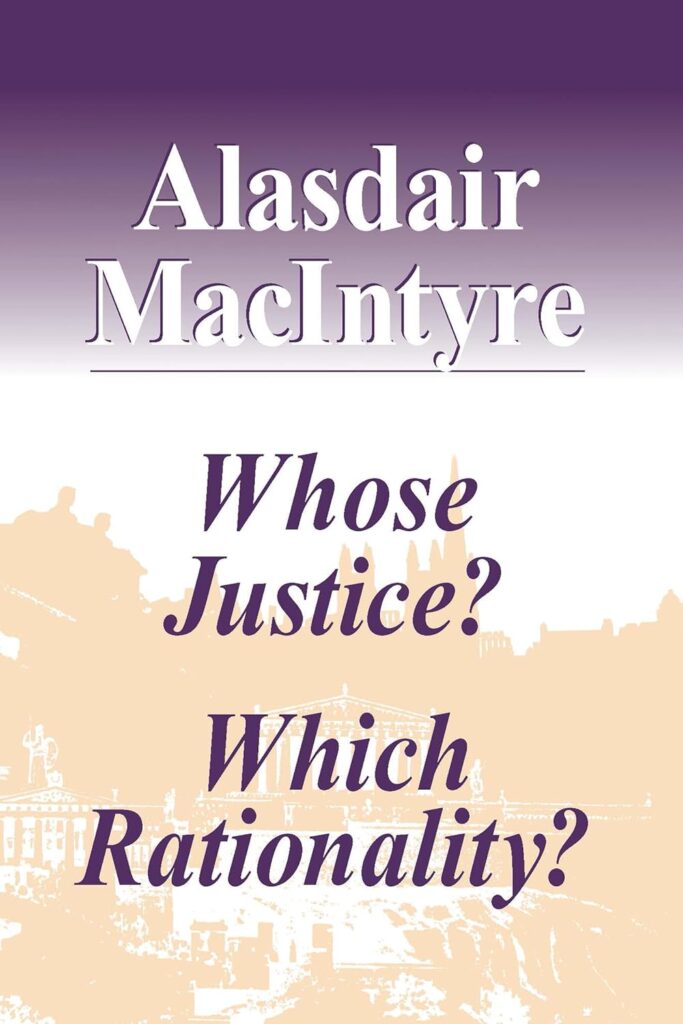
In the mid-1980s, MacIntyre landed a professorship at the University of Notre Dame, which he held until his retirement in 2010. During this mature stage of his career, he targeted liberalism for having become a “solvent of participatory community,” one that privileges the conflicting preferences and rights of individuals over a common good. Yet this unending conflict does not dissuade liberals from insisting that their beliefs be accepted by all. In Whose Justice? Which Rationality? (1988), MacIntyre denounced the “fictitious objectivity” that dominates liberal universities, which claim to give every idea a hearing even though they exclude or demean scholars with traditional religious beliefs. The liberal university, he further explained in Three Rival Versions of Moral Inquiry (1990), has “deprived itself of substantive moral inquiry,” given its intolerance of illiberal views.
With a nod to his Marxian background, MacIntyre saw within liberalism the perfect ideology for the moneyed interests. Modern societies are “oligarchies disguised as liberal democracies,” which exclude the majority of plain persons “from membership in the elites that determine the range of alternatives between which voters are permitted to choose.” At most, the average citizen is a mere spectator, unaware of hidden “presuppositions” that guide everyday politics.
Modern societies are “oligarchies disguised as liberal democracies,” which exclude the majority of plain persons “from membership in the elites that determine the range of alternatives between which voters are permitted to choose.”
The shallow reduction of ethical judgment to subjective taste is a perfect philosophical fit for managerial capitalism, which encourages human beings to perceive themselves as “individual preference maximizers” in search of the latest commodity that maximizes their pleasure and minimizes their pain.
Liberal rhetoric about the right of individuals to use the law against unethical corporations also gives the false impression of an even playing field between consumers and firms. Corporations do not see themselves as individuals who are morally accountable for their misbehavior. Commenting on the thalidomide poisoning controversy of the 1960s and 1970s, MacIntyre noted that firms such as Grünenthal Chemie in Germany and the Distillers Corporation in the United Kingdom, which made this sedative for treating morning sickness in pregnant women, were able to distance themselves from the birth defects the drug caused. According to those companies, responsibility for the defects lay with the physicians who poorly administered the drug, not with its manufacturers.
The corporate denial of any liability for their product demonstrated to MacIntyre that the admirable liberal notion of individual responsibility “is an endangered concept because of the combination in our society of corporate power and moral weakness.” This pattern of corporate bad faith persists to this day. When was the last time that a high-tech oligarch took any responsibility for the destructive effects of artificial intelligence, for example?
America was not immune to these conflicts. Although MacIntyre admired the founding documents for reflecting “the eighteenth-century ideal of a republican people, a people inspired by a common regard for virtue and for community,” the republic also faced opposite pressures from “the marketplace where people provide objects for consumption and act as instruments to satisfy the appetites of others.” A family that mourns the death of a child in a car accident understands this incalculable loss of life very differently from the automobile executives who see it as contributing “to an annual death rate that is an acceptable trade-off for the benefits of automobile sales to their industry and to society,” he wrote.
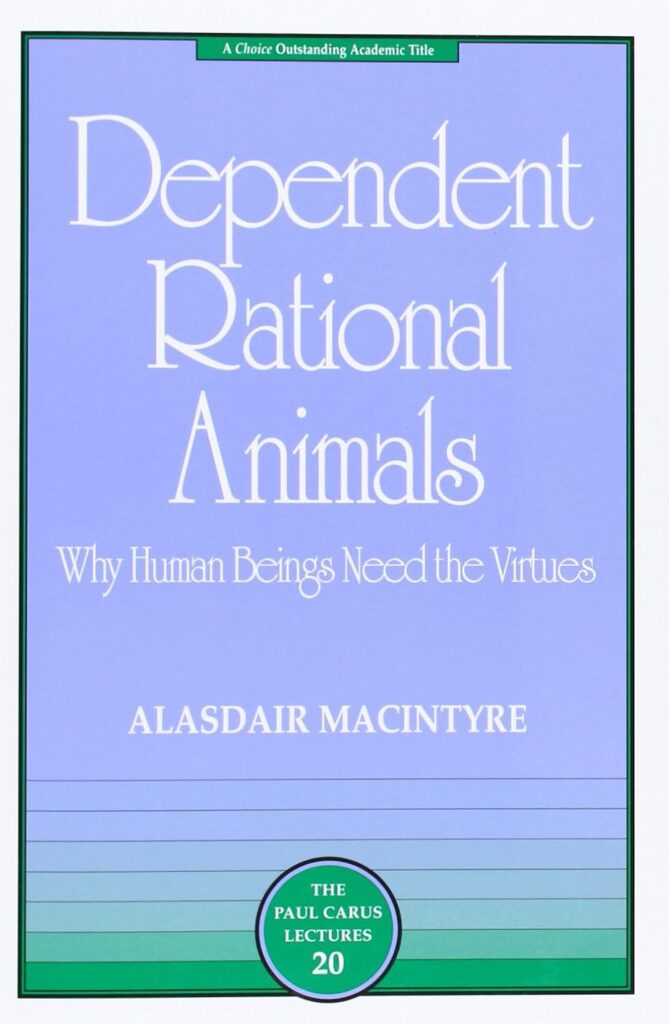
The good news is that most human beings do not live by this pure market morality. As MacIntyre explains in Dependent Rational Animals (1999), if a customer discovers that the neighborhood butcher is having a heart attack in his shop, he does not say “Ah! Not in a position to sell me my meat to-day, I see,” nor does he ignore the butcher’s cries for help and walk to another butcher shop to make a purchase.
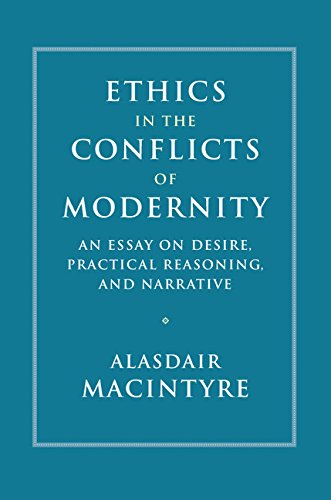
Even though plain persons practice virtue, America’s political system does not. In his last major work, Ethics in the Conflicts of Modernity (2016), MacIntyre wrote that America “is in some respects not a democracy, but a plutocracy,” hostile to any notion of a common good. Even the American left is content to fight it out with conservatives over which voting bloc has the greatest claim to its rights or entitlements.
In a 2000 essay on theories of natural law in advanced modernity, MacIntyre took aim at Senator Joe Biden’s grilling of Clarence Thomas’s adherence to the natural law tradition during his 1991 Supreme Court confirmation proceedings. Biden’s comment that “natural law dictates morality to us, instead of leaving matters to individual choice” MacIntyre saw as reflective of an anxiety that was, unfortunately, “felt” by many of his fellow Americans. The very idea of an objective morality has become political anathema to the Democratic Party, which treats every moral perspective as either a value judgment or a social construct. The radical left’s assault on traditional mores is a purer version of this pattern, one that provoked MacIntyre’s withering reply: if our societies are as “morally impoverished” as these radicals believe, whence are the principles for a more just future to be found?
MacIntyre’s own answer to this question pointed to “small and vulnerable property owners” who, along with families, schools, and churches, share a precarious existence sandwiched between big business and the big state. Although some critics have accused him of legitimizing regimes that would sacrifice individual and minority rights in a “post-liberal” dystopia, these objections misconstrue his message. As long as liberalism is the ideological tool of oligarchs and bureaucrats who seek more power over civil society in the name of “rights,” the only alternative, as MacIntyre writes in After Virtue, is to construct “local forms of community within which civility and the intellectual and social life can be sustained through the new dark ages which are already upon us.” It is up to these communities to bring some light into this darkness.
Leave a Reply