Poet Against the Machine
It is a significant irony that Vanderbilt University, the birthplace of the Agrarian movement, was founded in 1873 by shipping magnate Cornelius Vanderbilt, with the philanthropic hope that the school would promote reconciliation between the North and the South in the aftermath of the Civil War. Indeed, the arch-capitalist “Commodore” certainly did not envision that half a century later the Nashville institution bearing his name would spawn a reactionary cadre determined to impede the ongoing industrialization of the Southern states. But that is precisely what the Agrarians sought to do.
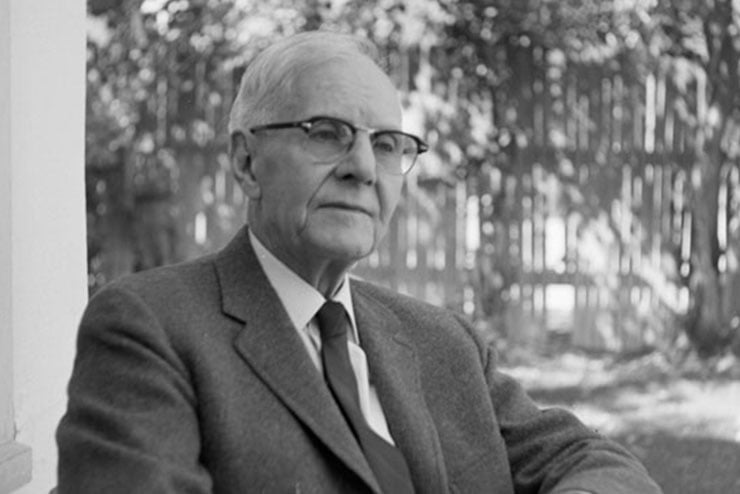
But first there were the Fugitives, a group of aspiring poets in the 1920s who had gathered at the feet of John Crowe Ransom (1888-1974), a young Vanderbilt English professor. Ransom had already published his first book of poems and sought to make a clean stylistic break with the rather genteel Southern poetry of the post-Civil War era. Among the most talented of these junior poets were two of Ransom’s students, Allen Tate and Donald Davidson, who were instrumental in establishing the legendary literary journal known as The Fugitive. Both would eventually be recognized as among the most accomplished American poets of the middle years of the 20th century. Along with Ransom, Tate and Davidson would also become core members of what became known as the Nashville Brotherhood after the publication of I’ll Take My Stand (1930), the manifesto of the Agrarian movement.
Ransom’s contribution to the volume, “Reconstructed But Unregenerate,” sounded its keynote. The South had endured the Northern killing machine and suffered the indignities of Reconstruction, only to be betrayed by its elite planter class. The wealthy planters had rashly believed that the South could prevail against the overwhelming power of the invader, but then made a Devil’s bargain with Northern financial interests. This led to the “gospel of Progress” of the New South—a movement inaugurated by Atlanta journalist Henry Grady, who called upon Northern industrialists to assist the South in her hopes of modernization. The “gospel” was holy writ for its disciples, many of whom occupied tenured positions in Southern bastions of higher learning. They embraced the post-Enlightenment conviction that by virtue of science and a free economy, humanity might ultimately achieve a perfect society free of poverty and base servitude. Calls for industrialization became strident and unceasing.
Yet, Ransom argues, if the onslaught of the forces of the New South on the traditional Southern way of life seemed unstoppable, thousands of Southerners—farmers especially—remained dubious. Instinctively, at least, they remained convinced that the South still possessed a patrimony that the North had abandoned. “The South,” Ransom notes, “is unique on this continent for having founded and defended a culture which was according to the European principles of culture.”
What were those European principles? Above all, they involved the belief that material progress must always be subordinate to a life lived in “an honorable peace with nature.” To embrace the gospel of progress and industrialization was to “wage an unrelenting war on nature,” Ransom wrote. The North had begun to wage that war well before 1860. Still, the old agrarian South had perpetuated a culture in which work and leisure remained delicately balanced, favoring social and economic stability over change and disruption. Importantly, Ransom argued that Southerners at every class level elevated the social “arts” of “dress, conversation, manners, the table, the hunt, politics, oratory and the pulpit” above the frenzied pursuit of personal success.
In the old South, unchecked lust for wealth was considered an affront to the social order—an order of communities rather than individuals. Industrialism, argues Ransom, was “an invidious spirit, full of false promises” and fatal to stability. But by the end of the 19th century, persistent poverty had “enfeebled” the Southern spirit: “Unregenerate Southerners were trying to live the good life [with] shabby equipment, and were grotesque in their effort to make an art out of living when they were not decently making the living.” Hence, they were increasingly willing to listen to the siren song of the New South propagandists.
The Agrarians sought primarily a Southern audience in I’ll Take My Stand. But few Southerners were willing to listen during the Great Depression to a message that called for the rejection of industrialization. Many critics took the line that the Agrarians, after all, knew nothing about economics and were blinded by nostalgia. Ransom had anticipated the latter charge. Properly understood, he opined, nostalgia is “the complaint of human nature … when it is plucked up by its roots from the place of its origins and transplanted in foreign soil, or left dangling in the air.”
Nostalgia alone is not, of course, a sufficient foundation for rebuilding a society, but it is a perfectly natural and justified response to cultural and social disruption. Indeed, Ransom argued it is “the instinctive objection to being transplanted [and] prevents the deracination of human communities.”
Nostalgia alone is not, of course, a sufficient foundation for rebuilding a society, but it is a perfectly natural and justified response to cultural and social disruption. Indeed, Ransom argued it is “the instinctive objection to being transplanted [and] prevents the deracination of human communities.” To discard one’s affection for memorial traditions in the rush to embrace progress is a kind of cultural suicide. “The progressivist says, in effect: Do not allow yourself to feel homesick,” Ransom wrote. “Form no such powerful attachments that you will feel a pain in cutting them loose; prepare your spirit to be always on the move.”
Ransom himself was no economist. He trained in philosophy and read deeply in theology, his father having been a Methodist pastor. But, as anyone who has studied the economic history of the modern West understands, professional economists are all too often ill-equipped to fathom the deepest reaches of social and cultural life. Thus, at least some of the Agrarians felt confident about taking their message to a broader American public, expanding the Agrarian platform to encompass an all-out attack on corporate America.
If their original manifesto had failed to make deep inroads in the South, several Northern and European writers had heard their message and applauded its diagnosis of a crisis—both economic and spiritual—that was more than just a Southern problem. In England, G. K. Chesterton and Hilaire Belloc had founded the Distributist movement upon many of the same principles that animated the Agrarians. In the American North, a number of Old Right thinkers like Herbert Agar had responded enthusiastically to the Agrarian attack on Big Business. When Agar proposed to Allen Tate that they co-edit a book that would reprise the Agrarian themes with a greater emphasis on the ills of the corporate order, Tate welcomed the opportunity. Thus, in 1936, they published Who Owns America?—a collection of essays many regard as a sequel to I’ll Take My Stand.
Contributors to Who Owns America? included Belloc, Tate, Agar, Davidson, Andrew Lytle, and Frank Owsley, among others, and featured another Ransom contribution titled “What Does the South Want?” Perhaps a more appropriate title would have been “What the South Should Want,” for Ransom admitted that the social unity of the South by the mid-1930s was a many-splintered thing, and he did not claim that his proposals would be met with broad acceptance.
One fundamental assumption that Ransom shares with most of the contributors is that “an orthodox capitalism for the South would be an economy with a wide distribution of the tangible capital properties.” This policy would be especially focused on enabling the development of small businesses. Business enterprises owned by individuals or families were “tangible” property, as opposed to property held in corporate shares, a “paper ownership which does not entail any part in management.” When the framers of the Constitution sought to guarantee the inviolability of persons and property, Ransom argued that it was tangible property they had in mind, for such small property ownership was an “indispensable qualification for the complete exercise of citizenship.” As large, centralized business interests became ever more predominant, small businesses were driven out of the market or absorbed into larger entities. Former owners became mere employees, and their interests as citizens were no longer tied to their localities.
Farmers, argued Ransom, should be regarded as the most important group of citizens who had survived the modern economy with some degree of independence. But their survival was in jeopardy. Rather than succumb altogether to the “money economy” and follow the directives of agricultural extension agencies, he believed farmers should seek out a balance between the age-old independence of subsistence farming and planting for the market. But to make this possible, some government assistance would be necessary: drastically lower land taxes, better roads for the transport of goods, and improved educational opportunities for the children of farm families.
Yet, even at the time that Ransom made these proposals, he was harboring doubts. As his biographer Thomas Daniel Young has shown (in Gentleman in a Dustcoat, 1976), he had come increasingly to think that the divisions of labor engendered by the Industrial Revolution were perhaps “predestined.” These doubts, tinged with historical fatalism, were primarily expressed in letters to Allen Tate and, 10 years later, in the pages of The Kenyon Review, a journal Ransom founded after leaving Vanderbilt to take up a position at Kenyon College. “We are far gone in our habit of specialized labor, whether we work with our heads or our hands,” he wrote. “It has become our second nature and nearly the only human nature we can have in a responsible public sense.”
In addition to such philosophical qualms, Ransom believed that his forays into political thought were “eating away” at his art. He longed to return to his first love, poetry, though in the years to come he directed his energy largely to literary criticism.
He broke with Vanderbilt in 1937, as Kenyon offered Ransom a generous salary and more time for his writing. So he settled there with his wife, Robb Reavill, and their three children.
During the Kenyon years, he established himself as the leading critic and literary theorist on the American scene. In essays in The World’s Body (1938) and The Kenyon Review, Ransom established an approach to literary interpretation known as the New Criticism, which rejected the historicist, humanist, and sociological criticism then predominant in the academy. His focus was aesthetic analysis of the literary work itself—its forms, stylistic strategies, and tropes. While he never denied that literary texts could or should convey extrinsic meaning, he always insisted that meaning must be appreciated as something subordinate to the form. But unlike the deconstructionists who would come along soon after his death, he never asserted that fictive works are radically subjective artifacts.
First and foremost, Ransom was a poet. His best work was published in the 1920s in several volumes, and many of those poems continue to be anthologized today, including the one that appears on the facing page, “Dead Boy,” which ranks among the finest American poems of the
20th century.
Death was a frequent theme in Ransom’s poems. In this instance, the setting is a family wake for a boy who was the last of an ancient Virginia line. Here, we see several of the most characteristic traits of his work: the complex use of irony; the subtle satiric thrusts; the sharp juxtapositions of archaic and modern diction; and the notable absence of even a trace of sentimentality. The speaker, who appears to be a distant relative or friend but not part of the intimate circle of the family (for he belongs to the “outer dark”), is almost brutally objective in his reflections on the unlovable boy with his “pasty face” who was such a torment to his mother.
Yet the speaker is not lacking in sympathy for the family, and especially the “elder men,” whose grief is the true subject of these verses. They are no doubt uncles or older cousins for whom the death is worthy of grief, not because the boy—who is “kinned by poor pretense”—would have been an adornment on the family tree, but because he is the last of his line and in him the family’s claim on the future has expired. These old men stride past the open coffin, muttering of their grief, but it is a “waste of breath” because it is too deep to express; it is not simply an emotional loss but a “dynastic wound.” And it is only after some close attention to the final stanza that the reader understands that the “sapless limbs” refer to the sterile loins of the elder men; it is they who have been “shorn” of their hopes of
family immortality.
Ransom’s oft-noted ironic detachment in the face of death likely has something to do with his lack of belief in the immortality of the soul. He was, to be sure, a theist, but had for most of his life remained skeptical of Christian claims regarding the redemptive role of Christ. Early on, in God Without Thunder: An Unorthodox Defense of Orthodoxy (1930), Ransom indicated his preference for the Old Testament deity—the God who was so inscrutable that the Jews refused even to pronounce the sacred name. From this preference, he seems never to have wavered.
After his own death, at the age of 86, Ransom’s mortal remains were laid to rest in the Kenyon College Cemetery, over 430 miles from his birthplace in the town of Pulaski, Tennessee, where he remains unhonored and, perhaps, unread.
Leave a Reply