
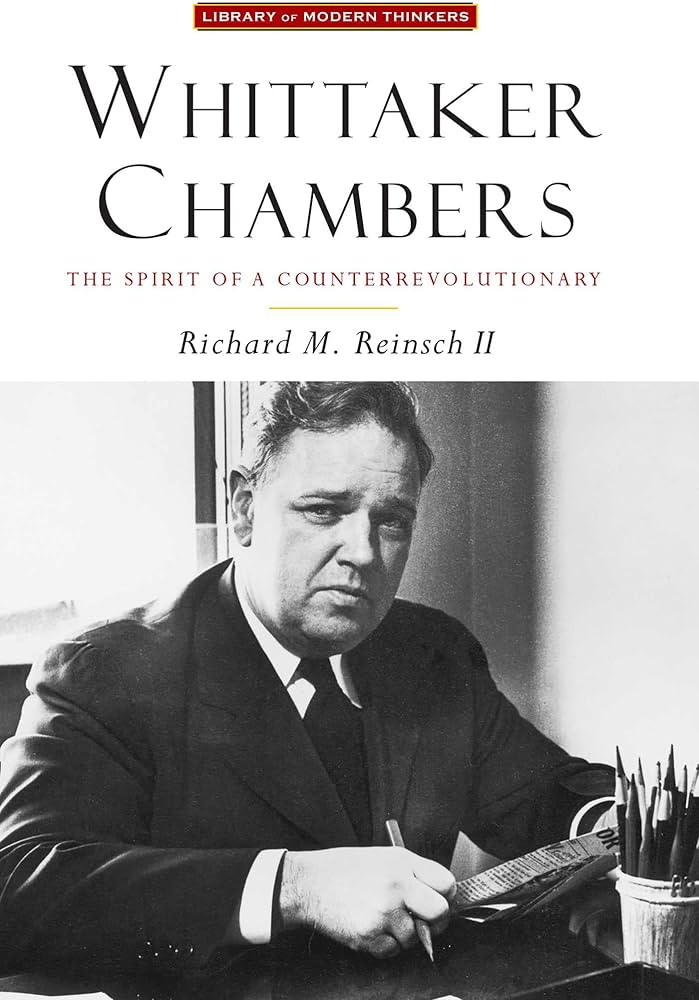
Whittaker Chambers: The Spirit of a Counterrevolutionary, by Richard M. Reinsch II (Regnery; 208 pp., $15.75). Whittaker Chambers’ name barely resonates with young conservatives today. A new biography of the gifted TIME Magazine editor, a former Communist spy turned informer, provides a welcome reminder for a new generation.
Those who recall Chambers’ role during the McCarthy era often overlook the philosophical depths he plumbed in his bestselling autobiography Witness (1952). He can’t be dismissed as a mere mouthpiece for the “red scare” purge, though he played a prominent role in revealing the infestation of Soviet Communist agents within FDR’s New Deal administration. Chambers had been an “underground” member of the 1930s Communist Party and assisted other Communist agents in America, among whom was Alger Hiss, a high-ranking State Department official. Even today, despite the decoded Venona Files’ confirmation of Hiss’s Soviet allegiance, many American leftists still insist Hiss was an innocent victim of McCarthy’s overzealous crusade.
Chambers broke from communism and the Communist Party at great personal risk. He was driven to do so not by political ambition but by a profound spiritual conversion and a recognition of communism’s inherent evil. He became, in short, a counterrevolutionary.
Chambers’ forceful New Deal criticisms in Witness led to repeated attacks from liberal anti-Communists angered by his seeming inability to distinguish between the lofty humanitarian ideals of the Roosevelt administration and those who had allied themselves with the USSR. Chambers dismissed this distinction as vacuous. Their ideological hope in a socialist future so blinded them that they discounted acts of Soviet terror as aberrations.
Chambers’ attacks on establishment conservatism in National Review also evinced his “counterrevolutionary” aims. He cautioned William F. Buckley Jr. against uncritically embracing Frank Meyer’s “fusionist” politics. Fusionism, he argued, trivialized the traditionalist moral parameters needed to rein in both individualism’s excesses as well as the unfettered free market. His devastating 1957 review of Ayn Rand’s Atlas Shrugged pointed out that it celebrated a capitalist system bereft of “sacrificial love or mercy.”
Chambers saw Communism as symptomatic of the West’s abandonment of the Christian faith and of classical models of moral restraint in the pursuit of enduring wisdom. He believed, until his untimely death in 1961, that the West was the “losing side.” He was wrong about Communism’s eventual triumph, but his critique of the West’s spiritual malaise endures. We need only observe today’s mindless technological optimism to ask, as Chambers did, “Does the West deserve to survive?”
(Jack Trotter)
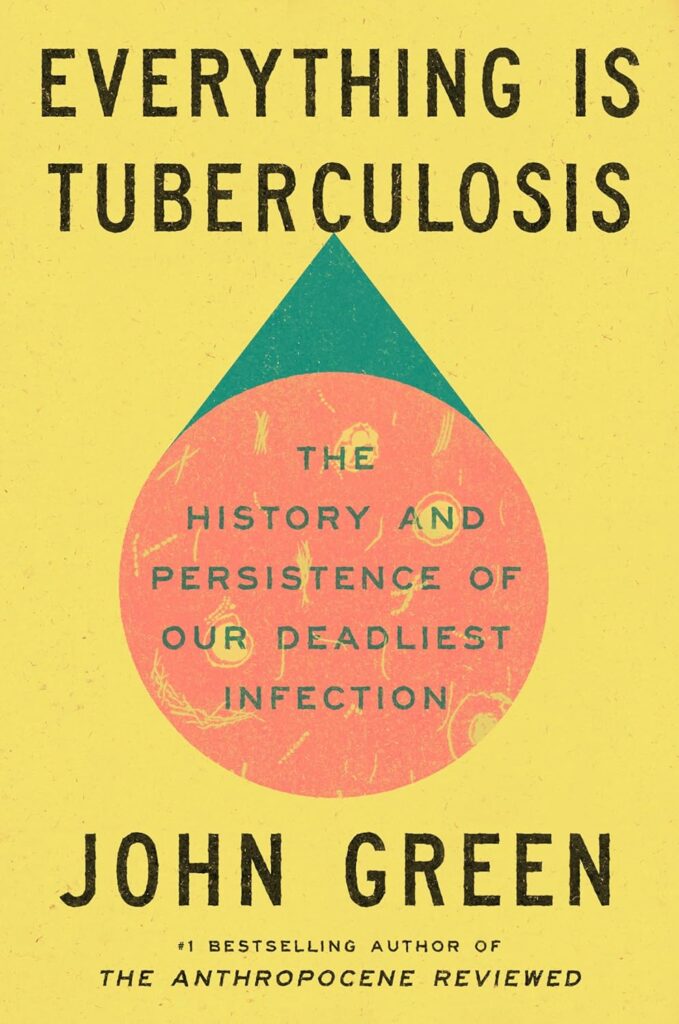
Everything Is Tuberculosis: The History and Persistence of Our Deadliest Infection, by John Green (Crash Course Books; 208 pp., $28.00). It may take one by surprise that John Green, the author of popular young adult novels such as Looking for Alaska and The Fault in Our Stars, has written a book of nonfiction, and on the subject of tuberculosis, no less. Green himself acknowledges this in Everything Is Tuberculosis’s postscript, suggesting that had he not met a teenager suffering from TB during a trip to Sierra Leone, he likely would have continued to think of the disease as a 19th-century relic rather than an active public health crisis.
Green reacquaints us with TB’s history: that Taoist priests called it the “corpse disease”; Hippocrates cautioned his students against even trying to treat it; and that it featured in the poetry of early-20th-century Japan. Yet TB is anything but a distant memory. It kills approximately 1.25 million people a year, making it the most lethal infectious disease. “Between 1985 and 2005,” Green chillingly reports, “roughly as many people died of tuberculosis as in World Wars I and II combined.”
While this book does not have the page-turning quality of David Fajgenbaum’s Chasing My Cure (about Castleman’s disease)or the quality and depth of Siddhartha Mukherjee’s The Emperor of All Maladies (about cancer), it succeeds in reminding an American readership that TB continues to take the lives of millions—often quite painfully.
The book is cheapened by Green’s near-constant claims that the persistence of TB on the African continent can be almost entirely explained by racism and colonialism. Never mind that Western doctors and aid organizations have worked tirelessly to combat TB (and other diseases) in Africa. Perhaps its persistence has more to do with the fact that a quarter of the world’s population carries the bacteria—typically latently—than with racism.
That said, Green’s book is readable and offers insights from effective TB mitigation strategies employed in the United States and Peru. If the reader can muddle through his frequent invocations of liberal buzzwords, he emerges with an interesting tale about one of humanity’s most long-
standing bacterial foes.
(Erich J. Prince)
Leave a Reply