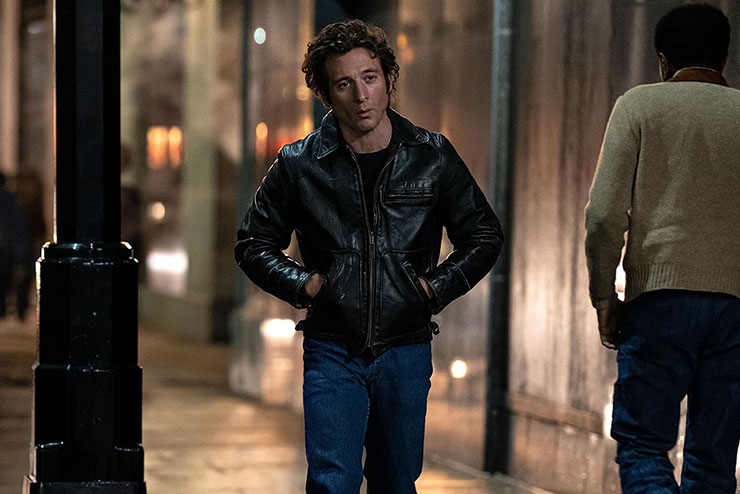
Springsteen: Deliver Me from Nowhere
Directed by Scott Cooper ◆ Written by Scott Cooper and Warren Zanes ◆ Produced and distributed by 20th Century Studios
Bruce Springsteen’s fans often call him a “man of the people.” It is undeniable that there is some genuine right-wing populist sentiment in some of his lyrics. Yet his personal politics have long been on the left, and he is outspokenly vicious in his denunciations of Donald Trump. He has called the sitting U.S. president “corrupt, incompetent, and treasonous.” He has also endorsed the impeachment of Trump as well as the “No Kings” movement.
However, the recent biopic, Springsteen: Deliver Me from Nowhere, which expands dramatically on themes Springsteen touched on in his 2016 autobiography, Born to Run, reveals considerable distance between the singer’s values and populist traditional America.
Deliver Me from Nowhere is fundamentally a film about the singer’s relationship with his father, Douglas “Dutch” Springsteen, who died in 1998. The biographical basics of Dutch Springsteen reveal a man in the mold of bygone American masculinity. He had honest, humble work as a bus driver. He served in World War II. He married his wife, Adele, in 1948 and was still married to her at his death a half-century later. These are accomplishments that instantly place him morally well above many millions of contemporary American men who shirk duty and embrace lives of moral nihilism and personal cowardice.
Yet the film reveals a young Springsteen fixated on what he sees as the shortcomings of his father. It begins with the singer as an eight-year-old boy being sent by his mother into a bar to fetch his father, who sits dazed in front of a drink. In a later scene, Dutch comes home drunk and wakes his young son to teach him boxing moves, while his mother tells him, “You’re a bully!” Another flashback reveals the son using a baseball bat to defend his mother from his father during an argument. Dutch praises his boy for standing up for his mother.
The only positive memory he recounts of his father is accompanied by part of the song “Mansion on the Hill.” Here, Dutch takes Springsteen and his sister on a ride to an idyllic corn field, the mansion of the song’s title in the background, and speaks yearningly of what the wealth to afford such a house would bring them, before the children run joyously through the corn.
In interviews, Springsteen has said he believes his father had a toxically masculine disdain for his son’s insufficiently masculine character:
Springsteen has never accused his father of physical abuse, and we see no inkling of that in the film. It does not even give any evidence of the verbal insults that Springsteen claims his father threw at him. Dutch is emotionally distant, but he is daily present in his child’s life. He was given to melancholy and eventually prescribed depression medication—something all too common in the last half century of American life. That’s it.
How many veterans of the most terrible war of the 20th century had similar characters? Contemporary therapeutic culture would have it that all of them were broken and incomplete without their therapists and their meds. But the traditional American narrative about them, and about masculinity, is quite different.
The film gives us insights into Springsteen’s behavior and response to his perceptions of his father’s abuse. In his relationship with Faye Romano, a fictional romantic interest depicted as the sister of a high school friend, he is more emotionally abusive than the father he disdains. Romano has a young daughter by another man who has abandoned them. After she has told Springsteen the story, he presciently observes, “It is a hard thing realizing people aren’t who you want them to be.” In due course, he takes the same exit the little girl’s father did and simply stops returning Faye’s calls. At their last meeting, she correctly informs him that he flees everything that frightens him. It is just the kind of situation you could imagine his father saying required Springsteen to: “Be a man, for God’s sake!”
An important theme in the film emphasizes Springsteen’s purist commitment to the simple songs that would make up his 1982 album, Nebraska. These songs were antithetical to the big arena rock numbers that made his career, and his struggles with his childhood memories especially informed them. His manager describes the music as “dark” and written by “someone who feels condemned.” The album’s title cut tells the story of Charles Starkweather, who murdered 11 people in the late 1950s before being executed.
In a 1984 Rolling Stone interview, Kurt Loder asked Springsteen if he believed Starkweather was “emblematic of the American condition.” Springsteen’s response was remarkable:
I think you can get to a point where nihilism … is overwhelming, and the basic laws that society has set up—either religious or social laws—become meaningless. Things just get really dark. You lose those constraints, and then anything goes. The forces that set that in motion, I don’t know exactly what they’d be … a lot of frustration, lack of findin’ somethin’ that you can hold on to.
The theme of sympathy for outlaws is not something Springsteen invented— whole subgenres of American popular music romanticize gangsters, thieves, and killers. Typically, though, there is at least a shred of an effort to transform the worshipped crooks into morally righteous victims of some oppressive context. The Bonnie and Clyde narrative has been attractive to so many precisely because they portrayed themselves not just as lawless nihilists engaged in destruction for destruction’s sake, but as warriors for justice against an unjust social system. It is telling that Springsteen wrote the song “Nebraska” about a straightforwardly soulless spree killer of innocents who murdered simply because he found it “fun,” as the lyrics describe.
While Springsteen was recording the Nebraska material, the film shows him listening to “Frankie Teardrop,” a song by the bizarre electronic punk band Suicide. The song’s lyric is a dreadful story of an impoverished man who murders his wife and children and then commits suicide. Springsteen tells a friend that he considers the song “the most amazing record I’ve ever heard.” Here are some of the lyrics:
Twenty-year-old Frankie
He’s married and he’s got a kid…
He’s just tryin’ to survive…
But Frankie can’t make it,
Coz things are just too hard…
He’s gonna kill his wife and kid.
Frankie picked up the gun,
Pointed at the six-month-old kid in a crib
Frankie looked at his wife
[Bang bang!]
My tears for Frankie…
Frankie put the gun to his head.
In all, the movie paints a picture of Springsteen that is, well, kind of pathetic, if not disturbing. This childhood emotionally broke him? This father? It all seems a bit of a stretch, to say the least. Those who had truly negligent parents and genuinely abandoned childhoods will likely not be able to dredge up much sympathy. The desire constantly to see oneself as victimized despite the lack of convincing evidence to support that belief is a frequent characteristic of people with leftist political sensibilities. That Springsteen has spent three or four decades in therapy for his supposedly unbearable childhood suffering is yet another fact distinguishing him from the kind of men exemplified by his father.
The movie could be read as an advertisement for the need for psychological therapy for everyone who grew up with a more or less traditionally masculine father. It moves directly, in its final moments, from Springsteen breaking down in tears at his first meeting with a therapist, after his manager has assured him he “needs professional help,” to 10 months later coming offstage into the welcoming arms of that same manager and happily telling him, “I’m finding my way!” The therapeutically energized rock star then makes his way backstage, where his parents are waiting. His father takes his adult son onto his knee and tells him, “I’m really proud of you… I know I wasn’t always good.” (“Which parents are always good?” I was asking myself during this scene). Springsteen responds, “You did the best you could. You had your own battles to fight. It’s ok.”
Far be it from me to speak in opposition to a parent and child reconciling. I am happy for both of them that this took place before Dutch’s passing. But the melodramatic overreach of the scene can hardly be missed by anyone who does not share the leftist belief that any parent—and especially a father—who does not tell a child 10 times daily how much he loves him is guilty of significant emotional abuse. Maybe “the Boss” should have learned to be a bit more of a boss and a bit less of a needy narcissist.
It is also worth remembering that the lyrics of Springsteen’s two biggest hits are solidly against the small-town America mythos that many of his fans see him embodying.
In “Born to Run,” the town in which the narrator has grown up is described as “a death trap … a suicide rap… [that] rips the bones from your back.” “We gotta get out while we’re young,” he croons.
In “Born in the USA,” the narrator describes being “born down in a dead man’s town,” kicked and abused from birth until ending up “like a dog that’s been beat too much.” The conclusion of the small-town world for the protagonist of Springsteen’s biggest hit is “the shadow of the penitentiary… Nowhere to run, ain’t got nowhere to go.” It is as bleak a vision of what awaits the ordinary American who commits to living in America as one is liable to encounter.
Leave a Reply