Downton Abbey : The Grand Finale
Directed by Simon Curtis ◆ Written by Julian Fellowes ◆ Produced by Carnival Films ◆ Distributed by Focus Features
“So this is how the world ends—not with a bang but a whimper,” says Robert Crawley, the fictional seventh Earl of Grantham, in Downton Abbey: The Grand Finale, as he contemplates the indignity of being downsized to a London flat. Lord Grantham’s scripted detachment from the modern world is far less than convincing in that painful scene, and he is, of course, paraphrasing a thoroughly clichéd line from the Anglo-American author T. S. Eliot’s bleak postwar poem appositely titled “The Hollow Men” (1925).
This third and mercifully final feature film in Julian Fellowes’s long-running Downton Abbey franchise captures Lord Grantham’s plight without abandoning the cloying sentimentality that carried the extended chronicle of the Crawley household over the perilous period between 1912 and 1930. Directed by Simon Curtis, real-life husband of the actress Elizabeth McGovern, who plays the American-born Lady Grantham, the film opened on the same day (Sept. 12) in both London and New York, much as Gilbert and Sullivan operettas once did. But unlike those jovial and lighthearted satires, the Downton sequel’s meandering melodrama plods along in a way that recalls why many critical viewers, myself included, never really became fans.
Nobody can deny that the Downton phenomenon was huge from its inception in 2010. The series revived the genre of costumed period drama, which had appeared exhausted after two decades of classic literary adaptations saturating the market. Nominated for 69 Emmy awards, 15 of which it won, along with three Screen Actors Guild awards for best ensemble, the original series paraded the popular trope of rich people facing adversity for the amusement of billions of largely middle-class international viewers. (About 700,000 viewers of each new episode were watching from the Chinese streaming app Youku Tudou, according to The Times of London.)
In recent years, the same voyeuristic rocket fuel has propelled Succession, Bridgerton, Yellowstone, The White Lotus, Palm Royale, and Fellowes’s latest project The Gilded Age, among others, as well as media attention to the continuing travails of Britain’s Royal Family. Following on the BBC’s 1970s television drama Upstairs, Downstairs, which, like Downton Abbey, also ended in 1930, Fellowes dressed up the franchise with a humanizing look at the Crawley family’s servants. Though they inhabit the “downstairs,” over the course of the series they sprout ambitions, outgrow social distinctions, experience joy and pain, and are generally more present “upstairs” than they probably were historically.
Unfolding during the craze of wokeism, the franchise also grasped at relevance by asserting storyline “inclusivity” for characters who are disabled, gay, politically radical, neurodiverse, feminists, or avatars of whatever other identity category offered to boost ratings.
Headed by Lord Grantham under the wise eye but sharp tongue of his mother, the dowager Countess, in what turned out to be Dame Maggie Smith’s celebrated late-career role before her death in 2024, the Crawleys are afflicted with great uncertainty when Grantham, who has only sired daughters, learns that his next two male heirs have perished on the Titanic. A far more distant cousin who is next in line to inherit the title and estate comes from a branch of the family that has fallen into the professions, in which he ignobly toils—to heavily affected gasps of apprehension—as a lawyer. “What is a weekend?” the dowager Countess asks in the franchise’s most memorable line, ostensibly perplexed by that basic feature of the modern calendar when he discusses his work.
Over six seasons totaling 52 episodes that ran through 2015, and the three films—the first of which appeared in 2019—the Crawleys must persevere as they adjust to a world that changes as rapidly as their own circumstances. The household’s comings and goings follow so many bizarre and often insipid plot twists that even die-hard fans have trouble remembering them all. But they unfold against a visually impeccable image of an England of yesteryear where, like King Arthur’s realm in Camelot, the rain only ever seems to fall after sundown and the depravities of today’s degraded neoliberal Britain could scarcely be imagined. Highclere Castle, the seat of the Earls of Carnarvon, stands in for the franchise’s titular stately home as a proud monument, not just to the Crawleys but to the ideal past they inhabit.
Fellowes peppered the Downton universe with figments of his own background, which combine England’s faded landowning gentry with financially necessary middle-class professional pursuits. After developing that familiar class-conscious theme in his script for Robert Altman’s 2001 murder mystery film Gosford Park, his own best-selling 2004 novel of marital mésalliance Snobs, and other projects, Fellowes conceived of the Crawley family as a paragon of Britain’s pre-World War I aristocratic order, which we know with the benefit of hindsight was doomed to decline.
There is an appealing element of truth in their root inheritance predicament. With rare exception, England’s hereditary peerage remains even today a male primogeniture system. The monarchy changed its rules in 2013 to allow the eldest child of either gender to succeed to the throne, but attempts to allow women to succeed to peerages even in the absence of a male heir have failed, despite repeatedly proposed parliamentary legislation informally called “the Downton Abbey Bill.” The prospect of what is dramatically known as a peerage’s “extinction” has also touched Fellowes, whose wife and, eventually, son could conceivably have inherited the now-extinct Kitchener earldom, created for the early 20th-century military hero, had the law been passed. Instead, the title died out in 2011, with Fellowes consoled only by the life peerage he received the same year.
The franchise’s “grand finale” unfolds as a longer but routine episode of the series. Fellowes’s plot betrays little imagination. As happened multiple times throughout Downton’s run, the Crawleys face imminent financial ruin—this time, as the victims of an American swindler who has exploited Lady Grantham’s hapless brother to extract much of the family’s fortune.
The high-strung and usually imperious Lady Mary, who is tapped to lead the family into the future, slides into yet more moral dilemmas and faces an improbable level of ostracism for her divorce from her ephemeral second husband, who has conveniently disappeared since the last film (her first husband, the distant male heir lawyer, was killed off in a freak accident in Season 3). Long after having entertained an amorous houseguest who unexpectedly died in her bed in Season 1, she commits yet another ill-advised sexual escapade—with the swindler—from which she recovers with about as much reflection and regret as a normal person would show after swatting a mosquito.
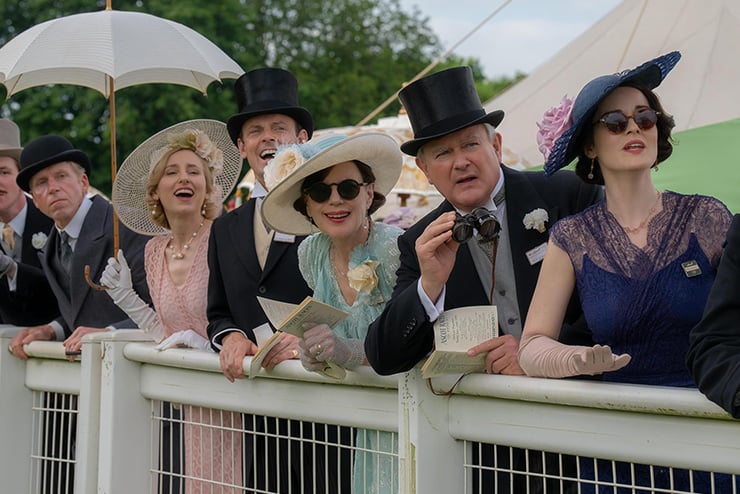
All turns out well, thanks to the usual bevy of magical solutions. The Crawleys appear to own a grand London house we have never heard much about before, which can conveniently be sold without being missed for just the right sum, while a chance encounter at a high-society event—the Royal Ascot horse races—tips them off to the swindler’s evil machinations.
The film lurches toward its end with a montage of scenes in which nice and age-appropriately coupled Crawley family servants retire to lives of blameless bourgeois domesticity, while Lord and Lady Grantham move to a lesser house on the estate. They leave Downton to Lady Mary, whose respectability is curiously saved by the visiting playwright and composer Noël Coward, played hammily by Arty Froushan, who arrives for an all-important dinner party to the strains of his satirical song “The Stately Homes of England.”
Fans of the show will probably enjoy the film, even if it ties up virtually no loose ends apart from the mass retirement of the franchise’s aging characters. The actors clearly have their roles and characters down. Hugh Bonneville leads the cast as Lord Grantham, a fundamentally colorless man whose entire life seems devoted to never making a mistake. Michelle Dockery is the same unevolved Lady Mary, who appears to end up, perhaps more deservedly than Fellowes intended, as an old maid. Laura Carmichael took the character of Mary’s sister Lady Edith beyond her longtime affliction of being a plainer sister to whom bad things always happen (“Poor Edith” was a longstanding cliché weighing down the franchise) and showed moxie facing the swindler. Jim Carter still musters great dignity as the butler Carson, now married to the retired head housekeeper Mrs. Hughes, played by Phyllis Logan, who has more personality than usual in this film, telling the rotund cook Mrs. Patmore about the supposed joys of late-middle-aged sex.
The film’s episodic nature inevitably sidelined some of the regular characters. The insufferable romance between Lord Grantham’s beefy valet Bates and Lady Grantham’s plain lady’s maid Anna was reduced to a handful of forgettable lines. Thomas, the malicious footman turned subpar butler, drifts in and out as the “assistant” of Dominic West’s homosexual actor character and creates a momentary stir in his new role when Lady Grantham invites him for a drink upstairs.
Is this really the end of the road for Downton Abbey? Fellowes told the media earlier this year that the same lead characters will never again appear in the franchise, but he did not rule out future developments, perhaps removed a generation or two from the Crawleys, to whom we are now finally saying goodbye. Down the road, riffs on the franchise could resume the soothing fantasy of distressed aristocratic life, updated for more recent times.
Leave a Reply