
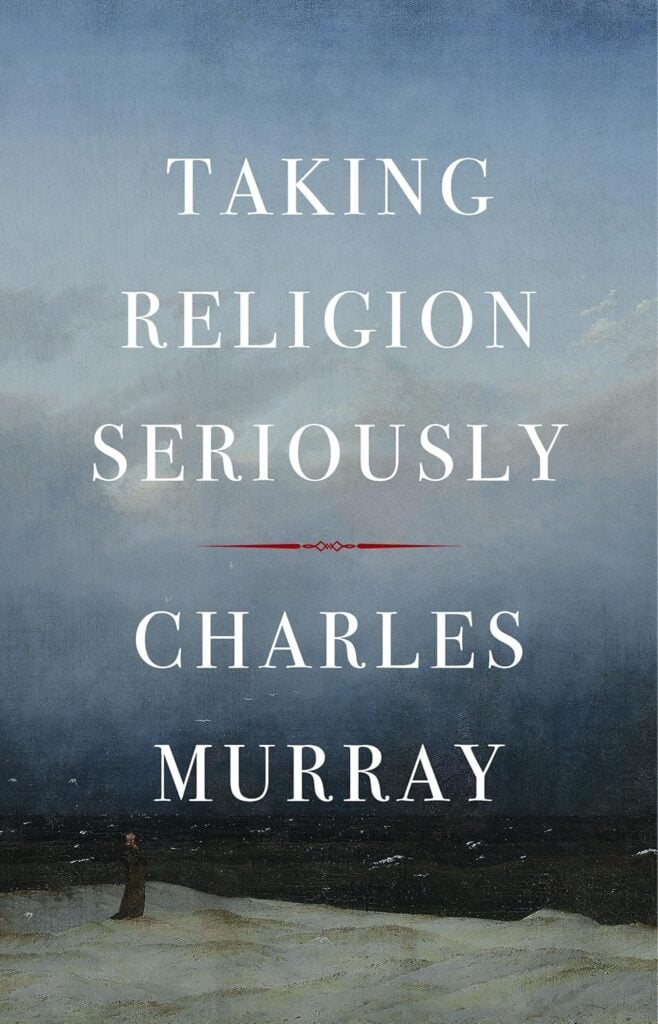
by Charles Murray
Encounter Books
152 pp., $29.99
In Taking Religion Seriously, political scientist Charles Murray takes the reader on a deeply intellectual journey toward the divine. Surveying Murray’s career and the passionate hostility aimed at him reminds one of Jefferson Smith, the character Jimmy Stewart played in the Frank Capra classic Mr. Smith Goes to Washington. He is an honest, well-meaning middle American who took our elites at their word, earnestly seeking success playing by their rules—only to be stunned and flabbergasted when he found out the game was rigged and the referees had been bought.
Before 1994, Murray was widely recognized as a sober scholar of American public policy with a track record of prescient judgments about the perverse, impoverishing effects of social welfare policies, which he established in his 1984 book Losing Ground. Murray’s decision to co-author The Bell Curve in 1994 made him a lightning rod for the left, as the book addressed evidence that IQ is partly hereditary and that Americans of different races, on average, score differently on IQ tests. Critics, often relying on short, inflammatory caricatures of the book, quickly labeled Murray a “scientific racist” and a “eugenicist.”
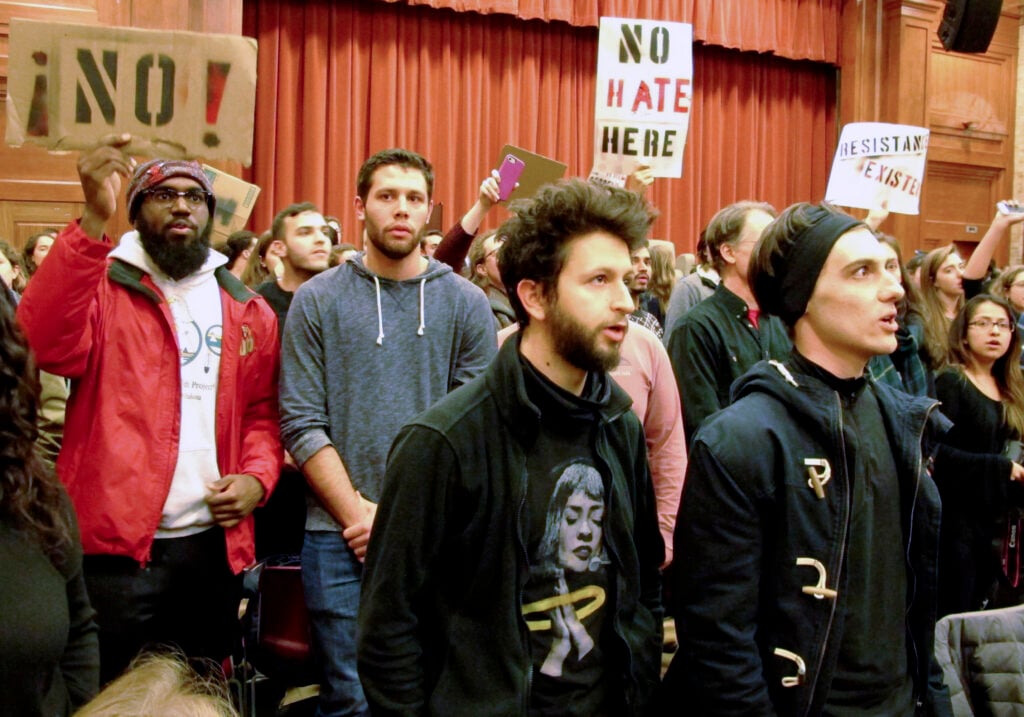
Ever since, activists have turned Murray’s infrequent appearances at American college campuses into sites for raucous, violent protests. His visit to Middlebury College in 2017 ended with a mob putting Middlebury professor Allison Stanger, the political science teacher who tried to interview him, in the hospital with a concussion. Murray was one of the first targets of “cancel culture,” and has responded to efforts to make him a pariah mostly with bemusement.
An honest account of The Bell Curve would conclude that it is a passionately anti-eugenicist, anti-elitist book. Eugenics, as a movement, was founded in the 19th century by the English polymath Francis Galton, nephew of Charles Darwin, who believed that we could and should speed up the evolution of man through selective breeding. Eugenicists argued we ought to use social pressure and government policy to encourage, in the words of the world’s most famous eugenicist, Planned Parenthood founder Margaret Sanger, “More children from the fit, fewer from the unfit.”
Sanger’s activism through her National Committee on Federal Legislation for Birth Control helped to pass eugenics laws in a dozen American states starting in the 1920s, leading to the forced sterilization of some 60,000 Americans. The Nazi regime modeled its own sterilization policies on Sanger’s, and even honored her close associate, Harry Laughlin, with an award. Recall that Supreme Court Justice Oliver Wendell Holmes approved forced sterilization laws, commenting that “three generations of imbeciles are enough.”
The Bell Curve, by contrast, opposes the tendency of America’s modern gentility to concentrate economic and social power in the hands of a “cognitive elite” that thrives on standardized tests and bureaucratic environments. It also targets the “managerial class” that Sam Francis opposed during his career as a “middle American radical.”
Murray wrote in a spirit of Tory paternalism about the need to rejigger the American economy to benefit those of every race who work with their hands, who don’t thrive in college, and who aren’t good at lobbying for government handouts. You might say that Murray anticipated the populism of Trump’s Make America Great Again movement, despite occupying an elite position in his scholarly ivory tower.
Murray’s 2012 book Coming Apart explored in depth the social pathologies faced by non-elite Americans and sought policy solutions to help them form stable families, raise healthy children, and thrive. Again, the aim of his scholarship was diametrically opposed to the eugenicist goals of reducing birth rates among the less gifted and gradually eliminating them in the name of “advancing” human improvement.
Murray is like the naïve Jefferson Smith in Capra’s 1939 film because he apparently took our left-coded elites at their word, believed them when they claimed a commitment to social justice and ameliorating the plight of the disadvantaged. What he certainly didn’t appreciate in 1994 was that those elites, in reality, were only passionately attached to their institutional power and economic advantages. They cynically used the language of racial grievance to shore up and make unassailable these privileges, by demonizing their critics and seizing the moral high ground in a post-Christian America, where white guilt has replaced the Gospel as our new civic religion.
Affirmative action, and the later Diversity, Equity, and Inclusion initiatives, were never intended by their creators as means of overcoming any genuine discrimination still suffered after the Civil Rights Act. Instead, these programs were a massive power grab by the managerial class, subjecting every commercial transaction and educational initiative to micromanagement by bureaucrats—even for evidence of “disparate impact” without any discriminatory intent. So, standards for Special Forces soldiers, firefighters, and other life-saving jobs must be lowered to accommodate women, as academic standards must be shattered to artificially boost the achievements of underperforming students.
The real end game of “anti-racism” has been exposed in the light of day over and over again, most recently in Minnesota—a formerly homogenous, high-trust, prosperous American state that was targeted for lacking “diversity” and flooded with hundreds of thousands of “refugees” from the pirate polity of Somalia. Nonprofits such as Catholic Charities flew these immigrants past half a dozen safe Sunni Muslim countries and resettled them at taxpayer expense in the predominantly ethnically German and Scandinavian state.
Minnesota’s new arrivals promptly became a highly disciplined political lobby wielding disproportionate power. Thousands of these migrants exploited generous, Scandinavian-style state welfare programs to scam billions of dollars from the state budget via fraudulent day care and disability-assistance businesses. The alleged immigration scamster, Ilhan Omar, who now represents this religio-ethnic bloc in Congress, somehow became a multimillionaire as this occurred, and the governor who allegedly quashed fraud investigations in the Somali community, Tim Walz, was nearly installed as vice president of the United States. Early this year, highly organized mobs of white leftists forcibly impeded the attempts of Immigration and Customs Enforcement agents to deport illegal immigrants from Minneapolis, smearing these federal law enforcement officers as “Gestapo” engaged in “ethnic cleansing.”

As one of the chief scapegoats of “social justice” crusaders, Charles Murray is uniquely well-placed to appreciate how toxic and irrational the post-Christian worldview really is. What’s surprising and enormously encouraging is that this experience may have helped drive Murray to reexamine the orthodox Christian order that preceded modern woke nonsense. And that’s the burden of Murray’s new, carefully argued, gracefully written book.
Murray makes some candid admissions. For instance, he confesses that he has less religious instinct than most—especially his wife, who became a Christian many years before him. In another passage, Murray explains how he came to his youthful, almost lifelong agnosticism:
Millions are like me when it comes to religion: well-educated and successful people for whom religion has been irrelevant. We grew up in secular households or drifted away from the faiths in which we were raised and never looked back. For them, I think I have a story worth telling. In my case, I attended Presbyterian Sunday School and, later, church services into adolescence but then went off to Harvard, where I was as thoroughly socialized to be secular as earlier generations of Harvard students had been socialized to be devout. By socialized, I don’t mean that my professors tried to convince me that Thomas Aquinas was wrong. I didn’t study religion at all. None of the professors I admired was religious (at least visibly). I didn’t have a single friend who was religious. When the topic of religion came up, professors and friends alike treated it dismissively or as a subject for humor. I fit into the zeitgeist. If asked, I would have said I was an agnostic, but I didn’t spend much time thinking about religion because I couldn’t see the point. If God exists, he could not be the kind of God who has anything to do with this flyspeck world, let alone with the lives of the individual human beings clinging to its surface.
Murray speaks here for most of the people I went to college with, who are now running the country. My old friend and schoolmate Eric Metaxas devotes a whole chapter of his memoir, Fish Out of Water, to the psychological mechanisms by which young “joiners” and “people-pleasers” drift from their childhood beliefs amid the Gothic libraries and dorms of elite universities. The vacuum of meaning and morality that results may simply go unfilled, in a life devoted to passing pleasures and profit. But for many, the void where God once lived is promptly haunted by the fever dreams of Karl Marx, Michel Foucault, Ta-Nehisi Coates, or whatever dark spirits their teachers assigned them to read.
The bulk of the book consists of Murray at last examining the cozy, secular Whig myths that he took in as a young man—and finding them wanting, sometimes almost comically so. He aims the book not at believers or atheists, but rather at people like himself, who didn’t reject religion in some existential crisis of faith, but instead just followed little breadcrumbs of Mammon, one after another, until at last the Church lay far behind them, unremembered in the distance. Murray picks up each of those breadcrumbs and patiently explains why it wasn’t worth eating. Then, he unpacks his personal journey of discovery for each point, including lists of the scholarly books he read, pro and con, to decide each issue. He admits that he was led on this pilgrimage by his wife, who decades ago began attending Quaker meetings.
In the first half of the book, Murray explores the arguments frequently adduced against the existence of a personal God. He unpacks the scientific evidence that it was enormously unlikely, by sheer random chance or the inevitable laws of nature, that any of the following things would happen:
• A universe would come to exist where life of any kind is possible. The odds were infinitesimal, as even “New Atheist” scientists have to admit, which is why they posit the untestable existence of billions of other universes, where life did not arise. We just got lucky.
• A planet would emerge where multicellular life is possible. So far, our best efforts to find another such planet have come up empty.
• That life would emerge from non-life, forming even the most primitive living cell, much less the biological supercomputer that is the human brain, arising from the silicon crystals on a beach. Origin-of-life scientists have made zero progress over the past decades toward solving this mystery, as nanotechnology pioneer James Tour has revealed.
In the final chapter of Part I, Murray examines the materialist assumption that human consciousness is merely a side-effect of the brain’s electrical activity—an epiphenomenon of sparks shooting through meat. If this were true, free will would be an illusion, and life after death unthinkable. Murray examines whether it is possible that such a spectral secondary effect of neurons firing could master mathematics, conduct reliable research, or make reliable truth claims about the universe, which materialists routinely do. He also cites the growing body of evidence from near-death experiences, conducted by mainstream, mostly irreligious researchers, that consciousness cannot be explained away by brainwaves—since thousands of people who had little or even zero brainwaves report detailed experiences they had while technically “dead.” (For a neuroscientist’s perspective on this, see one book Murray cites, The Immortal Mind, by Dr. Michael Egnor and Denyse O’Leary.)
The second part of the book examines the claims of historic, orthodox Christianity—again, from the viewpoint of someone who was conditioned to see religion as the enemy of science, and churchmen as obscurantist inquisitors. Murray cites the work of scholar Rodney Stark in dismantling the centuries-old polemic against the churches. He quotes Alfred North Whitehead, who noted that the biblical view of the world as the rationally comprehensible product of a rational creator is actually the origin of the scientific enterprise—which flourished in Christian Europe as nowhere else, and is currently shriveling up in universities where post-Christian dogmatists dismiss objectivity, meritocracy, and in some cases even mathematics, as culturally conditioned and “racist.”
Murray goes into much more granular detail, examining the reliability of New Testament documents, which strongly motivated (post-Christian) scholars have long dismissed as late, polemical patchworks far removed from the events they claim to report. He finds that the accounts of Jesus’ life and activities are, in fact, much older and much more reliable than most students at liberal divinity schools are taught to think. There’s stronger evidence of Jesus’ death than of Julius Caesar’s, for instance.
Also fascinating is Murray’s engagement with the work of literary scholar and amateur apologist C. S. Lewis, especially Lewis’ arguments about the universality of natural law—a moral code that seems to exist in most human cultures worldwide. That fact is difficult to explain on the materialist model. Murray even takes on the question—most likely to vex his fellow scientists—of miracles, and what we are to make of miracles reported throughout history, in the Bible and after.
The book, as a whole, is a poignant, intellectually rigorous, and uplifting experience. It’s one I’d heartily recommend, especially to high school and college students, as an antivenom to counter the massive cultural pressure they’re doubtless experiencing—even at most supposedly Christian institutions. Of course, if they’re seen reading a book by “racist” Charles Murray, they might well get literally attacked, so it’s probably better to give them the Kindle edition.
Leave a Reply