Remembering two films that defined the genre: The Searchers and The Outlaw Josey Wales
America’s most quintessential film genre is the Western. This year sees the 70th and 50th anniversaries of two monumental Westerns: John Ford’s The Searchers (1956) and Clint Eastwood’s The Outlaw Josey Wales (1976). Both films star the two giants of the genre: John Wayne and Clint Eastwood. Both films feature complex and controversial protagonists, by today’s standards: in both cases, former Confederates who have refused to surrender.
Both The Searchers and The Outlaw Josey Wales illustrate the power of the Western to examine the most complex American historical themes and to portray on-screen the conflicts that formed the American nation. The themes of cultural conflict and civilizing the wilderness dominate.
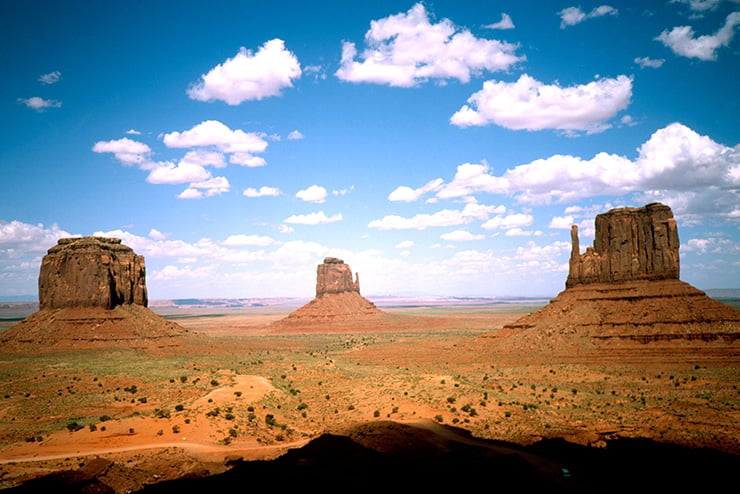
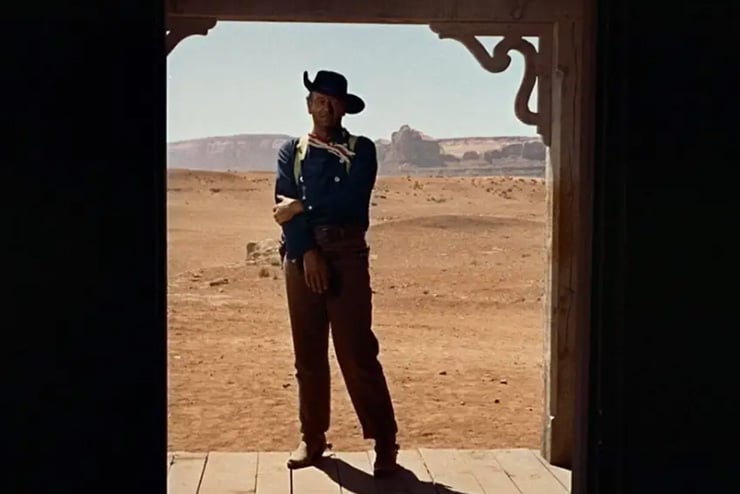
The opening credits of The Searchers give us no indication that we are watching anything beyond a standard 1950s Western, complete with a cheesy theme song. But then, the screen fades to black, and we are presented with one of the genre’s most memorable openings. The screen’s darkness is broken by a door opening and looking out upon the spectacular sight of Monument Valley, Utah (though the film’s setting is, in fact, Texas in 1868). Max Steiner’s awe-inspiring music begins. From the door, a woman walks onto a homestead porch. Initially, we only see her silhouette framed in the doorway and against the landscape. In the distance, a figure on horseback rides towards the camera. Other members of the family come out of the house. “The Bonnie Blue Flag” softly plays over the proceedings.
The figure on horseback turns out to be Ethan Edwards (John Wayne), clad in a grey Confederate overcoat, a man who has apparently come home from the Civil War three years late. This beautifully filmed scene immediately grips the viewer and sets the stage for the story to come.
That story concerns Edwards and his return home after a long absence. He is reunited with his brother, Aaron, and sister-in-law, Martha, and their three children, Ben, Lucy, and Debbie. We are not long into the film when the Reverend Samuel Johnson Clayton arrives at the Edwards homestead. Clayton is a church pastor but also a captain in the Texas Rangers. He wants to recruit Ethan to help him track down some stolen cattle. When Ethan and the Rangers set out for this purpose, they discover a dead cow with a Comanche lance through its body. Ethan realizes that the cattle theft was just a ploy by the Comanches, one of the most fearsome Indian tribes, to separate the men from their families.
(Warner Brothers Pictures)
The men rush back to the Edwards’ home to find it in flames. Aaron, Martha, and Ben are dead, while the two girls, Debbie and Lucy, have been abducted. Ethan, Debbie and Lucy’s adopted brother, Martin Pawley, and Lucy’s fiancé, Brad Jorgensen, set out in search of the girls. After Lucy’s body is discovered, Brad rides, in a fit of rage, into the Comanche camp, only to be killed. And thus begins Ethan and Martin’s grueling five-year quest to recover Debbie.
The conflict between the white European settlers and the Indians looms large over this film. This is a brutal fight for survival and an existential struggle for both sides. Although some have tried to portray it as an anti-racist film, The Searchers is mercifully free of moralism. While it is clear that the two sides hate each other, their hatred is understandable. The settlers are trying to forge a civilization from the wilderness. Their plans are constantly thwarted by a primitive people “whose known rule of warfare,” to quote the Declaration of Independence, “is an undistinguished destruction of all ages, sexes and conditions.” The whites respond in kind.
The savagery of this conflict is well portrayed in several scenes. One is the precursor to the Comanche attack on the Edwards homestead. The sun is setting over the porch, birds fly back and forth, a dog barks, and dust swirls in the distance. Within the house, Lucy lights a candle, only for Martha to yell at her to put it out. Lucy, realizing what is about to happen, looks at the camera, puts her hand to her mouth, and screams. The young Debbie, still only a child, is sent outside to a special hiding place, but doesn’t make it. As she crouches by one of the family gravestones, the shadow of a Comanche warrior falls upon her. We then see the warrior blow his horn, after which the screen fades to black. Today, we would almost certainly be shown the massacre in all its gory detail, though The Searchers is effective specifically for what it doesn’t show, but implies.
A later scene is similar. Ethan, Martin, and Brad are searching for Lucy and Debbie. Brad states that he saw Lucy in the Comanche camp, hoping that they can soon rescue her. Ethan informs him that what he actually saw was a Comanche wearing Lucy’s dress and that he had found Lucy’s body in a canyon and buried her in his overcoat. Brad asks, “Did they?… Was she?” implying rape. Ethan responds: “What do you want me to do, draw you a picture… Don’t ever ask me. As long as you live, don’t ever ask me more.” Once again, today’s filmmakers would probably force us to watch the rape and murder of Lucy in graphic detail. Undoubtedly, the Hollywood Production Code in effect at the time prevented such things from being shown, and that is all for the better. The Searchers is a brutal film, but one in which we do not see the brutality. Therefore, the whole family can watch the film.
John Wayne’s portrayal of Ethan Edwards is his greatest performance. Ethan is unlikeable, but a man of conviction. He returns from the Civil War three years late, but it is unclear what he has been doing during those three years. He may have been in prison or simply avoiding domestic life.
Ethan continues to wear his Confederate overcoat, and we soon learn that he refused to surrender at the war’s end. When Reverend Clayton asks him, “When did you get back? I ain’t seen you since the surrender. Come to think of it, I didn’t see you at the surrender.” Ethan responds: “I don’t believe in surrenders… I still got my saber, reverend. Didn’t turn it into no plowshare neither.” When Clayton tries to get Ethan to take the Texas Ranger oath, Ethan refuses, saying:
I figure a man is only good for one oath at a time. I took mine to the Confederate States of America.
Ethan’s hatred of the Indians is visceral. He has studied and learned the ways of the Comanches so as to use their own beliefs against them. On finding the body of a dead Comanche, Ethan shoots out the eyes of the corpse because “If he has no eyes, he can’t enter the spirit land. He has to wander forever between the winds.” He also scalps dead Indians and randomly kills large numbers of buffalo, in order to cut off their food supply. He treats Martin with contempt partly because he is “one-eighth Cherokee.”
Ethan is determined to find Debbie, but as time passes, he realizes she will now be old enough to be forced into marrying the Comanche chief. Therefore, he becomes determined to kill her, believing death to be a better fate. When Debbie is discovered in the Comanche camp and comes out to speak with Ethan and Martin, Ethan makes an attempt on her life, but she is rescued by Martin and a subsequent Comanche attack. Later, Ethan and Martin, aided by the Texas Rangers and U.S. cavalry, attack the Comanche camp. Martin kills the Comanche chief and rescues Debbie, only for Ethan to chase her on his horse. We fully expect Ethan to attempt to kill her again, but instead, he lifts her up in his arms and says, “Let’s go home, Debbie.”
Debbie is reunited with her surviving relatives, Martin marries his sweetheart, but Ethan is back where he started, alone and apparently unable to adapt to peacetime domestic life. The film ends with one of Wayne’s most memorable exits: the solitary figure of Ethan framed in the doorway of the homestead, looking inside but not crossing the threshold, then turning and walking away, after which the door closes, and the film ends.
Ethan Edwards is probably one of the most politically incorrect protagonists ever put on film. He is hateful, but his hatred is born of bitter experience. He is a realist with no time for idealism or sentimentality. He is almost certainly a true-to-life type that must have been common in the American West at the time.
Monument Valley is as important to The Searchers as any of the actors; it could even be called the film’s real star. There are an immense number of long shots of riders, dwarfed by the towering rocks of the Valley, looking like ants by comparison. Indeed, almost every shot in The Searchers is beautiful, spectacular, and expertly framed. This, perhaps more than any other of John Ford’s films, justifies the comment of film critic Andrew Sarris that Ford was a “poet of images,” and that of John Wayne, who stated that Ford put “in motion the moods of Remington and Russell.”

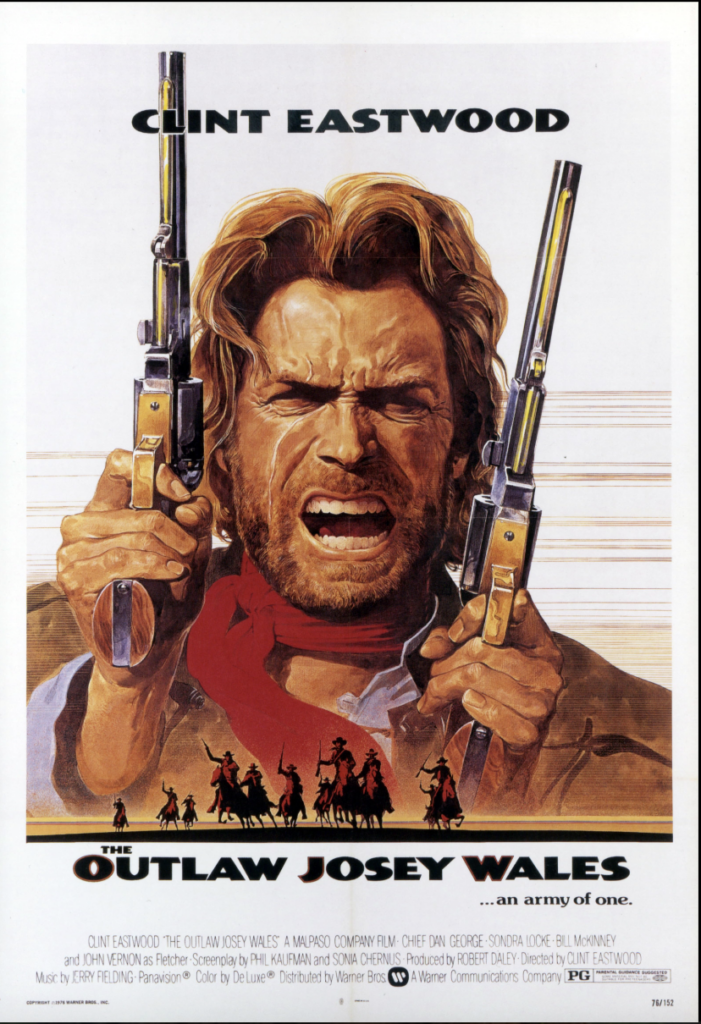
The Outlaw Josey Wales is Clint Eastwood’s greatest Western, even better than his later Oscar-laden 1992 film, Unforgiven. Josey Wales is based on a novel called Gone to Texas by Forrest Carter. “Forrest Carter” was the pseudonym of Asa Earl Carter, a former speechwriter for Alabama governor George Wallace and a militant Southern partisan. It is difficult to imagine present-day Hollywood producing a film from the work of such a thoroughly unwoke individual.
Outlaw Josey Wales
(Warner Brothers Pictures)
Phil Kaufman, who worked on the film script, recalling Carter’s book, remarked: “This was written by a crude fascist… The man’s hatred of government was insane.” Evidently, Kaufman misunderstood the meaning of fascism. He continued: “I felt that that element in the script needed to be severely toned down. But Clint didn’t, and it was his movie.” In fact, Kaufman was originally set to direct the film, but Eastwood, whose production company was producing it, disagreed with Kaufman’s vision and removed him as director, taking it on himself. Like The Searchers, The Outlaw Josey Wales explores the more controversial aspects of American history and, as a result, has been widely hated by liberal critics.
The film begins early in, or shortly before, the Civil War. Josey Wales (Eastwood) is a Missouri farmer whose life is devastated when his farm is destroyed, and his wife and son are killed by Kansas “Jayhawkers” or “Red Legs,” irregular troops supporting the Union cause. Seeking revenge, Josey joins the pro-Confederate guerrilla band led by “Bloody Bill” Anderson.
When the war ends, Josey’s band is the only Southern group that has not surrendered. One of the group’s leaders, Fletcher, makes a secret agreement with U.S. Senator, Union General, and Jayhawker Jim Lane to secure a surrender, believing that the men will be granted full amnesty. Josey, however, refuses to go. Following the surrender of the rest of Josey’s band, the men are treacherously massacred while taking a pledge of loyalty to the Union. Josey intervenes, killing large numbers of Union troops before escaping with the only survivor of the guerrillas, a boy named Jamie, who is seriously injured.
Josey and Jamie evade capture, but Jamie soon dies of his wounds, leaving Josey alone. Pursued by Fletcher and Captain Terrill, a former Jayhawker and now Union officer, Josey flees into the Indian Nations. There, he meets Lone Watie, a Cherokee who served with the Confederates. Josey reluctantly allows Lone Watie to tag along. Along the way, Josey rescues a Navajo girl, Little Moonlight, from an abusive employer. The three head to Texas, where Josey rescues an elderly woman, Grandma Sarah, and her granddaughter, Laura Lee, whose wagon train has been attacked by Comancheros, rogue traders who sell whiskey, guns, and women to the Comanches. The Comancheros have killed Sarah’s husband and attempted to rape Laura, only to be prevented by their leader, who says they cannot sell a violated woman to the Comanche.
Following Josey’s rescue of Sarah and Laura, Sarah tells the others of a ranch established in the wilderness by her son, who has been killed in the war. Sarah and Laura are proud Kansas Jayhawkers who had learned to curse the name of Josey Wales but are now grateful for his help.
The group discovers the ranch, but not before passing through a ghost town where Josey picks up yet more followers among the owners of a dying saloon. The group gets the ranch up and running, and a new community is established in the wilderness. Josey begins a romance with Laura. When two of the group are taken by the Comanches, Josey negotiates their release with Ten Bears, the Comanche chief. When Josey’s pursuers finally catch up with him, the disparate group, whom Josey has trained in the use of firearms, rallies to his defense and kills all of them.
Like Ethan in The Searchers, Josey is a Confederate who has refused to surrender and accept the new order. He is a loner like Ethan, but unlike him, this does not appear to be his nature. His peaceful family life as a settled farmer was shattered by the war. To begin with, he is solely focused on taking revenge for his family’s death. After his wartime comrades are massacred, he prefers to pursue this quest alone, but, through unexpected circumstances, he reluctantly keeps acquiring new followers, who become a substitute family.
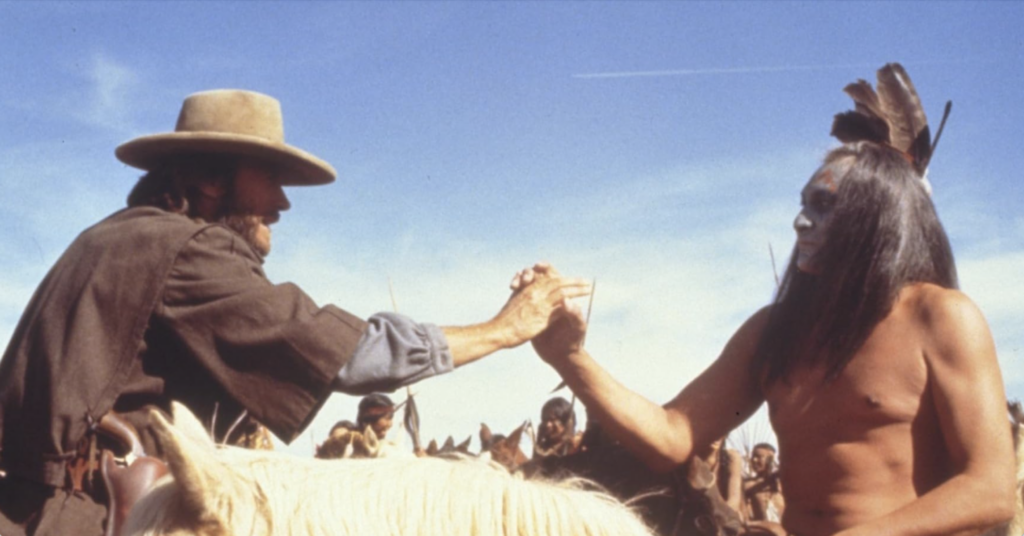
Originally focused on his own goals, Josey becomes human again and rediscovers the virtue of self-sacrifice for others. When two of his group are captured by Comanches, Josey goes all alone to meet with Chief Ten Bears. Considerable tension is built as the camera cuts between Josey riding alone towards the Comanche camp and the numerous, heavily armed Comanches advancing towards him. Josey is ready to die fighting the Comanche to rescue his friends. But instead, he is able to appeal to Ten Bears as a fellow warrior and victim of federal treachery:
Dying ain’t so hard for men like you and me, it’s living that’s hard; when all you ever cared about has been butchered or raped. Governments don’t live together, people live together. With governments you don’t always get a fair word or a fair fight. Well, I’ve come here to give you either one, or get either one from you.
After some discussion, in which Ten Bears describes federal government negotiators as having “double tongues,” Ten Bears says that Josey’s words have “iron” and that “no signed paper can hold the iron. It must come from men.” It appears that the message here is that while rival warriors can negotiate a successful peace with one another, professional politicians cannot be trusted and make conflict worse.
This anti-federal government theme is persistent throughout the film, and it was one Eastwood would return to, for example, in his 2019 film Richard Jewell, about the FBI’s persecution of an innocent man falsely suspected of planting bombs at the 1996 Summer Olympics in Atlanta. The theme is embodied not only in Josey Wales’ Confederate protagonist but in the character of Lone Watie, a Cherokee Indian.
Watie fought for the Confederacy and didn’t surrender, though, as he explains amusingly to Josey, “they took my horse and made him surrender.” Lone Watie tells Josey that he lost his wife and children on the Trail of Tears. He and other Indian leaders later met with Abraham Lincoln’s Secretary of the Interior, who told them to “endeavor to persevere,” a grand-sounding but ultimately meaningless slogan that only a politician could coin. When we first meet Lone Watie, he is wearing a black top hat and frock coat, which he tells Josey he and others deliberately wore in imitation of Lincoln. But in the next scene, we see this hat and coat symbolically burning in the fire.
Josey’s federal pursuer, Captain Terrill, is another interesting study. A former irregular involved in terrorizing Southerners such as Josey and his family, Terrill is now the “regular federal authority.” When Fletcher, who has reluctantly been commissioned in the hunt for Josey, states that getting Josey means the end of the conflict, Terrill corrects him: “Doing right ain’t got no end.” Terrill thus embodies the endless crusade against the outlaw, a forerunner of the modern progressive obsession to hunt down those who transgress “social justice,” or the neoconservative enthusiasm to make endless war against the “enemies of democracy.”
It is unlikely that either The Searchers or The Outlaw Josey Wales would be made by today’s ultra-woke Hollywood. While The Searchers is widely regarded as one of the greatest films of all time, liberal critics have tried to excuse its more controversial elements by portraying it as anti-racist, though it is difficult for anyone who actually watches it to read this into the film. On the other hand, Josey Wales was recently denounced for providing a “cultural safe haven for Confederate nostalgia” and smuggling “Lost Cause ideology into a countercultural narrative.”
The fact that liberals still feel the need to level such latter-day criticisms at these films is an indication of why they remain worth watching. Both films offer a refreshing look at the Old West, all the more relevant in an age of wokeness and political correctness. Most of all, both are exciting, compelling, and outstandingly made films that bring to life that most heroic chapter of the American story.
Leave a Reply