
Ronald Reagan’s vision for American conservatism was that it combined three disparate elements: social conservatism, free-market economics, and military intervention on behalf of Western democracy. Did the stool hold up under pressure, or collapse under its own rhetoric?
In the 1980 presidential race, Ronald Reagan famously described his party as a stool standing on three legs. These legs, he briefly explained, were fiscal, social, and foreign policy conservatism. The stands emphasized by Reagan also came down to socially traditional values, a free market economy, and anti-Communist military interventionism. Although the Cold War ended by the 1990s, as late as the Republican primary in 2007, Mitt Romney was campaigning in Iowa holding a literal three-legged stool, to remind voters that he still stood with Reagan and his brand of Republicanism. George W. Bush invoked the same image in identifying where he stood ideologically, but his critics wondered why Bush was referring to an already dated self-designation.
Sometimes Reagan’s Stool is traced back to Frank Meyer’s earlier efforts to construct a fusionist concept of the American Right. According to Meyer, about whom Daniel Flynn has recently produced a comprehensive, well-researched biography (The Man Who Invented Conservatism: The Unlikely Life of Frank S. Meyer), we should view the American conservative project as an amalgamation of personal freedom and social virtue. Meyer believed the United States was in a favorable position to blend different European principles, stressing both liberty and Christian ethics, and he encouraged bringing together both in a unified political vision. This speculative adventure seemed especially necessary at the height of the Cold War, as the U.S., together with other nations, battled a Communist foe that believed in neither liberty nor moral virtue.
It may be an exaggeration to present Reagan’s tripod as a variation on Meyer’s fusionism. One was campaign rhetoric, while the other was a conceptual synthesis of order and freedom, which revealed learning in both history and political thought. One needn’t ascribe great philosophical depth to Meyer’s call, in In Defense of Freedom (1962), for a blending of political order with respect for the individual person, to recognize that the author was speaking about something more profound than defining the GOP brand.
But the two attempts to define American conservatism did have one thing indisputably in common. They were both influenced by the Cold War and what their authors thought was America’s role in that protracted conflict. Fighting world Communism, which meant the Soviets, Red China, and their surrogates, and dealing with their agents and advocates in Western countries, became the big thing in the post-World War II conservative movement. Everything else had mere secondary importance in relation to this central confrontation.
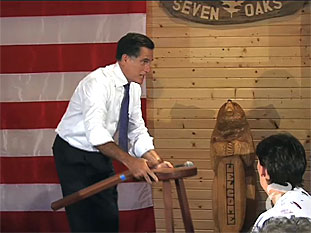
at his presidential campaign events in Iowa in 2007.
(photo from The New York Times archive)
Although the side dishes and condiments could be enjoyable and occasionally inspiring, the chef d’oeuvre in the American conservative repast was always the crusade against the Communist enemy, as I learned from reading National Review in the 1960s. This focus was even more persistent and pervasive than the crusade against the French Revolution among restorationist conservatives in the early 19th century. Joseph de Maistre, Karl Ludwig von Haller, Louis Bonald, Adam Mueller, and Friedrich Gentz all left behind bodies of political thought, as did Edmund Burke, which went well beyond fighting the Revolution. It is almost impossible to read conservative polemicists grouped around National Review without noticing their anti-Communist preoccupation.
It is also not surprising, given this single-minded concern, that helping to win the Cold War was this movement’s one towering achievement. It also, not at all insignificantly, attained that achievement in alliance with neoconservatives, who might be described as both ardent Zionists and defenders of the American welfare state. Moreover, by the time Reagan got around to invoking his tripod in 1980, the U.S. had a recognizably mixed economy, combining free enterprise with vast corporate wealth and costly government entitlements. Nor did the Reagan administration do very much to reduce the size of the federal government; unlike Trump, Reagan took no steps to rid us of the Department of Education, although he did find positions there for important neoconservative supporters, like the first wife of George Will and Irving Kristol’s client, Bill Bennett (who is now in his old age a richly compensated foreign agent of Qatar).
Since Reagan’s presidency, the U.S. has slid toward the lunatic left on gender identity, gay marriage, and other social matters. The conservative establishment has done little to resist this advancing social left.
What the conservative movement that still celebrates Reagan’s tripod has done in the social realm has been either pathetically little or profoundly disappointing. Since Reagan’s presidency, the U.S. has slid toward the lunatic left on gender identity, gay marriage, and other social matters. The conservative establishment has done little to resist this advancing social left, and in criticizing the woke mayoral candidate in New York City, Zohran Mamdani, the devotees of Gipper’s Stool carefully avoid bringing up his unsettling views on gender-affirming surgery for children. Instead, our establishment conservatives, out of old habit, play up his alleged communist beliefs and his “anti-Semitic” sympathy for the Palestinian cause.
These, mind you, are the same “conservatives” who tried to foist Caitlyn Jenner upon us as a transgendered conservative. Although these media personalities are free to characterize themselves as anything they want, their claim to stand for traditional social principles as part of Reagan’s tripod verges on the ridiculous. The Russian Communist Party, which opposes gay unions and affirms traditional gender differences, has a better claim on the socially conservative leg of Reagan’s tripod than today’s authorized media conservatives.
The only leg of the old tripod that holds any kind of relevance for the conservative establishment is the one representing an interventionist foreign policy, and the ones who rally around that leg are overwhelmingly neoconservatives, including the NeverTrump members of that sodality. Typically, their attacks on Trump that appeal to Reagan’s legacy focus on Trump’s less exuberant interventionist rhetoric or his use of tariffs. Presumably, if Reagan were still president, we would have neoconservative foreign policy advisors calling the shots and fewer tariffs imposed on imports. Although Reagan did raise tariffs on imported steel, semiconductors, and Japanese-made motorcycles, he was in principle opposed to that populist practice.
All these things considered, it’s hard not to conclude that the Gipper’s Stool was never more than a rhetorical image created for electoral use. It was certainly not based on serious thinking, and the continued reference to this image indicates the utter shallowness of those who appeal to it. In fact, even at the time when we first heard of Reagan’s tripod, it no longer described either the Republican Party or what the U.S. was becoming: a managerial state engaging in leftist indoctrination.
Like so much else in what I’ve called Conservatism Inc., Gipper’s Stool is a dated memento of Boomer culture. It goes with the nostalgic view of the 1980s as a period of “conservative counterrevolution” led by the onetime movie star, who announced, “It’s morning again in America.” Unfortunately, that slogan had no more to do with reality than the fanciful tripod we’re discussing in this issue. Like other cults of privileged moments in the past, this one, too, is based on a selective reconstruction of memories.
The Boomer conservatism that Gipper’s Stool symbolizes has an exaggerated view of how well “American democracy” is doing. The GOP, we are regularly assured on Fox News and other branches of Rupert Murdoch’s media empire, has a winning message that historically disadvantaged minorities are now running to hear. The same day I began composing this essay, I went to buy fish from a wholesaler in Middletown, Pennsylvania, whose owners are effusively Republican. These gentlemen were happy to see me not only to sell their specialty, Scottish salmon, but also to assure me that once discriminated-against groups are coming over to our side.
From watching Fox News, they learned that blacks are now in the Republican camp, because they got wise about how the Democrats, starting with Southern slaveowners, have treated them badly. (Didn’t Mark Levin and Brian Kilmeade divulge such pearls of wisdom?) These shop owners also announced exultantly that most gays and lesbians are now conservatives who want to lead quiet lives. Apparently, “the one percent” of radicalized gays give the other ones a bad rap. Although these acquaintances heard this wisdom multiple times on Fox News, their views are also what Boomer conservatives want to believe. Everyone will flock to their side, or so they seem to think, if only they reach out far enough and woo long-time leftist constituencies.
For Boomers, devotion to the tripod is usually mixed with some kind of social guilt. Working to fulfil the Gipper’s vision will obviously require making up for past WASP iniquities, such as the racial and gender prejudice of their ancestors, or for the kind of anti-Semitism that culminated in the Holocaust. It seems to me that the hyperbolic Zionism permeating the present conservative establishment is attributable to more than Protestant dispensationalism and neocon dollars. Our Boomer conservatives feel preternaturally guilty for historical anti-Semitism, although they and their ancestors, with very few exceptions, had nothing to do with that. Somehow, by being Christians, they are complicit in this evil.
This may seem far removed from the tripod, but it’s not. We are speaking in both cases about Boomer fixations that don’t go away and which demand that their bearers trade in inclusive symbols and associations. Precisely because the Gipper’s Stool is an open-ended, friendly thing, it’s not likely to draw any fire from the left, unlike, say, the Confederate Battle Flag or a banner with the words “Don’t Tread on me!” The tripod is not a thrown-down gauntlet but something that conveys political inoffensiveness.
The Wikipedia entry for Reagan’s Stool states that Reagan may have had in mind paleoconservatives when he referred to the social leg. If that were the case, it’s news to me. Except for his anti-abortion stand, there was nothing that would link this leader specifically to the paleoconservative camp, which in fact took shape in reaction to Reagan’s reliance on neoconservative advisors. The Reagan years represented a period of retreat for the Old Right, as the conservative movement became less open to its exponents. As the new administration pushed its honors and favors in another direction, conflicts broke out among contenders for the conservative label; the ones on the traditional right, as we know, ended up losing.
Leave a Reply